AI Revolutionizes Space Exploration: From Data Deluge to Martian Autonomy
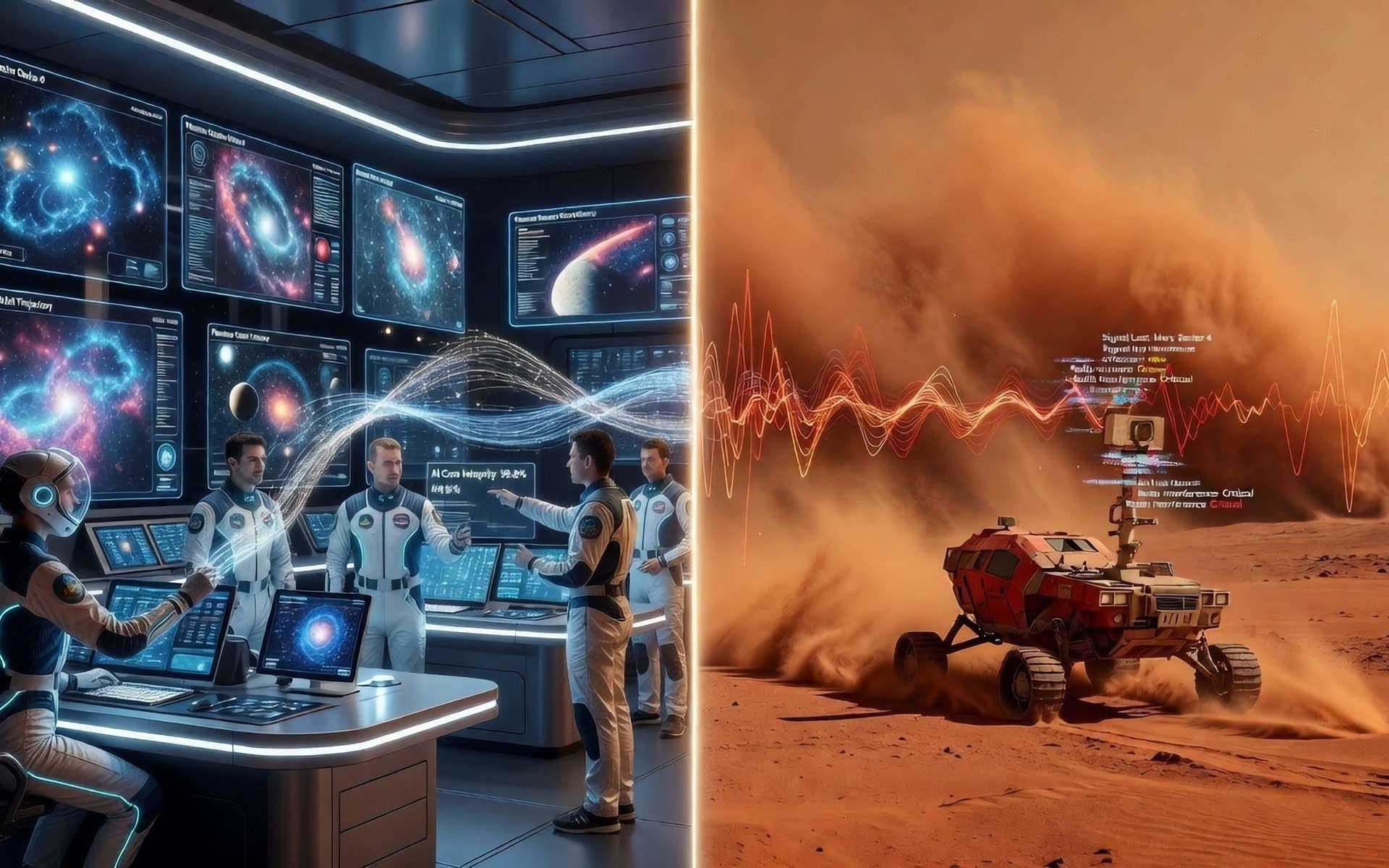
Artificial intelligence is no longer a future concept but a present-day operational reality in space, enabling unprecedented data analysis and autonomous vehicle navigation.
Artificial intelligence (AI) has transitioned from theoretical promise to an indispensable tool in space exploration, handling vast data streams and enabling autonomous operations. This technology is already crucial for tasks ranging from processing petabytes of data from telescopes to guiding rovers across the Martian surface and assisting astronauts aboard the International Space Station.
AI's impact is profound, allowing humanity to "see what humans cannot" and navigate environments where real-time human control is impossible. Telescopes and space probes now gather immense volumes of data, including images, spectral readings, and magnetic measurements, at speeds that far exceed human processing capabilities. AI analyzes these data flows with unparalleled speed and scale, revealing phenomena previously undetectable by human observation alone. This includes predicting planetary weather, mapping geological compositions of uncharted territories, cataloging celestial objects, classifying galaxies, detecting exoplanet transits, and unearthing hidden cosmic events from decades-old archives.
The James Webb Space Telescope serves as a prime example, generating such massive datasets that AI analysis is essential to unlock its full scientific potential. AI's contribution lies not in replacing scientists but in significantly amplifying their capacity for observation, comprehension, and discovery.
Beyond data analysis, AI is driving a revolution in spacecraft autonomy, particularly for missions on celestial bodies like Mars. Historically, every rover movement and orbital maneuver required instructions sent from Earth, a process significantly delayed by communication lags. On Mars, a one-way signal can take up to twenty minutes, making real-time decision-making impossible for critical operations. The Perseverance rover exemplifies this advanced autonomy, equipped with sophisticated systems like AutoNav, vision-language models, and terrain-relative navigation.
Perseverance actively perceives, analyzes its surroundings, and makes independent navigation decisions. This autonomous capability is built on four synergistic pillars: computer vision for terrain identification and hazard detection; trajectory planning algorithms that analyze data in real-time to select safe and efficient routes; and reinforcement learning, enabling the rover to continuously refine its navigation strategies over time. This integration allows spacecraft to operate effectively in challenging, unpredictable environments where constant human input is unfeasible.
The integration of AI, as exemplified by Perseverance's autonomous navigation and telescopes' data processing, marks a pivotal acceleration in our multi-planetary imperative. By overcoming the limitations of Earth-bound control and data analysis bottlenecks, AI directly empowers us to explore and eventually inhabit Mars. The ability of rovers to make complex decisions independently, unhindered by light-speed delays, is fundamental to establishing a sustained presence on the Red Planet. This technological leap extends our cognitive reach across vast distances, transforming raw data into actionable intelligence and paving the way for self-sufficient Martian outposts. AI is not merely a tool; it is a cognitive amplifier, essential for the exponential expansion of life and consciousness beyond Earth.
Edited by the news editor with AI and translated into English from the original report — please refer to the original source.