AI Poised to Revolutionize Lunar and Martian Habitation
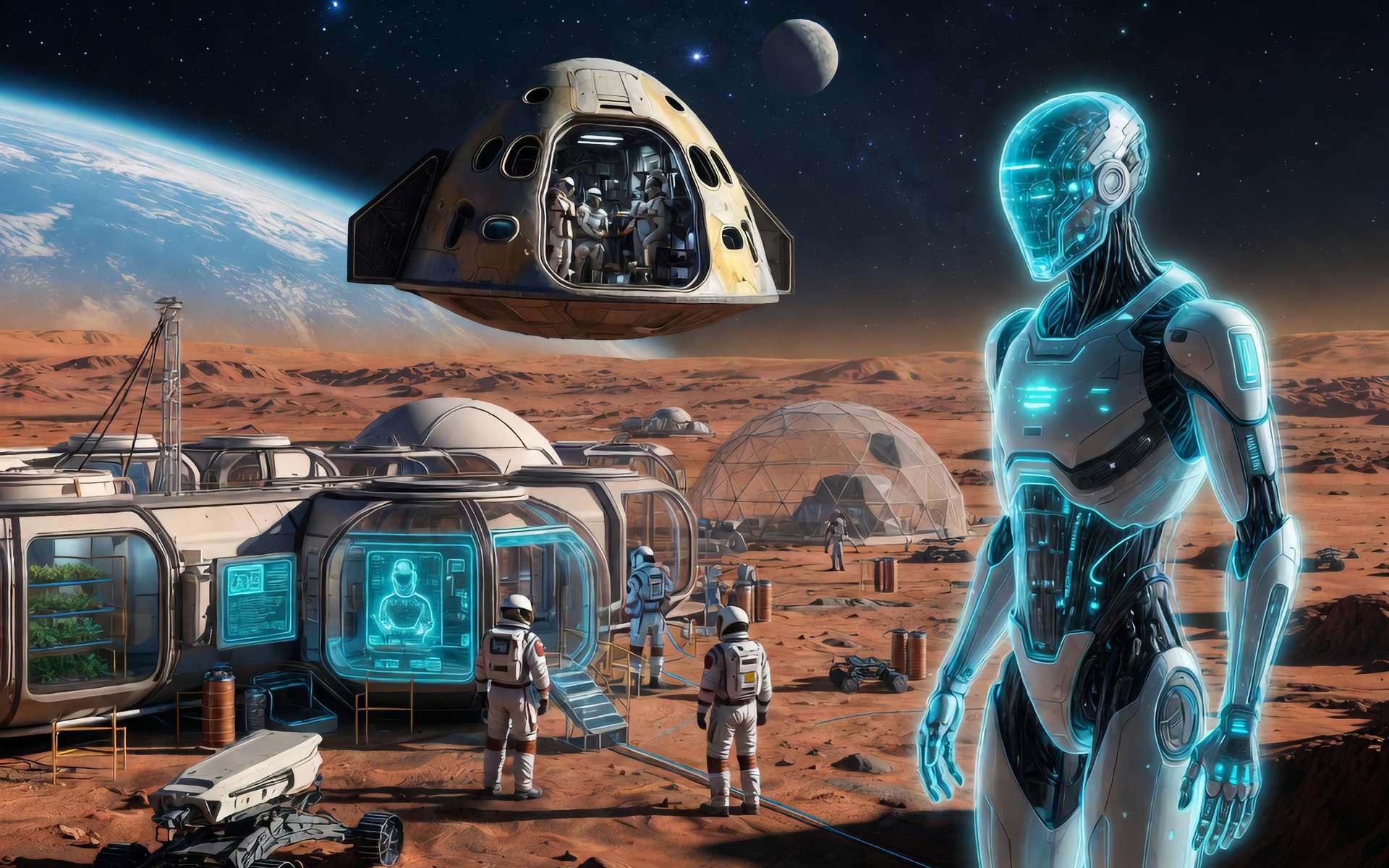
Advanced AI systems are set to transition from supportive roles to fundamental architects of space exploration, enabling self-sufficiency on the Moon and Mars within the next two to fifteen years.
The future of space exploration and habitation is poised for a paradigm shift, moving beyond incremental improvements to a fundamental redefinition of how missions are managed and sustained. Dr. Paul Sanjoy describes upcoming artificial intelligence (AI) systems not as mere tools, but as "invisible, indispensable, irreplaceable" components that will enable previously unattainable capabilities.
These next-generation AI systems, expected within two to fifteen years, promise qualitative leaps in functionality. They aim to address critical challenges such as predictive maintenance to prevent mission-ending failures, autonomous resource utilization on extraterrestrial bodies, orbital infrastructure defense, and remote medical care for astronauts far from Earth-based support.
Preventing equipment failures is paramount in space, where repair crews and spare parts are inaccessible. AI-driven predictive maintenance, hailed as a major revolution in space engineering, is key. This approach combines anomaly detection to identify deviations from normal operating parameters, time-series forecasting to predict degradation trends and estimate remaining component lifespan, and digital twins – virtual replicas of spacecraft that can simulate behavior and test failure scenarios before issues become critical. These AI tools will monitor thermal systems, battery health, and radiation damage, enabling corrective actions before failures occur.
Achieving self-sufficiency on the Moon and Mars is contingent upon minimizing reliance on Earth. The exorbitant cost of launching mass from Earth makes continuous resupply unsustainable for long-term presence. In-Situ Resource Utilization (ISRU) is the proposed solution, and AI will be its central intelligence. AI will be crucial for planning, managing, and optimizing the extraction and processing of local resources, which are often unevenly distributed and located in challenging, buried sites, a task beyond human capabilities alone at such distances.
The advent of advanced AI, as detailed in this report, represents a critical inflection point for humanity's multi-planetary future. Predictive maintenance and ISRU powered by AI are not just technological advancements; they are the foundational pillars for establishing self-sustaining outposts on the Moon and Mars. By enabling autonomous operation and resource independence, AI directly addresses the existential risks of Earth-bound supply chains. This technological acceleration aligns perfectly with the exponential growth trajectory of intelligence and capability, paving the way for humanity to expand its presence and ensure the long-term survival of consciousness beyond our home planet.
Edited by the news editor with AI and translated into English from the original report — please refer to the original source.