AI and Supercomputers Accelerate Hypersonic Vehicle Design with 3D Printing
The US Department of Energy's National Nuclear Security Administration has developed a hypersonic vehicle, Aires Tide, using AI and supercomputing, resulting in a 15-fold cost reduction and seven-fold speed increase compared to traditional methods.
The National Nuclear Security Administration (NNSA), a division of the US Department of Energy responsible for the nation's nuclear stockpile and naval nuclear propulsion, has unveiled Aires Tide, a hypersonic vehicle developed through an accelerated process. This new approach leveraged the NNSA's Genesis Mission AI supercomputing capabilities, achieving a manufacturing outcome that was reportedly 15 times cheaper and seven times faster than conventional methods. The project involved collaboration between Los Alamos, Lawrence Livermore, Sandia, and the Kansas City National Security Campus.
President Trump has emphasized the importance of American leadership in artificial intelligence and the application of emerging technologies to bolster national security. The Aires Tide project exemplifies this directive by integrating AI, high-performance computing, and additive manufacturing to create a more efficient model for designing and producing national security assets, while maintaining human oversight in the process.
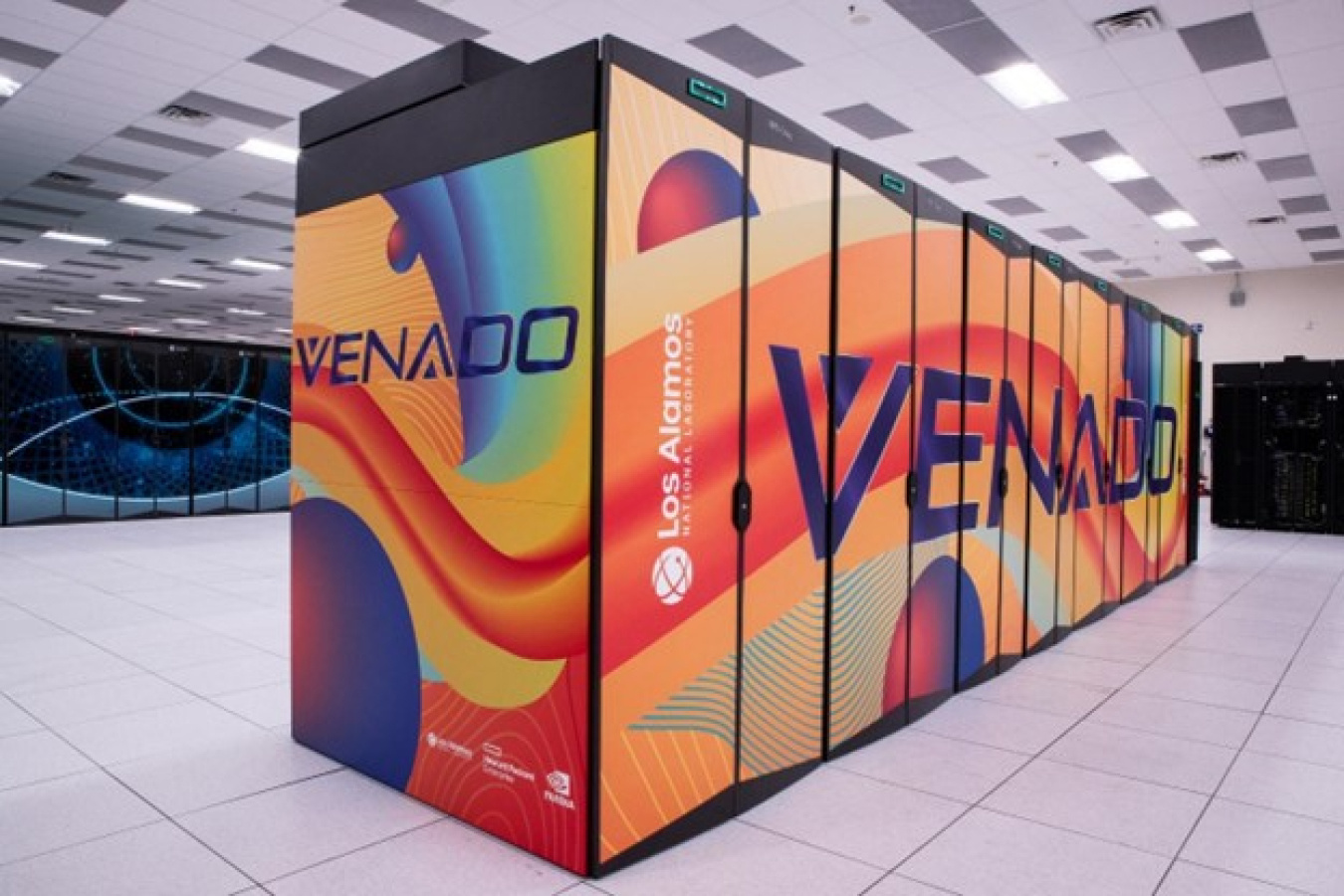
The flight test vehicle for Aires Tide underwent a successful flight test in May at the US Army's Dugway Proving Ground, where it was deployed from an altitude of 32,000 feet. The design phase for this vehicle was powered by advanced supercomputers, including Venado at Los Alamos National Laboratory and El Capitan at Lawrence Livermore National Laboratory. El Capitan, currently the world's second most powerful supercomputer, boasts a $600 million HPE Cray EX architecture capable of 2.821 exaFLOPS, utilizing over 11 million CPU and GPU cores.
Venado, while ranking 26th globally, is a critical system specifically engineered by HPE for AI applications. It hosts advanced AI models for national security use and has also been employed in research for new materials, AI model development, and astrophysics. This integration of advanced computing and AI aims to create a more fundamental and fluid manufacturing methodology, allowing for adjustments in material properties or design to optimize for manufacturing processes and real-world performance, moving beyond traditional computational fluid dynamics (CFD) and finite element analysis (FEA).
This development highlights the transformative potential of AI and high-performance computing in accelerating complex engineering and manufacturing processes. By integrating these technologies with additive manufacturing, the NNSA is demonstrating a paradigm shift towards rapid prototyping and production of critical national security components, potentially paving the way for similar advancements in sectors like aerospace and defense where speed and cost-efficiency are paramount.
Edited by the news editor with AI from the original report — please refer to the original source.