3D Printed Garment Designed Using Physiological Data, Not Size Charts
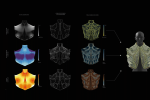
Designer Laura Civetti has developed a data-driven methodology for creating 3D printed garments that integrate a wearer's physiological and biomechanical data directly into the design process.
Designer Laura Civetti's "Adaptive System" research methodology aims to create clothing that collaborates with the wearer's body by incorporating physiological and biomechanical data, such as sweating patterns, posture, skin sensitivity, curvature, and sun exposure, into the garment's design, which is then realized through 3D printing.
Civetti, working with researcher Juan Daniel Cabrera Cobo, has created a proof-of-concept algorithm that translates a wearer's body data into design specifications. The goal is to establish a unified design methodology that can translate multi-parametric body data into actionable design decisions, addressing a gap where tools for specific physiological needs exist but a comprehensive framework for integrating diverse body data is lacking.
Their "Adaptive System" combines color mapping with computational design to select appropriate materials and geometries based on the collected data, which are then 3D printed. The initial proof-of-concept, produced with Stratasys, features a layered, latticed top. Its structure is informed by a color-coded map representing simulated physiological data, with different colors indicating curvature, sun exposure, and sweat levels.
Civetti believes this personalized approach can combat overproduction in the fashion industry by reducing excess inventory and material waste, as garments are designed for individual data rather than mass-produced based on standardized sizing. The system acts as a translation layer, converting physiological inputs into specific design choices regarding garment density, thickness, rigidity, and openness, without manual designer intervention for each trade-off.
This development signifies a move towards hyper-personalization in apparel manufacturing, leveraging additive manufacturing for bespoke designs. By integrating multi-parametric physiological data, it pushes beyond current 3D scanning applications in fashion, potentially leading to more functional and sustainable clothing production by minimizing waste associated with mass-market sizing.
Edited by the news editor with AI from the original report — please refer to the original source.