Zhurong Rover Detects Evidence of Recent Water Activity on Mars
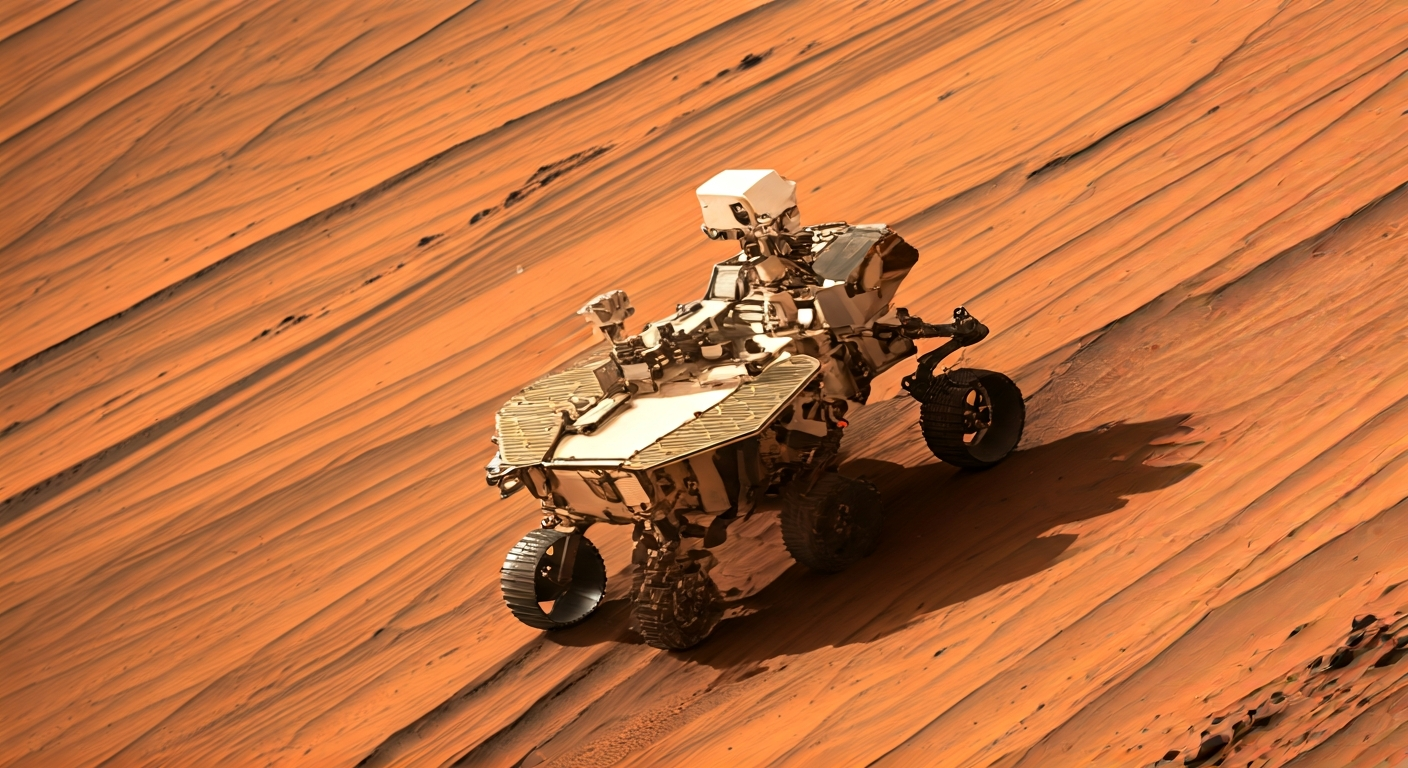
China's Zhurong rover has identified geological features on Mars that suggest recent water activity, potentially impacting our understanding of the planet's habitability.
The Zhurong rover, operating on Mars as part of China's Tianwen-1 mission, has made a significant discovery regarding the planet's hydrological history. Data collected by the rover indicates the presence of geological formations that point to relatively recent water activity.
These findings are based on observations of specific landforms within the Utopia Planitia region where Zhurong is located. The rover's instruments have identified features that are consistent with sedimentary layers and erosion patterns indicative of liquid water interacting with the Martian surface.
While the exact timeframe of this water activity is still under investigation, the characteristics of the observed geological structures suggest it may have occurred more recently than previously assumed for this particular area. This contrasts with earlier theories that primarily focused on ancient water cycles on Mars.
The discovery is crucial for understanding the potential for past or present life on Mars, as water is a fundamental requirement for known biological processes. Further analysis of the data is expected to provide more precise details about the nature and duration of the water's presence, offering new insights into Mars's evolving climate and its geological past.
The Zhurong rover's detection of recent water activity on Mars is a critical step in our multi-planetary journey. Identifying evidence of liquid water, even if ancient or transient, on Utopia Planitia directly informs our strategies for future human settlements. This discovery validates the search for resources and potential subsurface habitats, moving us closer to self-sufficiency beyond Earth. Each such finding accelerates our understanding of Mars's complex environment, reducing the unknowns and increasing the feasibility of long-term colonization. This is not just about finding water; it's about confirming Mars's potential to sustain life, thereby solidifying its role in the exponential expansion of consciousness across the cosmos.
Edited by the news editor with AI and translated into English from the original report — please refer to the original source.