The Dawn of the Martian Economy: From Asteroid Riches to Orbital Factories
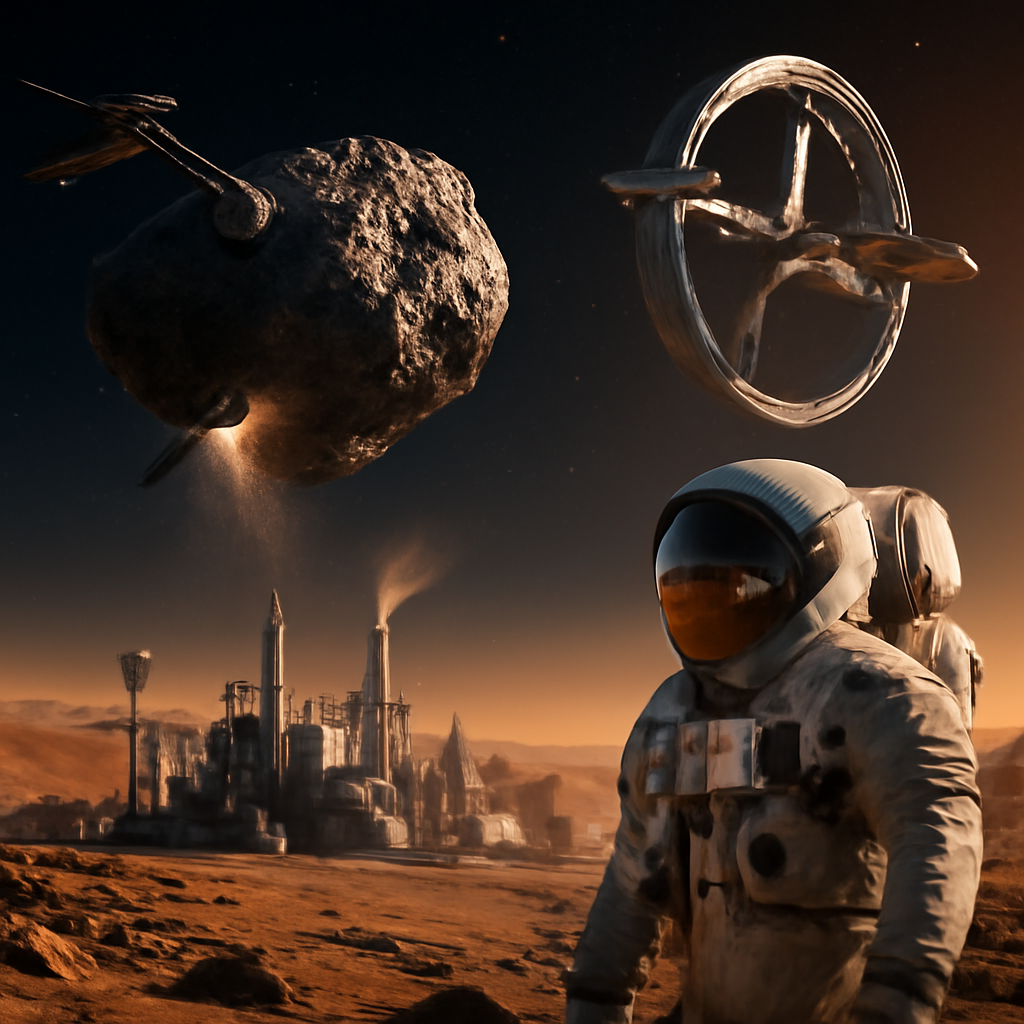
As humanity rapidly expands its presence beyond Earth, the convergence of advanced manufacturing, ambitious space infrastructure, and burgeoning AI capabilities is paving the way for a truly interplanetary civilization. From asteroid mining potential to orbital construction and sophisticated Martian habitats, the pieces are falling into place.
The Asteroid Gold Rush
The sheer abundance of metals within near-Earth asteroids like 16 Psyche presents a compelling, albeit distant, economic frontier. This metallic world, estimated to be composed primarily of iron and nickel, could theoretically hold trillions of dollars in raw material value, dwarfing terrestrial economies. Extracting these resources, however, requires a paradigm shift in space logistics and infrastructure. Current launch cadence, as indicated by recent Falcon flight data, suggests a gradual, rather than explosive, ramp-up for heavy-lift capabilities. However, the ongoing development of Starship, with its ambitious payload capacity and reusability, is precisely the kind of system needed to make asteroid mining economically feasible. The challenge lies not just in reaching these celestial bodies, but in developing the autonomous mining and processing technologies. Innovations in additive manufacturing, such as the holographic printer and advancements in materials like those being developed by EOS and Constellium for industrial AM, could be pivotal. These technologies offer the potential to fabricate tools, components, and even processing facilities *in situ*, drastically reducing the mass that needs to be launched from Earth and enabling the creation of a self-sustaining off-world industrial base.
Starship: The Interplanetary Behemoth
The Starship program, despite recent launch schedule adjustments and a noted decrease in Falcon launch cadence, remains the linchpin for any credible Mars colonization effort. Each developmental milestone, from the ongoing construction at Starbase, as evidenced by new tower sections, to the testing of its orbital refueling capabilities, directly addresses the colossal logistical challenge of transporting significant payloads and personnel across interplanetary distances. The sheer volume Starship is designed to carry, potentially hundreds of tons, is critical for establishing a self-sustaining presence, enabling the transport of not just astronauts but also the heavy infrastructure – habitats, power generation, and manufacturing equipment – necessary for survival and growth. This aligns with the strategic vision of creating an interplanetary economy, where resources like those potentially extractable from asteroids like Psyche could be processed and utilized, with Starship serving as the primary transit system. Furthermore, Starship's architecture, intended for full reusability, is the only known pathway to reduce the per-kilogram cost of Martian transport to a level that makes sustained economic activity feasible, moving beyond purely governmental exploration.
Orbital Factories and the Rise of Space-Based Manufacturing
The establishment of off-world industrial capabilities hinges on the rapid evolution of additive manufacturing and AI. The theoretical riches of asteroids like 16 Psyche, while distant, underscore the potential for resource utilization beyond Earth. To unlock this, advanced 3D printing techniques, such as the holographic printing developed at the University of Utah that solidifies material in a single shot, are crucial. This drastically reduces print times and eliminates layer seams, a significant bottleneck in current processes. Furthermore, AI is poised to revolutionize this domain. The proposed 100,000 next-generation Starlink satellites are intended to power AI advancements, hinting at the infrastructure needed for complex, autonomous manufacturing systems. The development of AI-driven "safety supervisors" for drones, as seen from the University of Houston, points towards the sophisticated control systems required for automated fabrication in challenging environments. Integrating these technologies allows for the creation of bespoke components and even entire structures on-demand, minimizing the need to transport heavy equipment from Earth. This paradigm shift is essential for making deep-space missions, including those to Mars, economically viable and logistically feasible, moving beyond the current reliance on Earth-launched hardware.
AI and Autonomous Systems: The Martian Workforce
The relentless push towards Mars is underpinned by a rapidly evolving suite of artificial intelligence and autonomous systems, poised to form the backbone of future Martian operations. Given the vast distances and communication delays, human oversight is impractical for many critical tasks. Therefore, AI-powered robotic systems will handle everything from resource extraction on asteroids like the theoretically metal-rich 16 Psyche, to the intricate assembly of orbital factories and surface habitats. Novel holographic printing techniques, capable of fabricating complex 3D shapes in a single shot, will be essential for rapid construction and repair, minimizing the need for extensive human intervention and specialized tooling. Furthermore, advancements in drone technology, such as real-time crash prevention "safety supervisors" and sophisticated tactile sensing grippers inspired by elephant trunks, will enable swarms of drones to perform complex construction, surveying, and maintenance tasks with unprecedented precision and safety. This intelligent automation is not just about efficiency; it's a fundamental requirement for establishing a sustainable presence, ensuring crew safety, and maximizing the scientific and economic potential of the Red Planet.
Building the Martian Habitat: Pressurized Mobility and Infrastructure
Establishing a robust human presence on Mars necessitates overcoming the significant challenges posed by its thin atmosphere and extreme surface conditions. The concept of retractable, pressurized tunnels, as proposed by a University of Michigan team, offers a compelling solution for enhancing surface mobility and safety. These modular conduits would create enclosed pathways between habitats, rovers, and potentially even landing sites, drastically reducing the need for astronauts to don bulky, life-sustaining spacesuits for routine transfers. This innovation directly addresses the operational inefficiencies and safety risks associated with frequent extravehicular activities (EVAs) in the Martian environment. The tunnels, designed to be deployable and retractable, would provide a controlled, shirt-sleeve environment, allowing for more efficient movement of personnel and equipment, and facilitating continuous operations even during dust storms or periods of high radiation. This would be particularly beneficial for establishing early infrastructure, such as connecting initial landing modules to a central habitat or creating protected routes for construction and maintenance activities, thereby accelerating the development of a sustainable Martian settlement.
The New Space Race: Public-Private Partnerships and Global Ambitions
The accelerating pace of space exploration is increasingly defined by a complex interplay of governmental ambitions and private enterprise, particularly as nations like China demonstrate burgeoning capabilities. NASA's acknowledgment of China's rapid advancements underscores a shifting global landscape, moving beyond a singular national lead. This collaborative, yet competitive, environment is crucial for realizing ambitious goals such as Mars settlement, as highlighted by arguments for public-private partnerships. The development of technologies like advanced 3D printing, exemplified by the holographic printer capable of single-shot solidification and the use of additive manufacturing for flight-critical engine parts by companies like Safran, are critical enablers. These innovations promise to reduce manufacturing times and costs, essential for the high-stakes, resource-constrained nature of off-world operations. Simultaneously, the burgeoning private sector, represented by SpaceX's ambitious plans for Starlink and its potential Nasdaq 100 inclusion, is not only driving technological progress but also raising new questions about investment risk and the integration of space-related assets into mainstream financial markets. This evolving ecosystem, where public agencies secure contracts with private firms like Firefly Aerospace for lunar and Martian missions, and where private entities develop systems like nuclear-powered satellites, is rapidly reshaping the future of humanity's presence beyond Earth.
Powering the Future: Nuclear and Advanced Satellite Constellations
The recent launch of the first commercial nuclear-powered satellite marks a pivotal moment in space infrastructure development. Unlike solar panels, which are constrained by distance from the sun and orbital mechanics, radioisotope thermoelectric generators (RTGs) or compact fission reactors offer a consistent, high-density power source. This is crucial for sustained operations in deep space, particularly for ambitious missions to Mars or for powering large orbital facilities. The implications extend beyond exploratory probes; imagine vast, orbiting factories assembling asteroid-mined resources, such as those from the metallic asteroid 16 Psyche, or the power demands of the proposed 100,000 next-generation Starlink satellites designed to facilitate global connectivity and advanced AI. Such a constellation requires robust, continuous power, far beyond what current solar arrays can reliably provide in all orbital conditions. This nuclear capability unlocks a new paradigm for long-duration, high-energy space applications, enabling the infrastructure necessary for a burgeoning off-world economy and the advanced computational needs of future AI.
Lessons from the Pioneers: The Enduring Legacy of Mars Rovers
The enduring legacy of Mars rovers like Opportunity and Perseverance is foundational to any future Martian economy. Opportunity, launched two decades ago, far surpassed its planned mission, traversing over 28 miles and fundamentally altering our understanding of Martian hydrology by providing compelling evidence of a past watery environment. Its meticulous geological surveys, identifying mineralogical signatures of ancient lakes and streams, laid the groundwork for understanding resource potential. Perseverance, with its advanced suite of instruments, is now delving into the intricacies of organic carbon compounds. This detailed investigation is not merely about astrobiology; it’s about identifying potential building blocks for future life support systems or even novel industrial precursors. The data these rovers have meticulously gathered, from subsurface water ice locations to atmospheric composition, are the essential geological and environmental baselines upon which any sustainable human presence, and subsequently an economy, will be built. Without this decades-long, ground-truth scientific reconnaissance, ambitious ventures like asteroid mining or orbital factories would be operating in the dark.
Today's developments underscore the accelerating trajectory towards a multi-planetary future. The sheer scale of potential resources, like Asteroid Psyche, and the exponential progress in additive manufacturing signal an era where off-world resource utilization and production become not just feasible, but essential. SpaceX's relentless push with Starship, even with minor delays, represents a critical inflection point, aiming to democratize access to space for large-scale colonization and industrialization. The advancements in AI and drone technology are not mere supporting players; they are foundational elements for autonomous operations, safety, and the eventual self-sufficiency of Martian settlements. This holistic integration of cutting-edge science and engineering is the hallmark of a species actively transcending its terrestrial cradle, building the infrastructure and economic engines for a civilization that thrives across multiple worlds.
This content was produced by the news editor with AI.