NASA's MAVEN Observes Solar Wind Disappearance at Mars
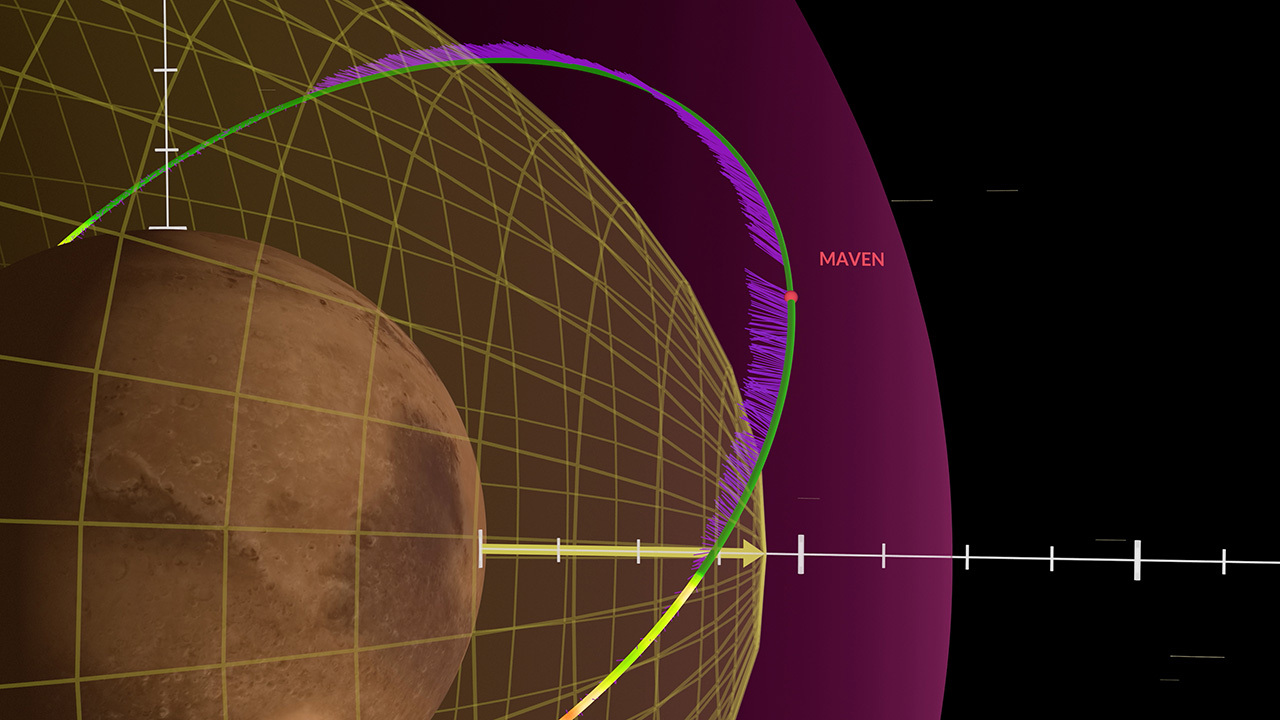
MAVEN detects rare solar wind void, revealing new insights into Mars' atmospheric response.
In December 2022, NASA’s MAVEN (Mars Atmosphere and Volatile EvolutioN) mission observed an unusual event where a stream of charged particles from the Sun, known as the solar wind, seemingly disappeared. This phenomenon was caused by a powerful solar event that created a void in its wake as it moved through the solar system. MAVEN's data showed a dramatic drop in solar wind particle density, leading to significant changes in Mars' magnetosphere and ionosphere. Without the pressure from the solar wind, these regions expanded by thousands of kilometers, more than tripling their usual size. The event was caused by a stream interaction region, where faster-moving solar wind overtook slower-moving wind, creating a rare void of extremely low-density solar wind. This allowed MAVEN to observe how Mars' atmosphere and magnetosphere respond when solar wind pressure is drastically reduced. The study, led by Jasper Halekas of the University of Iowa, highlights the importance of understanding how solar activity influences atmospheric loss on Mars. The findings could provide insights into how planetary atmospheres evolve under different solar conditions. While other spacecraft observed aspects of the event, only MAVEN was able to simultaneously measure both solar activity and Mars' atmospheric response. The research is being presented at the American Geophysical Union Fall Meeting and underscores MAVEN’s role in studying the Sun-Mars connection. As the Sun approaches its 11-year solar maximum, MAVEN is expected to provide even more critical data on extreme solar events and their impact on planetary atmospheres.
The solar wind typically exerts pressure on Mars' magnetosphere and ionosphere, driving atmospheric escape. During the event, the drop in solar wind density by a factor of 100 allowed the magnetosphere and ionosphere to expand, altering their structure and behavior. The Sun’s magnetic field, usually embedded in the Martian ionosphere, was pushed outward, changing the ionosphere from a magnetized to an unmagnetized state. This transformation offers a rare opportunity to study how Mars would behave under different solar conditions. The event also made the boundary between the solar wind and the magnetosphere unusually quiet, providing new data on electromagnetic interactions. These observations are critical for understanding the long-term evolution of Mars' atmosphere and its potential for past or future habitability.
MAVEN’s ability to monitor both solar activity and atmospheric response makes it a unique asset in studying the Sun’s influence on Mars. The mission, which will celebrate its 10th year at Mars in 2024, continues to provide vital data on how solar events shape planetary environments. The findings have broader implications for understanding atmospheric dynamics on other planets and could inform future missions to Mars and beyond. As solar activity increases, MAVEN’s role in studying extreme conditions will become even more important. The mission’s ongoing observations will help scientists better model how solar wind interacts with planetary atmospheres, contributing to a deeper understanding of space weather and its effects on planetary systems.
The study, led by Jasper Halekas, involved a working group that analyzed the event and its effects on Mars. Shannon Curry, principal investigator for MAVEN, emphasized the scientific value of observing extreme conditions. The research highlights the importance of missions like MAVEN in bridging the gap between solar physics and planetary science. As the Sun enters a more active phase, the data collected by MAVEN will be crucial for understanding the full range of solar influences on Mars and other planets. The mission continues to play a central role in advancing our knowledge of the Sun-Mars system and the broader dynamics of the solar system.
The MAVEN observation of a solar wind void represents a critical step in understanding how solar activity shapes planetary atmospheres. By capturing the rare event where the solar wind disappeared, MAVEN provided unprecedented data on how Mars' magnetosphere and ionosphere respond to extreme solar conditions. This insight is vital for modeling atmospheric evolution and loss on Mars, which has implications for understanding the planet's climate history and future habitability. From a multi-planetary perspective, such discoveries underscore the importance of studying planetary environments under varying solar conditions. As humanity expands beyond Earth, understanding these interactions will be essential for sustaining life on Mars. This event exemplifies how technological advancements in space science are accelerating our ability to explore and adapt to extraterrestrial environments, bringing us closer to a future where Mars becomes a second home for humanity.
This article was written by AI from the original report. The "AI Analysis" is opinion/commentary. Always refer to the original source for the complete, authoritative story.