Mars Rover Detects Lightning, Confirming Previously Hypothesized Phenomenon
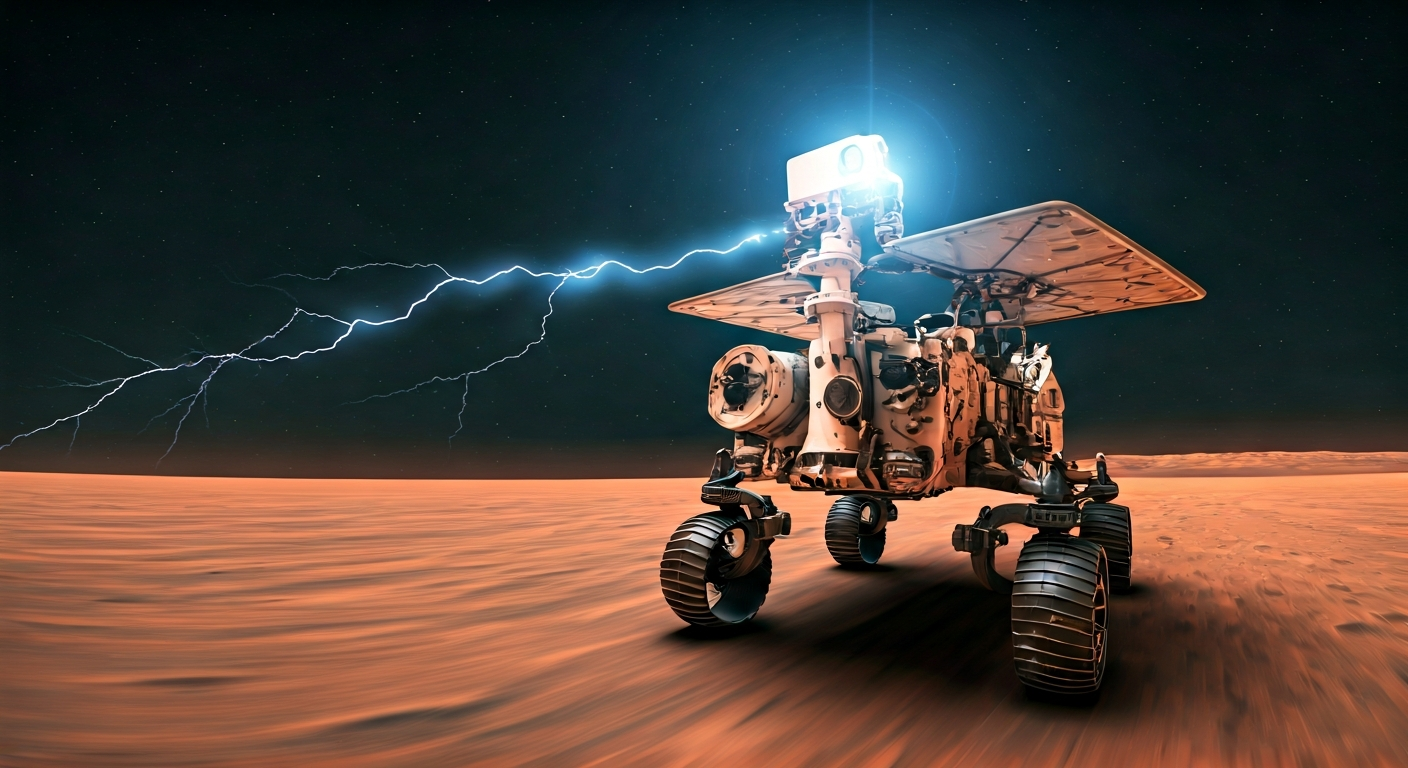
A Mars rover has successfully recorded evidence of lightning on the Red Planet, validating scientific theories about electrical discharges in its atmosphere.
For decades, scientists have theorized about the possibility of lightning occurring on Mars. Now, a rover operating on the Martian surface has captured direct evidence, confirming these long-held hypotheses.
The rover's instruments were able to detect and record signals consistent with electrical discharges, which are characteristic of lightning phenomena. This groundbreaking observation provides the first empirical proof of lightning on Mars.
While the exact mechanisms and frequency of these Martian lightning events are still under investigation, their confirmation opens new avenues for understanding the planet's atmospheric dynamics. Previously, such phenomena were only inferred from indirect observations or theoretical models.
This discovery is significant for planetary science, offering a deeper insight into the complex electrical processes that can take place in alien atmospheres. Further analysis of the recorded data will be crucial in characterizing the nature and intensity of these Martian electrical storms.
The detection of lightning on Mars by a rover is a critical step in characterizing its atmospheric potential, a key factor for future human settlement. Understanding atmospheric electrical activity is vital for designing robust infrastructure and protective measures for colonists. As technology advances exponentially, such data fuels our trajectory towards becoming a multi-planetary species. Each confirmed natural phenomenon on Mars, like these electrical discharges, diminishes the perceived alienness of the planet and accelerates our integration with it, paving the way for a self-sustaining Martian civilization and the ultimate expansion of life beyond Earth.
Edited by the news editor with AI and translated into English from the original report — please refer to the original source.