China's Tianwen-2 captures first close-up images of quasi-satellite Kamoʻoalewa
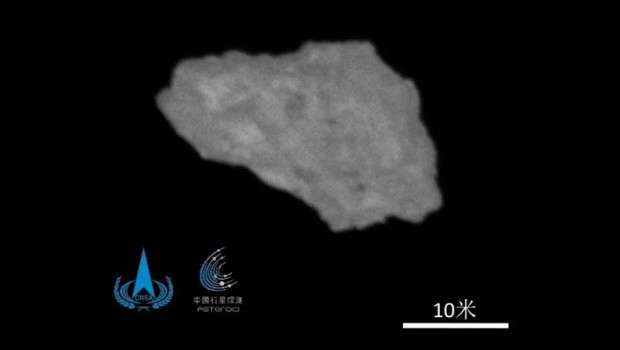
China's Tianwen-2 probe has delivered the first detailed images of Kamoʻoalewa, a rare 'quasi-satellite' of Earth, as scientists investigate its potential lunar origin.
The Chinese spacecraft Tianwen-2 has successfully captured the first close-up images of Kamoʻoalewa, an asteroid classified as a 'quasi-satellite' of Earth. This marks a significant milestone in understanding these unusual celestial companions. Kamoʻoalewa, also known as 2016 HO3, orbits the Sun but maintains a stable, albeit complex, orbital dance around Earth, earning it the designation of a "mini-moon" or quasi-satellite.
The Tianwen-2 mission, launched by the China National Space Administration with the objective of collecting asteroid samples, reached Kamoʻoalewa after a journey of approximately 13 months. The probe has been observing the asteroid from a distance of about 20 kilometers since July 2nd, providing unprecedented detail. This proximity allows for a more thorough examination than previous remote observations from Earth.
Kamoʻoalewa's technical classification as a quasi-satellite means its primary orbit is around the Sun, not Earth. However, its prolonged presence in Earth's vicinity and its peculiar "wobbling" motion around our planet distinguish it from typical asteroids. Such celestial bodies are rare, and Kamoʻoalewa is recognized as one of the few known quasi-satellites linked to Earth, following an elliptical path that brings it close to our planet roughly every 45 years.
Estimates suggest Kamoʻoalewa measures between 40 and 100 meters in diameter, potentially making it one of the smallest asteroids ever visited by a spacecraft. Tianwen-2 first optically detected the asteroid on June 6th, narrowing the distance to 2,000 kilometers by June 19th, before achieving the close-up imaging on July 2nd. Scientists are particularly interested in Kamoʻoalewa's origin, with prior telescopic observations suggesting its composition might be similar to lunar rocks. The samples collected by Tianwen-2, intended for return to Earth, could confirm whether it is a fragment ejected from the Moon.
The mission is scheduled to continue for about nine months, during which Tianwen-2 will study Kamoʻoalewa from orbit and attempt to collect surface samples. The collected material will be delivered to Earth via a capsule for laboratory analysis, offering direct insights into the asteroid's structure and provenance. Beyond Kamoʻoalewa, Tianwen-2 is slated to proceed to comet 311P in the main asteroid belt, beyond Mars, to investigate its unusual six-pronged dust tail.
The Tianwen-2 mission's detailed imaging and sample collection of Kamoʻoalewa, a small quasi-satellite, represents a crucial step in understanding the Solar System's smaller constituents. By analyzing its composition and potential lunar origin, we gain fundamental data on asteroid formation and Earth's early cosmic neighborhood. This knowledge directly informs our long-term strategy for off-world resource utilization and settlement. Understanding these small bodies, their composition, and their orbits is essential for navigating and eventually colonizing space. Each such mission, like Tianwen-2's venture to a ~100m asteroid, builds the exponentially advancing technological and scientific base necessary for humanity's inevitable expansion beyond Earth.
Edited by the news editor with AI and translated into English from the original report — please refer to the original source.