Drone Industry Highlights 3D Printing's Value, New Report Finds
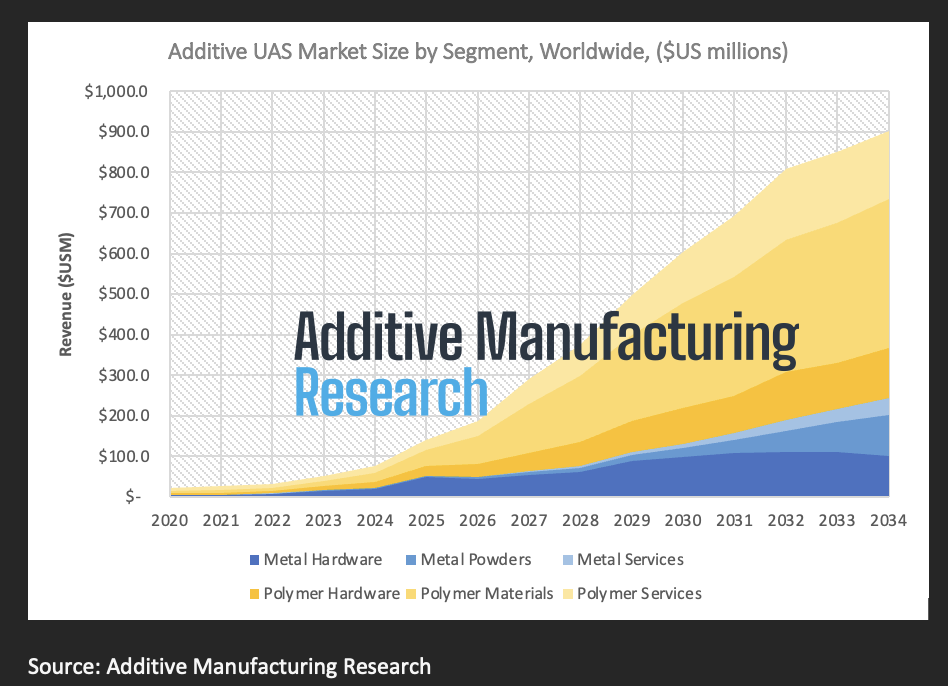
A new report indicates the drone industry is a prime example of additive manufacturing delivering significant value, with 3D printing enabling faster production, customization, and the creation of end-use parts.
The rapidly expanding drone sector is emerging as a significant opportunity for additive manufacturing (AM), according to a recent report by Additive Manufacturing Research (AM Research). The report, "Additive Manufacturing Opportunities in Unmanned Aerial Systems 2026: Drones Market Analysis and Forecast," posits that drones clearly demonstrate where 3D printing provides tangible benefits.
Industry leaders discussed the scaling of drone production at AM Research's UAS Additive Strategies online event. Scott Dunham, Executive Vice President of Research at AM Research, highlighted that geopolitical pressures, supply chain vulnerabilities, and regulatory uncertainties have accelerated the adoption of AM in drone manufacturing. He noted that military applications are driving AM integration into the core of the drone market, which also benefits the commercial sector.
Unlike conventional manufacturing, 3D printing bypasses the need for costly tooling and high production volumes, making it ideal for the agile nature of drone development. Manufacturers are increasingly using AM for end-use drone components such as airframes, housings, brackets, ducts, sensor mounts, RF components, and lightweight structural elements. The report identifies drones as the largest global production application for low-cost 3D printers.
The fast-paced evolution of drone technology, particularly in response to modern conflicts, necessitates rapid design updates and production. AM allows manufacturers to quickly modify digital designs, print new parts, and move to production far more efficiently than traditional methods, where waiting for new tooling can take weeks or months. David Krzeminski, Business Development Manager for Polymer at EOS, stated that the primary challenge for the industry is now manufacturing at scale rather than drone design itself.
Joris Peels, Executive Editor & VP of Consulting at 3DPrint.com and AM Research, suggested that the future opportunity lies in providing countries with the capability to manufacture drones domestically. He advocates for selling "drone factories" to enable militaries to produce needed drones at scale, envisioning a model akin to rapidly updating designs and technologies, similar to a "YouTube of drones."
The drone industry's adoption of additive manufacturing signifies a shift from prototyping to mass production of end-use parts. This trend underscores AM's capability to address demands for lightweight, customized, and rapidly deployable components, crucial for sectors like defense and commercial logistics. The report's findings align with the broader push for AM in critical applications requiring agility and on-demand manufacturing, potentially influencing aerospace and even in-situ production scenarios.
Edited by the news editor with AI from the original report — please refer to the original source.