APAC Additive Manufacturing Focus Shifts to Infrastructure Over Printers
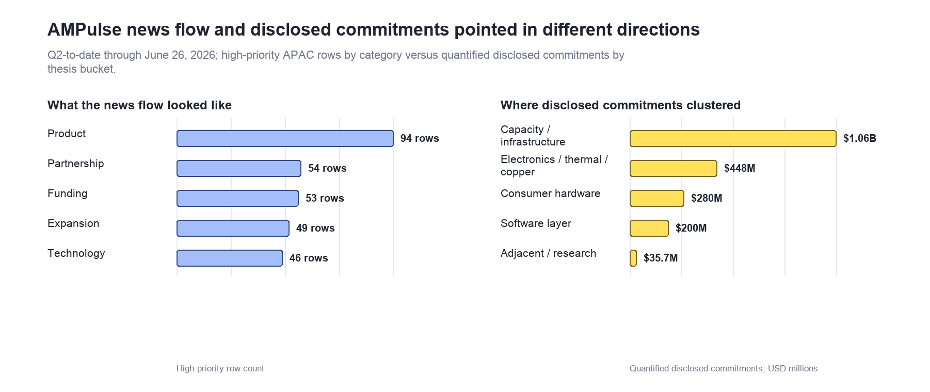
In the second quarter, the Asia-Pacific region's additive manufacturing sector saw a significant portion of investment directed towards industrial capacity and infrastructure rather than new printer hardware.
Analysis of the additive manufacturing landscape in the Asia-Pacific region during Q2 reveals a notable shift in investment focus. While product launches dominated news headlines with 94 entries, the financial commitments did not follow suit. Instead, substantial funding was allocated to less conspicuous areas such as production capacity, factory expansions, thermal management components, copper processing, and feedstock materials.
The data indicates a concentration of investment, with the three largest financial commitments accounting for approximately 70.7% of the total disclosed pool, reaching about $1.43 billion. This suggests that the additive manufacturing sector in APAC during this period was primarily driven by large-scale industrial investments rather than a broad surge across diverse companies.
When investment figures are considered, the picture changes dramatically from news volume. Capacity and infrastructure alone represented about 52.3% of the committed funds. When combined with investments in electronics, thermal management, and copper additive manufacturing, the industrial-facing share rises to roughly 74.4%. Consumer hardware, though still active, accounted for a smaller portion of the committed value at approximately 13.9%.
While venture capital and IPOs contributed around $556 million, including private and growth rounds and Creality's Hong Kong listing, a larger pool of approximately $2.02 billion encompasses various commitments. This broader figure includes planned private placements, acquisition considerations, capital expenditures, project values, and program funding, alongside closed financing rounds and IPO proceeds. It is crucial to distinguish these commitments from venture capital rounds, as planned placements and acquisition prices differ significantly from raised capital.
This trend highlights a maturing additive manufacturing market in APAC, moving beyond initial hardware adoption towards scaling industrial production. The emphasis on capacity, infrastructure, and specialized materials like copper indicates a strategic push for end-use part manufacturing and integration into established industrial supply chains, potentially enabling more complex applications in sectors like aerospace and automotive.
Edited by the news editor with AI from the original report — please refer to the original source.