Ancient Asteroid Shattering Linked to Early Solar System Bombardment
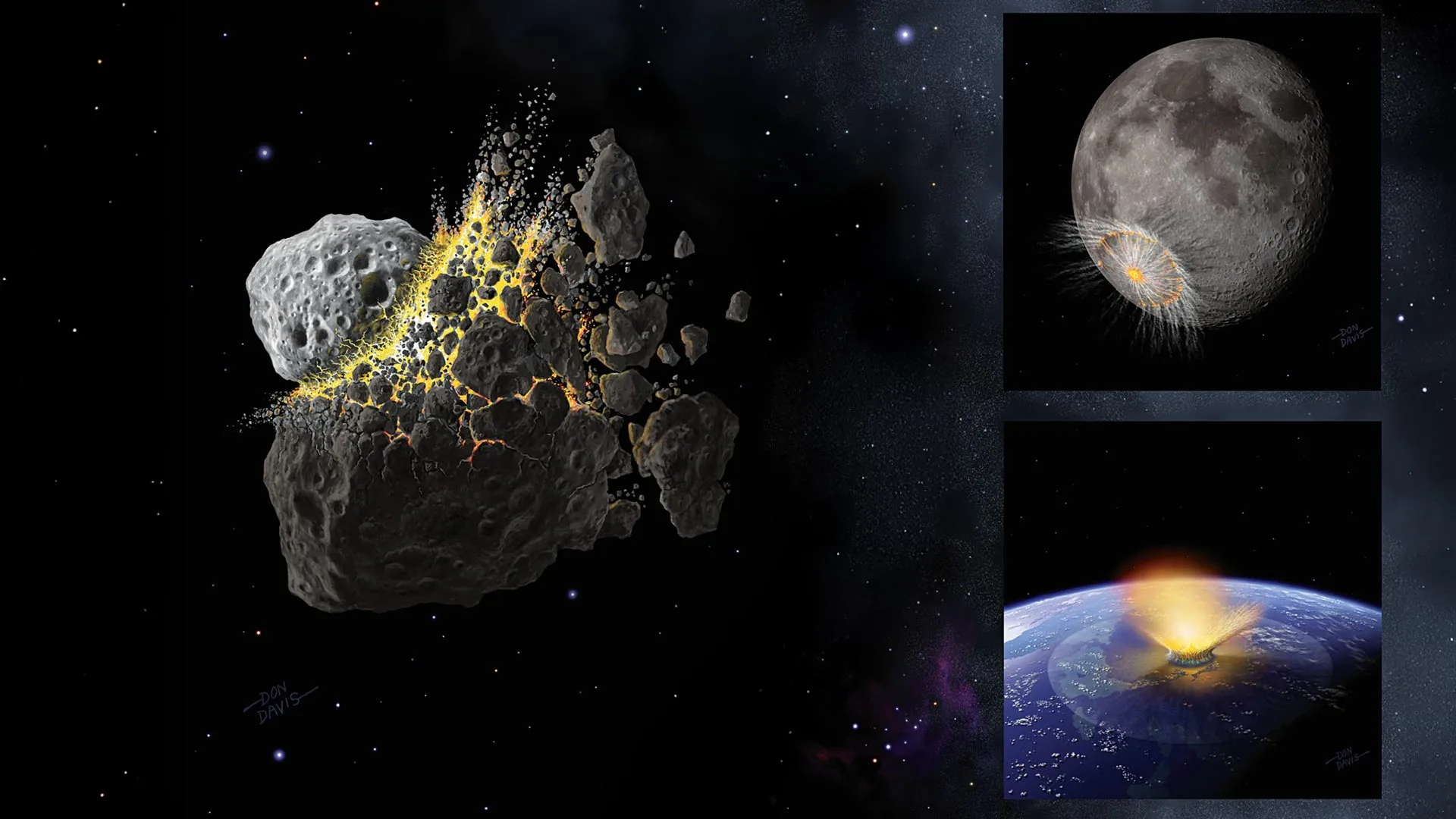
A massive asteroid collision approximately 800 million years ago may have unleashed a prolonged barrage of debris across the inner solar system, according to new research.
Scientists propose that a significant event in the main asteroid belt, specifically the fragmentation of the parent body forming the Eulalia asteroid family, sent a substantial volume of debris toward Earth, the Moon, and Mars. This cosmic debris shower, if correctly identified, could have instigated widespread geological alterations and potentially influenced planetary climates and life.
Understanding the role of impacts in the origin and evolution of life remains a challenge, with the Chicxulub impact 66 million years ago being a notable exception for its clear link to a mass extinction event. Reconstructing older impacts is difficult on Earth due to continuous geological processes like volcanism, plate tectonics, and weathering, which erase or bury ancient impact evidence. The Moon, however, with its static surface, serves as a more reliable archive.
Previous lunar studies indicated a surge in large impacts around 800 million years ago, based on crater dating and analysis of impact glass from Apollo missions. This glass, formed from molten rock during impacts, provides crucial chemical and chronological data. The new research connects this lunar observation to a specific asteroid belt event: the collision of a primitive, carbonaceous chondrite-like object with another body.
The critical factor was the parent asteroid's location near Jupiter's gravitational 3:1 mean motion resonance. This orbital region, where asteroids complete three orbits for every one of Jupiter's, acts as a gateway, destabilizing asteroids and flinging them into orbits that intersect with inner planets. Simulations suggest that roughly half of the Eulalia fragments immediately entered this resonance.
This resonance then efficiently dispersed the resulting debris throughout the inner solar system, initiating a period of increased bombardment on terrestrial planets. The study indicates this bombardment was not a brief event, with an additional quarter of the fragments gradually entering the resonance over the subsequent 100-150 million years due to the Yarkovsky effect—a subtle force stemming from uneven thermal radiation.
The identification of the Eulalia family's breakup as the source of an 800-million-year-old impact surge on Earth, Moon, and Mars is a critical step in reconstructing our solar system's violent past. This research directly links a specific celestial event to widespread geological and potentially biological consequences across multiple worlds. For humanity's multi-planetary future, understanding these ancient impact dynamics is essential. It informs our assessment of planetary habitability and the long-term resilience of life, guiding our efforts to establish self-sustaining outposts on worlds like Mars. Each such discovery reinforces the narrative of life's cosmic journey, highlighting the necessity of spreading consciousness beyond a single, vulnerable planet.
Edited by the news editor with AI from the original report — please refer to the original source.