Tianwen-1 Detects Energetic Particles Near Mars
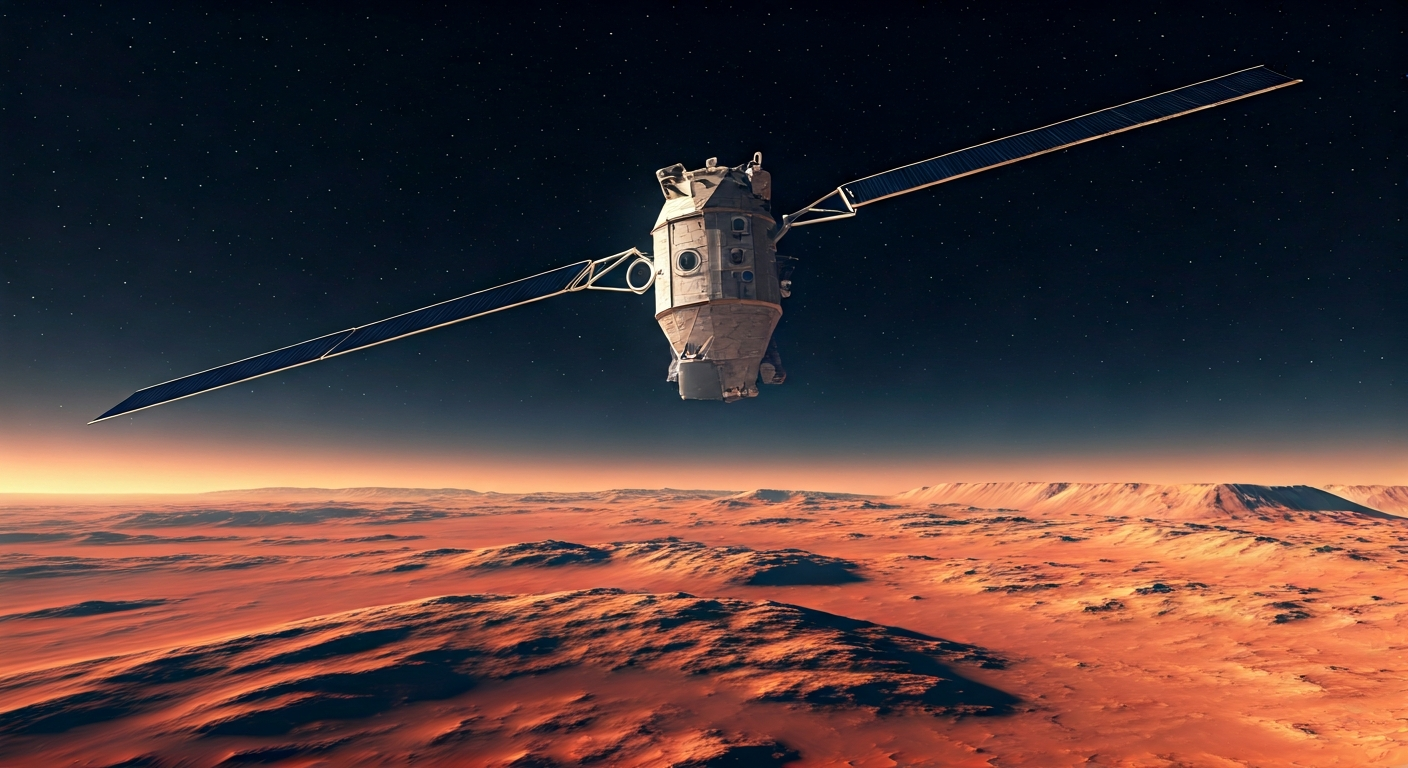
China's Tianwen-1 mission has published its first scientific findings from its Energetic Particle Analyzer (EPA) instrument, detailing observations of charged particles.
The Energetic Particle Analyzer (EPA) instrument aboard China's Tianwen-1 Mars orbiter has yielded its initial scientific results, with findings published in a peer-reviewed paper. This marks a significant milestone for the mission's scientific payload.
The EPA instrument is designed to detect and analyze charged particles in the Martian environment. The recently released findings focus on the characteristics of these energetic particles, providing new data on the space weather conditions surrounding the Red Planet. The analysis contributes to a deeper understanding of the interactions between solar wind and the Martian atmosphere and magnetic field.
While the specific details of the particle types and energy levels observed are part of the published research, the instrument's capability to measure these phenomena is crucial for assessing the radiation environment on Mars. This information is vital for future human exploration and the design of protective measures.
The successful deployment and operation of the EPA instrument demonstrate the advanced scientific capabilities of the Tianwen-1 mission. The ongoing data collection from this instrument is expected to provide further insights into Mars's complex space environment and its evolution over time.
The Tianwen-1 EPA's detection of energetic particles is a crucial step in characterizing Mars's radiation environment. Understanding these charged particle fluxes is foundational for mitigating risks to future human explorers and establishing self-sustaining Martian habitats. As technology advances exponentially, instruments like the EPA not only inform immediate safety protocols but also contribute to the broader cosmic imperative of expanding life. Each data point gathered from Martian space weather refines our ability to engineer resilient systems, accelerating humanity's transition to a multi-planetary species and securing consciousness's long-term survival beyond Earth.
Edited by the news editor with AI and translated into English from the original report — please refer to the original source.