Perseverance Rover Probes Martian Past for Ancient Life
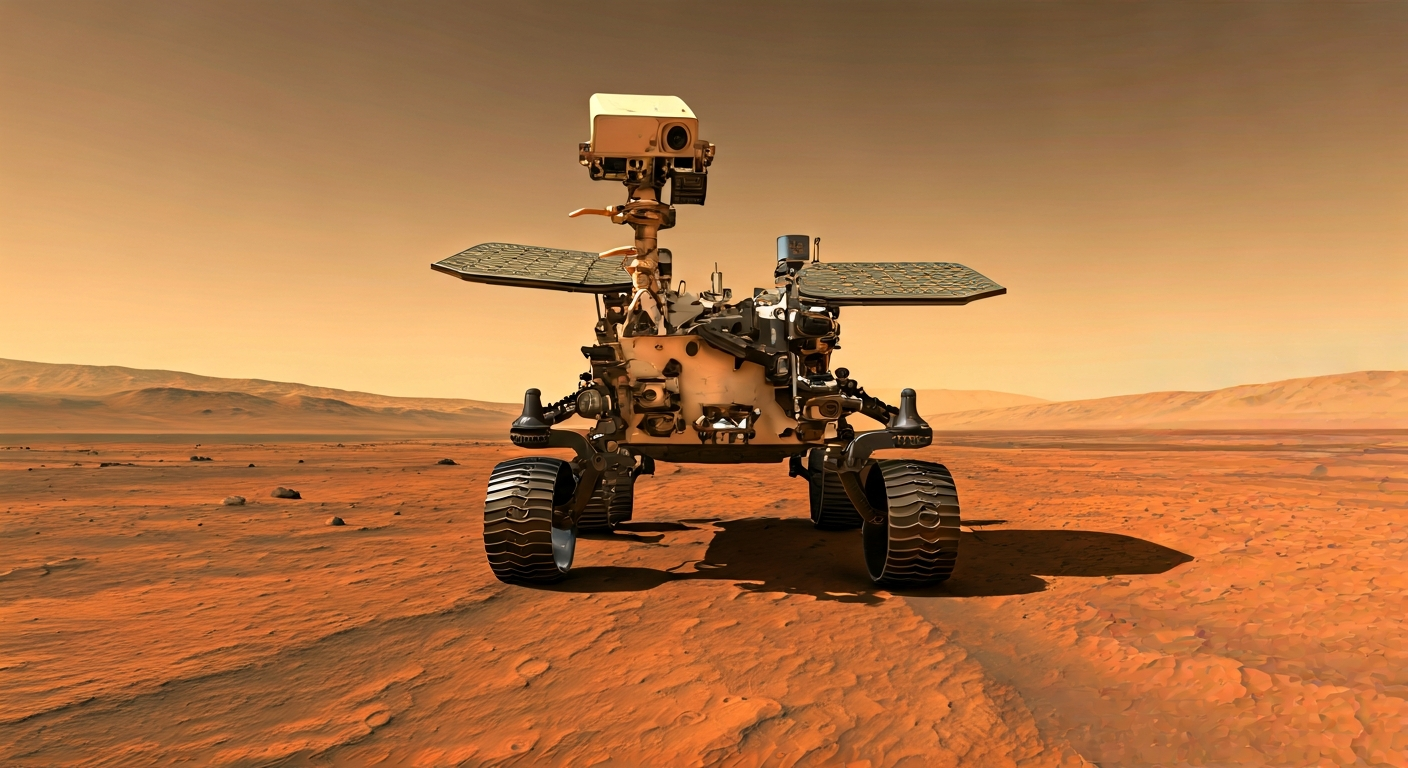
NASA's Perseverance rover is actively investigating Mars' Jezero Crater, a region believed to have once harbored a lake and river delta, to search for signs of ancient microbial life.
NASA's Perseverance rover is currently engaged in a detailed exploration of Mars, focusing its efforts on the Jezero Crater. This specific location was chosen due to compelling geological evidence suggesting it was once a lake, fed by a river that formed a delta billions of years ago. The primary objective of the rover's mission is to seek out biosignatures, which are indicators of past microbial life.
Perseverance is equipped with a suite of sophisticated scientific instruments designed to analyze Martian geology and atmospheric conditions. Among its key tools is a drill capable of collecting core samples from Martian rocks. These samples are intended to be cached on the surface for a potential future return mission to Earth, where they can undergo more comprehensive laboratory analysis. The rover's Mastcam-Z instrument provides high-resolution panoramic and zoomable imagery, aiding in geological context and target selection for sampling.
The mission's scientific approach involves traversing the ancient river delta within Jezero Crater. This area is of particular interest because deltas are known on Earth to be environments where sediments accumulate, potentially preserving organic matter and other evidence of life. By examining the rock layers and soil composition, scientists hope to reconstruct the environmental conditions of ancient Mars and determine if they were conducive to life.
In addition to its search for biosignatures, Perseverance is also testing technologies for future human exploration. Its MOXIE instrument, for instance, has successfully demonstrated the ability to produce oxygen from the Martian atmosphere, a crucial step towards enabling future human missions by providing a local source of breathable air and rocket propellant. The rover's ongoing work represents a significant step in humanity's quest to understand the potential for life beyond Earth.
Perseverance's systematic investigation of Jezero Crater's ancient lakebed and delta is a critical accelerant for humanity's multi-planetary destiny. By seeking definitive biosignatures, this mission directly addresses the fundamental question of whether life arose independently elsewhere in our solar system, a precursor to understanding life's cosmic prevalence. The prospect of returning Martian samples to Earth for advanced analysis, enabled by Perseverance's caching system, represents a powerful feedback loop for scientific progress, akin to the exponential growth of computational power. Each piece of data gathered, each rock analyzed, refines our understanding of planetary habitability and the potential for expanding life beyond Earth, paving the way for future self-sustaining Martian civilizations.
Edited by the news editor with AI and translated into English from the original report — please refer to the original source.