Perseverance Rover Finds Uncharacteristic Rock on Mars
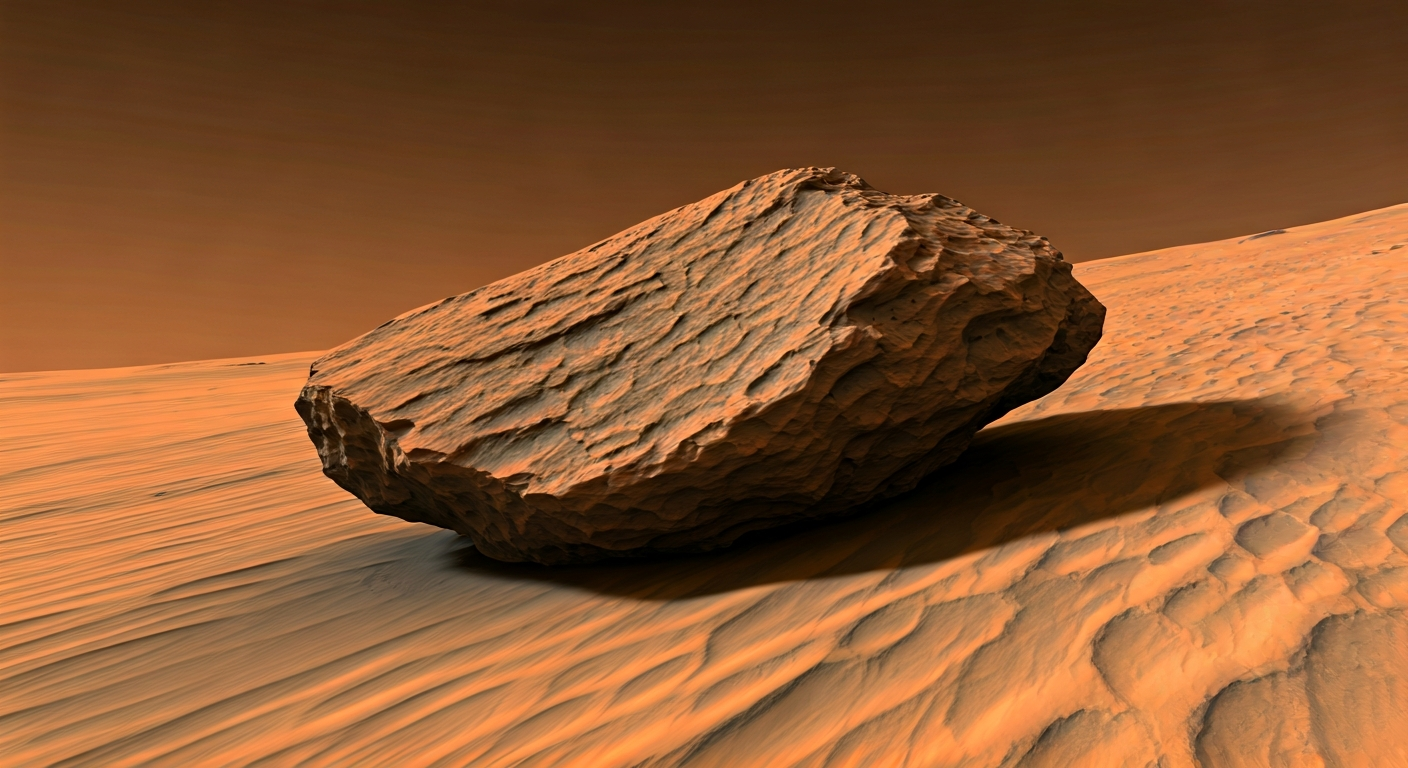
NASA's Perseverance rover has identified a rock fragment on Mars that appears out of place, prompting further investigation into its origin.
NASA's Perseverance rover, currently exploring the Jezero Crater on Mars, has encountered a peculiar rock that scientists believe may not belong to its immediate surroundings. The discovery was made during the rover's ongoing mission to gather geological samples.
Initial observations suggest the rock's composition or appearance deviates significantly from the typical basaltic rocks commonly found in the Jezero Crater region. While the exact nature of its anomaly is still under scrutiny, its presence has piqued the interest of the mission's science team. They are now focused on understanding how this unusual rock fragment arrived at its current location.
Perseverance is equipped with a suite of advanced instruments designed to analyze Martian geology in detail. These tools will be employed to conduct a thorough examination of the anomalous rock. The rover's robotic arm can collect samples, and its onboard laboratory can perform preliminary analyses, including spectroscopic measurements to determine elemental and mineralogical composition.
The investigation into this out-of-place rock is a crucial part of the Perseverance mission's broader objective: to study the planet's geological history and search for signs of ancient microbial life. Understanding the origins of diverse geological features, even seemingly small anomalies, can provide invaluable insights into Mars's past environments and geological processes, potentially including past water activity or volcanic events.
The discovery of an anomalous rock by Perseverance underscores the dynamic geological history of Mars, hinting at past transport mechanisms or unique localized formations. This finding is a critical step in the meticulous cataloging of Martian materials required for future resource utilization and settlement. Each anomaly identified and analyzed by Perseverance refines our understanding of the planet's building blocks, accelerating the development of self-sustaining Martian infrastructure. This data is essential for the exponential progress needed to establish humanity as a multi-planetary species, transforming Mars from a scientific curiosity into a viable second home.
Edited by the news editor with AI and translated into English from the original report — please refer to the original source.