Perseverance Rover Finds Sediment Layers in Martian Lakebed
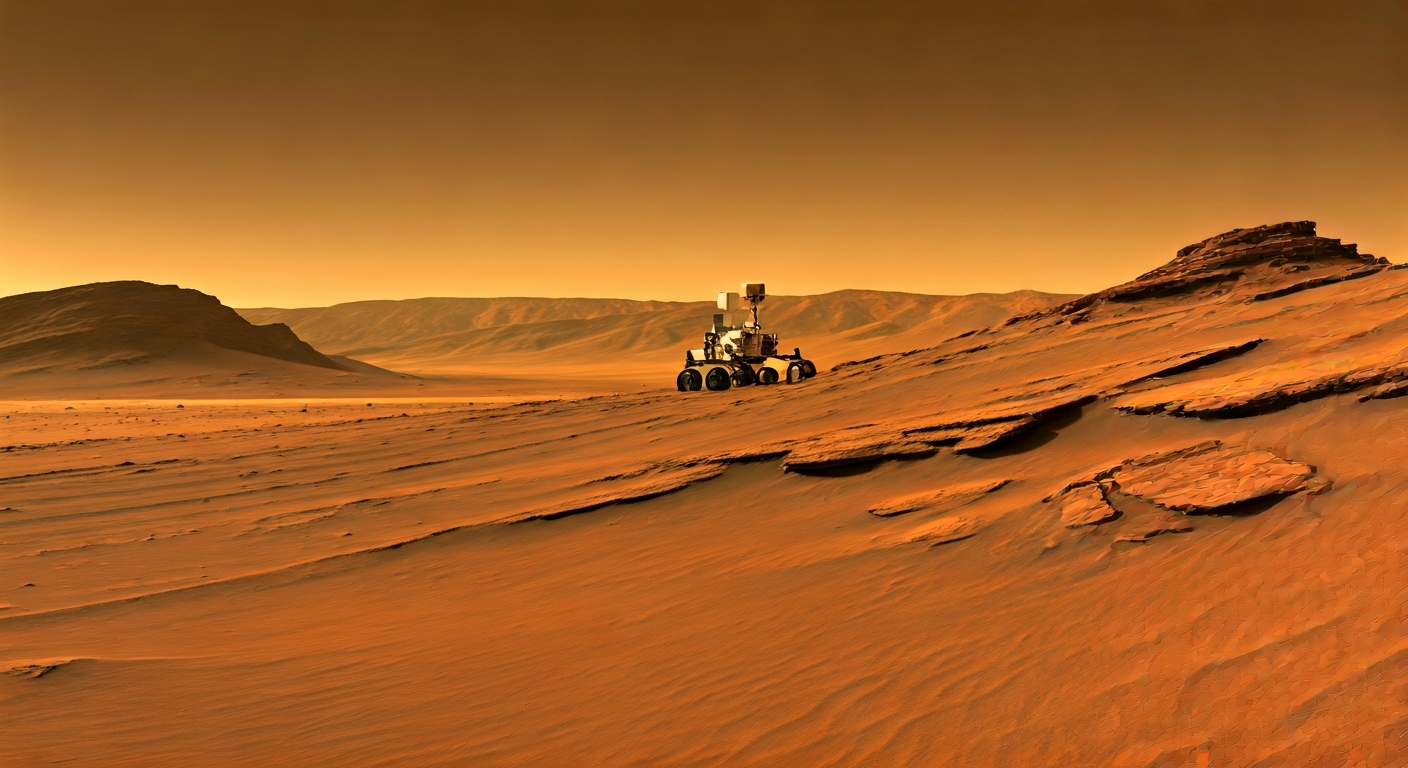
NASA's Perseverance rover has identified layered sediment deposits within Jezero Crater, indicating a history of water and geological activity on Mars.
Data transmitted from NASA's Perseverance rover has provided compelling evidence of sedimentary layers preserved within the ancient lakebed of Jezero Crater. These distinct layers, observed by the rover's sophisticated instruments, suggest a prolonged period where water was present and actively shaped the Martian landscape.
The rover's instruments, including its cameras and ground-penetrating radar, have been instrumental in mapping these subsurface structures. The identification of these layered deposits is significant because such formations on Earth are typically formed by the gradual accumulation of particles carried by water over extended timescales. This discovery lends further support to the theory that Jezero Crater once held a substantial body of water, possibly a lake or even a shallow sea.
Scientists are now meticulously analyzing the composition and arrangement of these sediment layers. Understanding their origins and the processes that formed them will offer crucial insights into Mars' past climate and its potential habitability. The rover's ongoing exploration aims to gather more detailed information about these geological features, potentially revealing more about the environmental conditions that existed billions of years ago.
The findings from Perseverance continue to build a comprehensive picture of Mars' watery past. The presence of these sediments is a key piece of evidence in the ongoing quest to understand whether Mars could have once supported life and what geological history it holds.
The discovery of layered sediments in Jezero Crater by Perseverance is a critical step in understanding Mars' hydrological past. These sedimentary structures, akin to terrestrial lakebed deposits, directly indicate sustained water activity, a fundamental prerequisite for life as we know it. For the multi-planetary imperative, this confirms Mars' potential for harboring biosignatures and provides a tangible geological record of a once-habitable environment. This data accelerates our understanding of planetary evolution and the conditions necessary for life's emergence, bolstering the case for Mars as humanity's second home.
Edited by the news editor with AI and translated into English from the original report — please refer to the original source.