Next-Gen Spacecraft Materials Promise Resilience and Resourcefulness
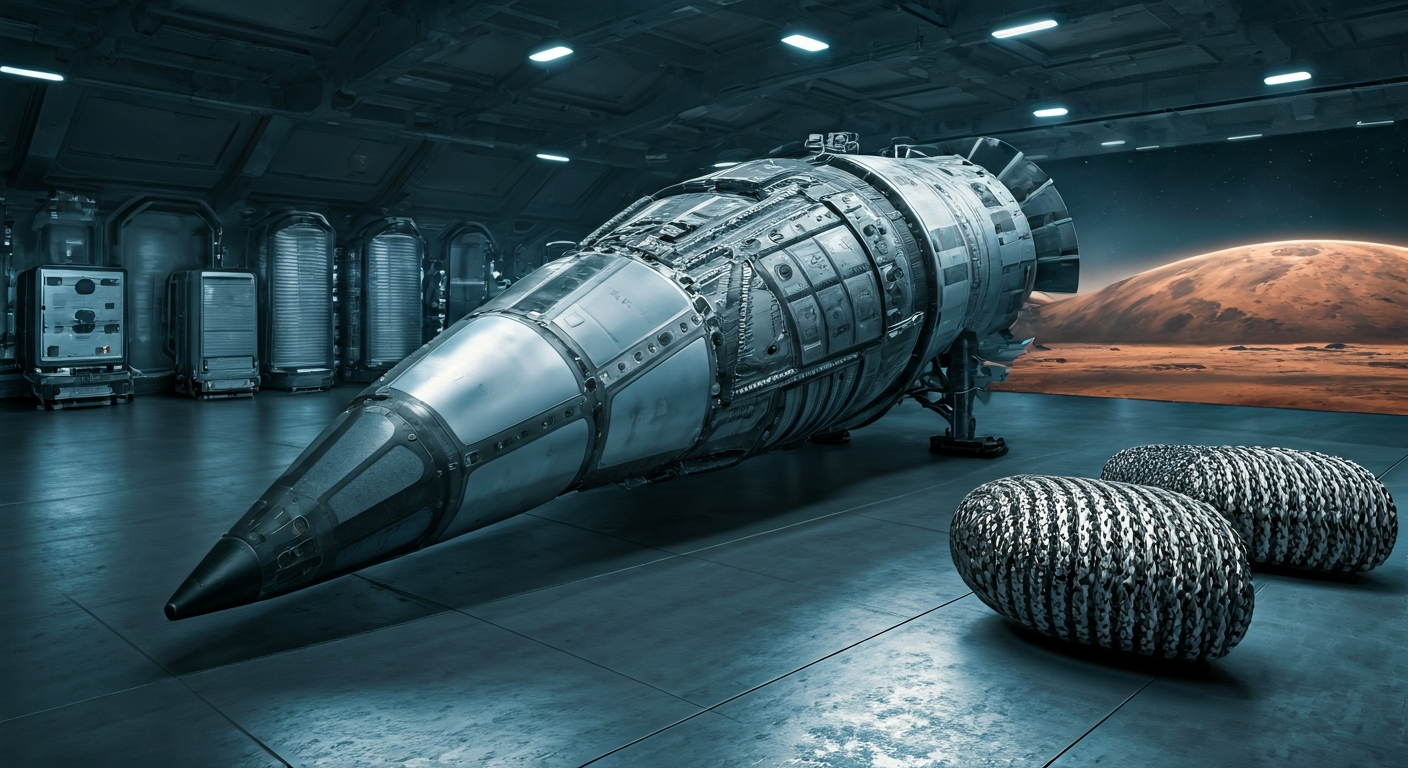
From advanced heat shields to self-healing composites and in-situ resource utilization, materials science is rapidly evolving to support ambitious space exploration.
The upcoming Artemis II mission is putting NASA's Orion spacecraft heat shield under intense scrutiny. This critical component, designed to withstand the extreme temperatures of re-entry, is at the forefront of thermal protection system development. Beyond re-entry, the need for robust materials in deep space is driving innovation in radiation shielding. Researchers are developing ultra-thin, flexible materials that can offer significant protection against cosmic rays, a crucial step for long-duration human missions.
European researchers are also contributing with the development of self-healing composite materials. These advanced composites can autonomously repair minor damage, enhancing spacecraft longevity and reducing maintenance needs in the harsh space environment. Meanwhile, additive manufacturing, or 3D printing, continues to revolutionize spacecraft component production. Companies like Rocket Lab are achieving milestones with 3D-printed rocket engines, demonstrating faster production rates and the ability to create complex, lightweight designs from specialized alloys. This technology is also being explored for rocket propellants, potentially leading to more efficient and rapidly deployable propulsion systems.
Looking towards lunar and Martian exploration, the focus is shifting to In-Situ Resource Utilization (ISRU). Scientists are actively researching how to use lunar and Martian regolith—the loose soil and rock on these celestial bodies—as a primary building material. Experiments are showing that regolith can be processed into construction blocks or even used in concrete-like mixtures, promising to reduce the mass that needs to be launched from Earth and enabling the construction of habitats and infrastructure directly on other worlds.
The rapid advancements in materials science, from resilient thermal protection and self-healing composites to additive manufacturing and ISRU, are not just incremental improvements. They are foundational pillars enabling a future of sustained human presence beyond Earth. By reducing launch mass, enhancing durability, and leveraging extraterrestrial resources, these materials are paving the way for affordable, scalable, and ultimately, multi-planetary civilizations.
This content was produced by the news editor with AI.