Mars' Next Chapter: From Skyfall to Stellar Manufacturing
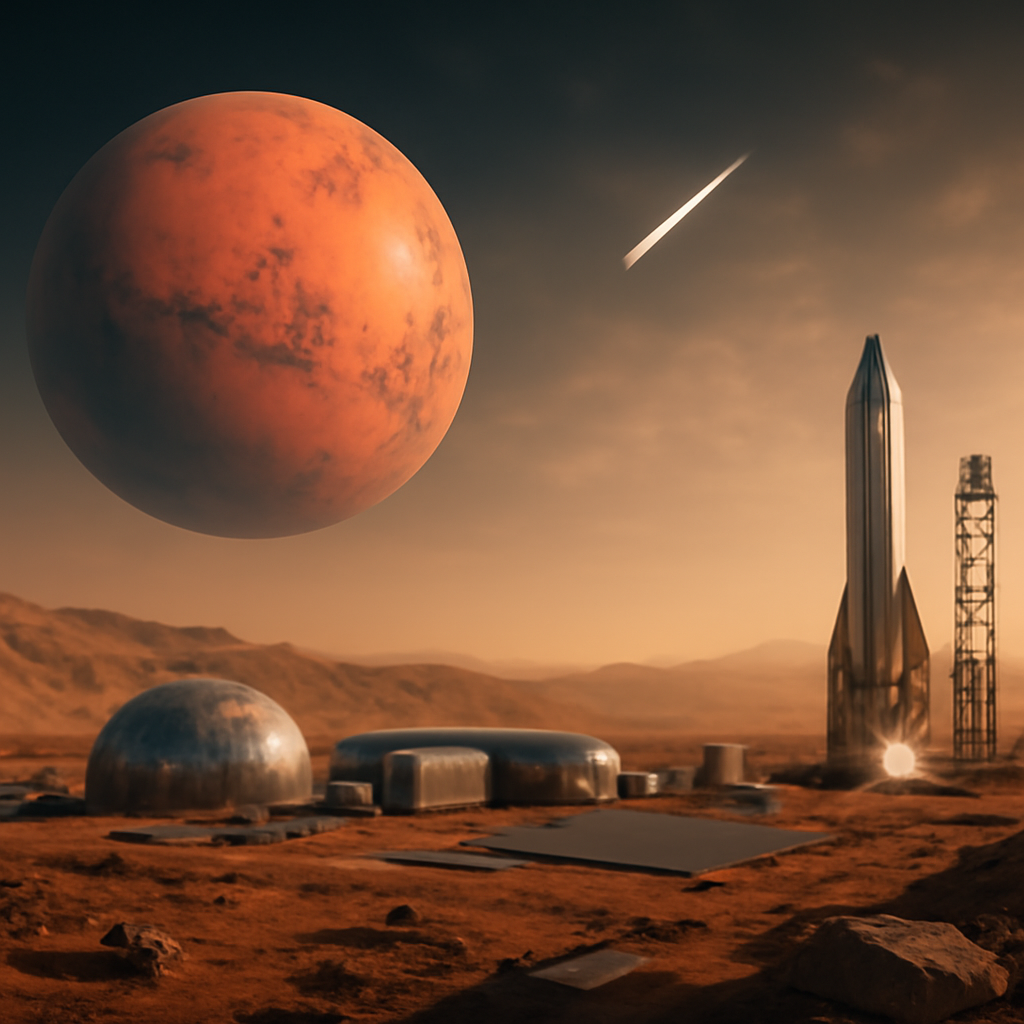
As humanity edges closer to becoming a multi-planetary species, new developments in robotic exploration and advanced manufacturing signal a paradigm shift for Mars. From the hardware funding of the Skyfall helicopter mission to the burgeoning use of additive manufacturing for space-bound components, the Red Planet is becoming an increasingly tangible destination.
Skyfall's Ascent: A New Era of Martian Aerial Reconnaissance
The "Skyfall" mission, slated for a 2028 launch window, represents a significant leap in Mars aerial reconnaissance, building upon the foundational success of Ingenuity. While Ingenuity demonstrated powered flight on another planet, Skyfall is designed for extended operational capability and enhanced scientific data acquisition. Its primary objective is to scout potential landing sites for future sample return missions and to perform high-resolution imaging of geological features inaccessible to rovers. This involves a more robust airframe, likely incorporating advanced lightweight composites, and a sophisticated navigation and control system capable of autonomous flight in challenging Martian atmospheric conditions, which are significantly thinner than Earth's, requiring higher rotor speeds and precise aerodynamic design. The mission's funding, initiated by NASA, signals a commitment to pushing the boundaries of robotic exploration, recognizing that aerial perspectives are crucial for understanding Mars' complex geological history and identifying areas of astrobiological interest. This investment underscores a strategic shift towards more dynamic and agile exploration methodologies on the Red Planet.
The Martian Forge: Additive Manufacturing's Role in Off-World Construction
The construction of robust infrastructure on Mars hinges on our ability to manufacture large, complex components *in situ*, minimizing reliance on Earth-based resupply. Wire Arc Additive Manufacturing (WAAM) stands out as a prime candidate for this off-world fabrication. This process, akin to a highly controlled, automated welding operation, deposits molten metal layer by layer from a wire feedstock, guided by a robotic arm. Recent advancements, such as those showcased by Lincoln Electric and utilized by Framatome for nuclear reactor components with MX3D's technology, demonstrate WAAM's capacity for producing substantial metal structures. This scalability is crucial for building everything from habitats and landing pads to potential propellant depots. The energy and material efficiency of WAAM, particularly when using regolith-derived feedstock, could drastically reduce the cost and complexity of Martian construction. Furthermore, the development of specialized WAAM systems capable of operating in the thinner Martian atmosphere, potentially with modified gas shielding or in vacuum-sealed environments, is a key engineering challenge being addressed. This technology, coupled with the ongoing simulation efforts for long-duration Mars missions, represents a significant leap towards establishing a sustainable human presence beyond Earth.
Simulating the Red Frontier: Preparing Humanity for Year-Long Martian Stays
NASA's simulated Mars missions are not just about replicating the physical challenges of the Red Planet, but critically, about understanding the human element. These year-long analog environments are meticulously designed to isolate participants, mirroring the vast distances and communication delays inherent in actual interplanetary travel. The primary objective is to gather robust data on crew dynamics, examining how prolonged confinement impacts interpersonal relationships, decision-making under stress, and overall psychological resilience. Researchers closely monitor communication patterns, conflict resolution strategies, and individual coping mechanisms, employing a battery of psychological assessments and physiological sensors. Simultaneously, these simulations serve as crucial testbeds for burgeoning technologies. Future Mars explorers might rely on advanced additive manufacturing techniques, akin to the Wire Arc Additive Manufacturing (WAAM) systems being scaled for defense and nuclear applications, for in-situ repair and fabrication. Similarly, breakthroughs in personalized medicine, like those being pursued by CurifyLabs, could be tested for their efficacy in providing essential healthcare within a closed-loop system, ensuring crew well-being on extended voyages. The data gleaned from these Earth-bound Martian outposts is indispensable for refining mission protocols, identifying potential psychological stressors, and validating the reliability of life-support and manufacturing systems before committing astronauts to the real frontier.
From Earth to Mars: Lessons from Defense Procurement Reform for Space
The drive to accelerate Mars missions, exemplified by the upcoming Skyfall helicopter hardware funding and the year-long simulation for future crews, mirrors a growing urgency in defense procurement. UK additive manufacturer AMufacture, for instance, is advocating for a wholesale reform of defense acquisition processes, arguing that current systems stifle the rapid integration of advanced manufacturing technologies. This sentiment is echoed across industries, from Framatome's new nuclear WAAM facility producing large metal components to Lincoln Electric expanding its Wire Arc Additive Manufacturing (WAAM) capabilities for defense and infrastructure. The core issue is bridging the gap between innovation and deployment. Traditional procurement often relies on lengthy qualification cycles and established supply chains, ill-suited for the agile, iterative development that additive manufacturing enables. Applying lessons from defense procurement reform—such as streamlining qualification pathways, embracing digital thread philosophies for traceability, and fostering closer collaboration between end-users and manufacturers—could significantly de-risk and expedite the adoption of advanced manufacturing for Mars hardware. This would allow for faster iteration on critical components, like the heat shield for Skyfall being developed by Firefly Aerospace, and potentially enable on-demand part production on Mars itself, reducing reliance on Earth-based resupply.
The Chemistry of Survival: Martian Organics and Resource Utilization
The discovery of complex organic molecules, including a nitrogen-bearing ring structure, within a 3.5-billion-year-old Martian rock by the Curiosity rover has profound implications for future in-situ resource utilization (ISRU). This finding confirms that complex carbon-based chemistry can persist over geological timescales on Mars, offering a potential foundational element for life and a resource for future explorers. Beyond simply finding organic building blocks, research into converting Martian atmospheric carbon dioxide into useful materials is progressing rapidly. A recent breakthrough involves a cost-effective catalytic process that transforms captured CO2, methanol, and hydrogen into ethanol. Ethanol, besides being a potential biofuel, is a versatile chemical feedstock. It can be processed into ethylene, a precursor for plastics, or used as a solvent. Such advancements are crucial for developing self-sustaining Martian habitats and fuel production systems, reducing reliance on Earth-based resupply. The development of technologies like Wire Arc Additive Manufacturing (WAAM), highlighted by companies like Lincoln Electric and Framatome, also points towards a future where Martian resources can be directly transformed into structural components and tools, mirroring terrestrial advancements in defense and infrastructure.
Navigating the Void: Heat Shields and Martian Entry Dynamics
The Martian atmosphere, though tenuous, presents a formidable barrier for any spacecraft descending to the surface. As the Skyfall mission prepares for its 2028 launch, the development of its heat shield by Firefly Aerospace is paramount. This critical component must withstand the extreme thermal and mechanical stresses generated during hypersonic atmospheric entry. When a spacecraft enters Mars' atmosphere at speeds exceeding Mach 20, friction with the thin atmospheric gases converts kinetic energy into intense heat. This process can generate temperatures reaching thousands of degrees Celsius. The heat shield's primary function is to ablate, meaning its outer layers are designed to vaporize and carry away thermal energy, protecting the underlying structure and sensitive payload. The materials used are typically advanced composites, often carbon-phenolic or similar ablative substances, engineered for specific thermal decomposition properties. Beyond heat, the shield must also endure significant aerodynamic forces. The rapid deceleration creates immense pressure, requiring a robust structural design. For Skyfall, the engineering challenge lies in optimizing the shield's geometry and material composition to ensure a stable deceleration profile and minimize heat transfer, all while considering mass constraints crucial for interplanetary transit. The success of this heat shield is directly linked to the safe delivery of the Skyfall helicopter, paving the way for future aerial exploration.
The Venusian Parallel: Atmospheric Habitability and Exploration Strategy
While Mars presents formidable challenges for human settlement, recent analyses of Venus's atmosphere reveal an unexpected potential for a different kind of extraterrestrial habitation. A region approximately 50 kilometers above Venus's surface offers atmospheric pressure remarkably similar to Earth's sea level. This presents a stark contrast to Mars, where achieving equivalent surface pressure would necessitate significant atmospheric thickening or heavily engineered habitats. On Venus, the advantage lies in leveraging aerostats—lighter-than-air vehicles—as floating cities. These could be constructed from materials that can withstand Venus's corrosive sulfuric acid clouds, perhaps utilizing advanced composites or specialized metal alloys, echoing the advancements seen in additive manufacturing for defense and aerospace. Such a strategy would bypass the need for extensive terraforming or deep subterranean bases that Mars exploration might require, potentially offering a more immediate and less resource-intensive pathway for sustained human presence beyond Earth, while still demanding robust engineering solutions for survival in a hostile, albeit more pressure-friendly, environment.
Beyond Earth: The Economic Underpinnings of Multi-Planetary Ambitions
The ambitious goal of colonizing Mars, as espoused by entities like SpaceX, hinges on a fundamental economic equation: the cost of sustained presence must eventually be offset by tangible returns. This necessitates a radical departure from the Earth-centric, high-cost launch models that currently dominate. The recent skepticism surrounding SpaceX's astronomical valuation, as reported, underscores this tension. Investors are grappling with the immense capital expenditure required for interplanetary transport and habitat construction against the nebulous timeline for generating profit. Crucially, this economic viability is inextricably linked to advancements in on-site manufacturing and resource utilization. Technologies like Wire Arc Additive Manufacturing (WAAM), already seeing significant investment and application in terrestrial defense and nuclear sectors by companies like Framatome and Lincoln Electric, offer a pathway. The ability to fabricate complex metal components directly on Mars, using local regolith as feedstock, drastically reduces the payload mass and cost associated with resupply missions. Similarly, advancements in 3D printing for specialized applications, such as Venus Aerospace's rocket engine development, hint at a future where propulsion systems themselves can be manufactured and iterated upon off-world. The development of novel additive manufacturing tools, as exemplified by Meltio's funding rounds, and the growing demand for 3D printing in sectors like drones, further validate this trend. Ultimately, until Mars can become a self-sustaining manufacturing hub, capable of producing everything from spare parts to habitats, its colonization will remain a capital-intensive endeavor with uncertain economic underpinnings.
The convergence of these headlines paints a clear trajectory for humanity's expansion beyond Earth, a fundamental imperative for long-term survival and progress. The 'Skyfall' mission, alongside the growing maturity of additive manufacturing for critical components and in-situ resource utilization (ISRU) potential, directly addresses the engineering challenges of establishing a sustained presence. The simulation efforts highlight the human factor, while the discoveries of complex organic molecules underscore Mars' scientific allure and potential for unlocking the secrets of life's origins. This integrated approach, from robotic scouts to terrestrial manufacturing innovations, accelerates the exponential march towards a multi-planetary future.
This content was produced by the news editor with AI.