NASA's Perseverance Rover Unveils Ancient Mars Chemistry Clues
New research suggests Perseverance's findings indicate chemical reactions involving water and possible organic material on early Mars, offering insights into potential habitability.
NASA's Perseverance rover has uncovered significant clues about the ancient chemistry of Mars, shedding light on possible environments that could have supported life. Over three years of exploration in Jezero Crater, the rover has provided detailed insights into the planet's geological history, revealing evidence of chemical reactions that shaped Mars billions of years ago.
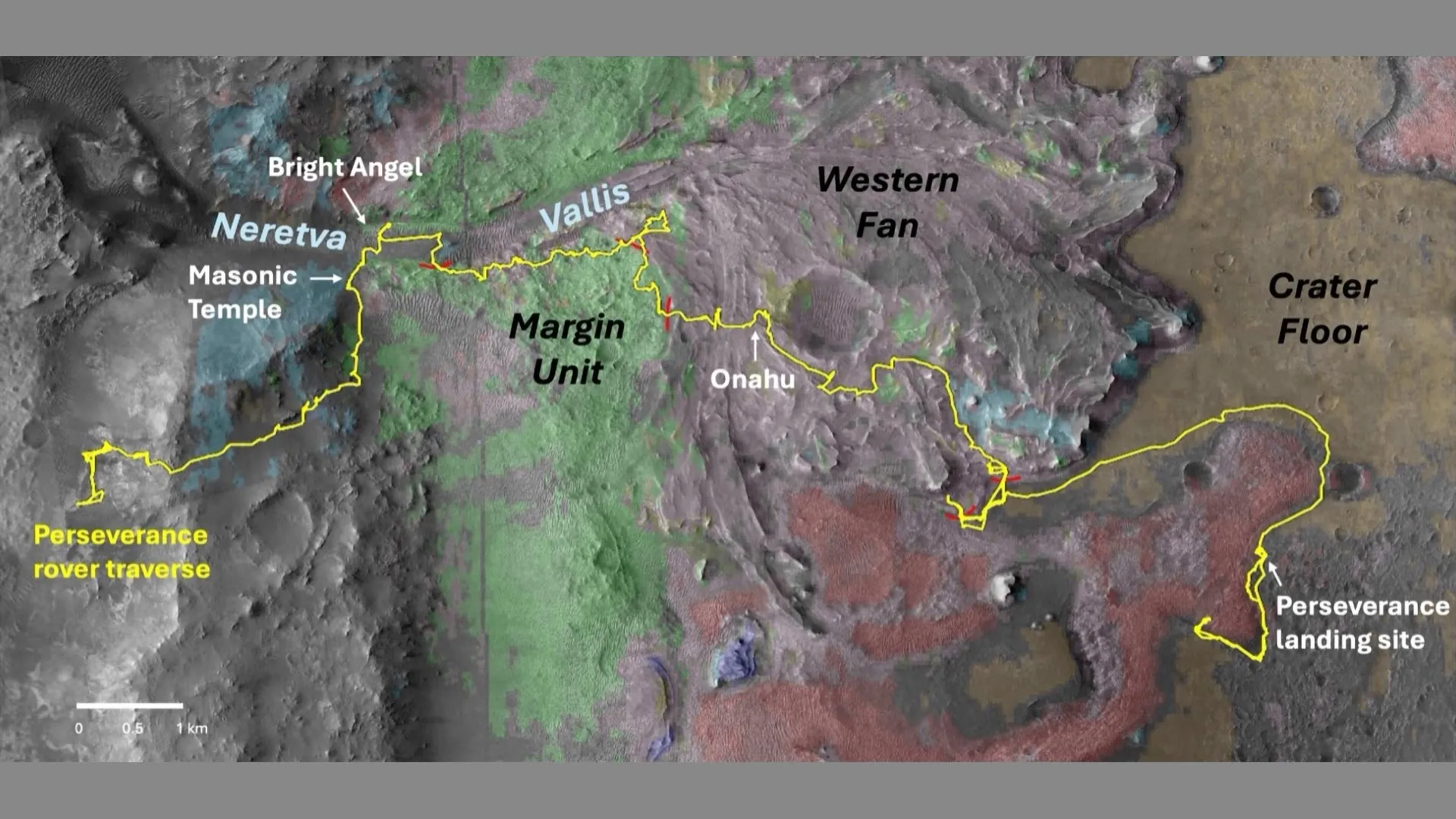
Janice Bishop of the SETI Institute and Mario Parente of the University of Massachusetts analyzed data from the Mars Reconnaissance Orbiter's CRISM instrument, creating a mineral map of the crater. This map, combined with Perseverance's in-situ measurements, shows deposits of clays and carbonates, indicating past water activity. The rover also discovered unusual minerals not detectable from orbit, such as iron phosphate and iron sulfide nodules, which suggest complex redox reactions.
Perseverance's findings, including the presence of smectite clays, ferric oxides, and calcium sulfates, point to a dynamic environment where organic compounds may have interacted with minerals. These interactions could have created energy-rich conditions that might have supported early life. The rover's SHERLOC instrument detected organic compounds, reinforcing the idea that Mars once had a chemically active surface.
Bishop's team conducted lab experiments showing that organic compounds can drive redox reactions, producing minerals like magnetite. The discovery of vivianite, a phosphate mineral, and its oxidation at different sites suggests that Mars' environment changed over time, influencing its habitability. These findings highlight the importance of understanding Martian minerals to reconstruct ancient geochemical processes.
While orbital data provides a broad view, in-situ analysis by Perseverance offers a more detailed perspective. However, atmospheric conditions and instrument limitations can complicate data interpretation. Ongoing research aims to refine these methods, ensuring accurate mineral identification on Mars.
This article was written by AI from the original report. The "AI Analysis" is opinion/commentary. Always refer to the original source for the complete, authoritative story.