NASA's Opportunity Rover: A Decade-Plus Martian Pioneer
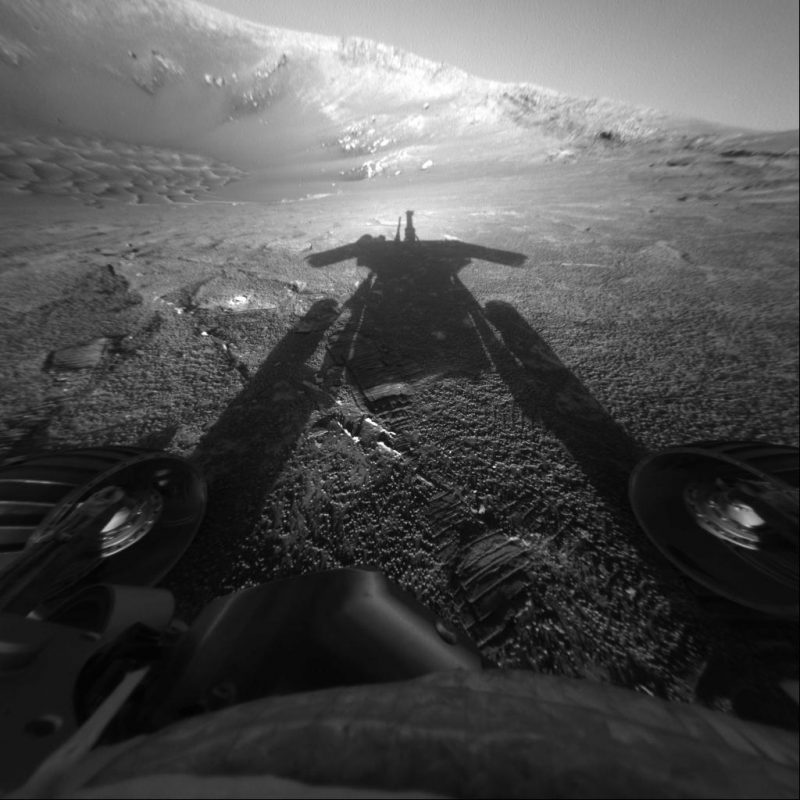
Launched in 2003, NASA's Opportunity rover far exceeded its design life, traversing over 28 miles and making significant discoveries before succumbing to a Martian dust storm.
NASA's Mars Exploration Rover Opportunity, affectionately known as Oppy, began its historic journey to the Red Planet on July 7, 2003. After a seven-month voyage, it touched down in Meridiani Planum on January 25, 2004, three weeks after its twin rover, Spirit, landed elsewhere on Mars. Opportunity was engineered for a mere 90 Martian days and to cover 1,000 meters, but it defied these expectations by operating for 15 years and covering an astonishing 45 kilometers.
Opportunity's mission officially concluded in 2019, having vastly surpassed its intended operational lifespan by approximately 60 times. Its final resting place was Perseverance Valley, where it ceased communication in June 2018 due to a planet-wide dust storm that likely obscured its solar panels. Engineers at NASA's Jet Propulsion Laboratory attempted an eight-month recovery strategy, sending over a thousand commands, but received no response.
The rover's final days were marked by a poignant farewell effort in February 2019, including playing "I'll Be Seeing You" by Billie Holiday in the control room, a song chosen by the mission's principal investigator. Despite these efforts, Opportunity remained silent, marking a difficult but necessary end for the long-serving machine.
Throughout its extensive mission, Opportunity navigated challenging Martian terrain, including steep slopes up to 32 degrees, a feat unmatched off-world. It set a one-day driving record of 220 meters in 2005 and captured over 217,000 images, including numerous 360-degree panoramas. Key scientific findings included the discovery of hematite, a mineral indicative of water formation, and strong evidence of ancient, Earth-like water bodies at Endeavour Crater.
Despite facing numerous obstacles such as wheel damage, a stuck heater, memory issues, and sand traps, Opportunity's dedicated Earth-based team consistently found solutions. However, the severe dust storm of 2018 proved to be the ultimate challenge for this veteran explorer.
Opportunity's 15-year odyssey, covering 45 kilometers and revealing evidence of ancient water, represents a critical step in humanity's multi-planetary expansion. This rover's ability to overcome numerous technical failures and operate far beyond its design parameters showcases the accelerating robustness of robotic systems essential for off-world exploration. Each kilometer traveled and data point collected by Oppy builds the foundational knowledge for future self-sustaining Martian settlements. Its resilience and scientific discoveries underscore our existential imperative to extend life and consciousness beyond Earth, transforming Mars from a scientific target into our second home.
Edited by the news editor with AI from the original report — please refer to the original source.