NASA's InSight Probe Maps Martian Interior
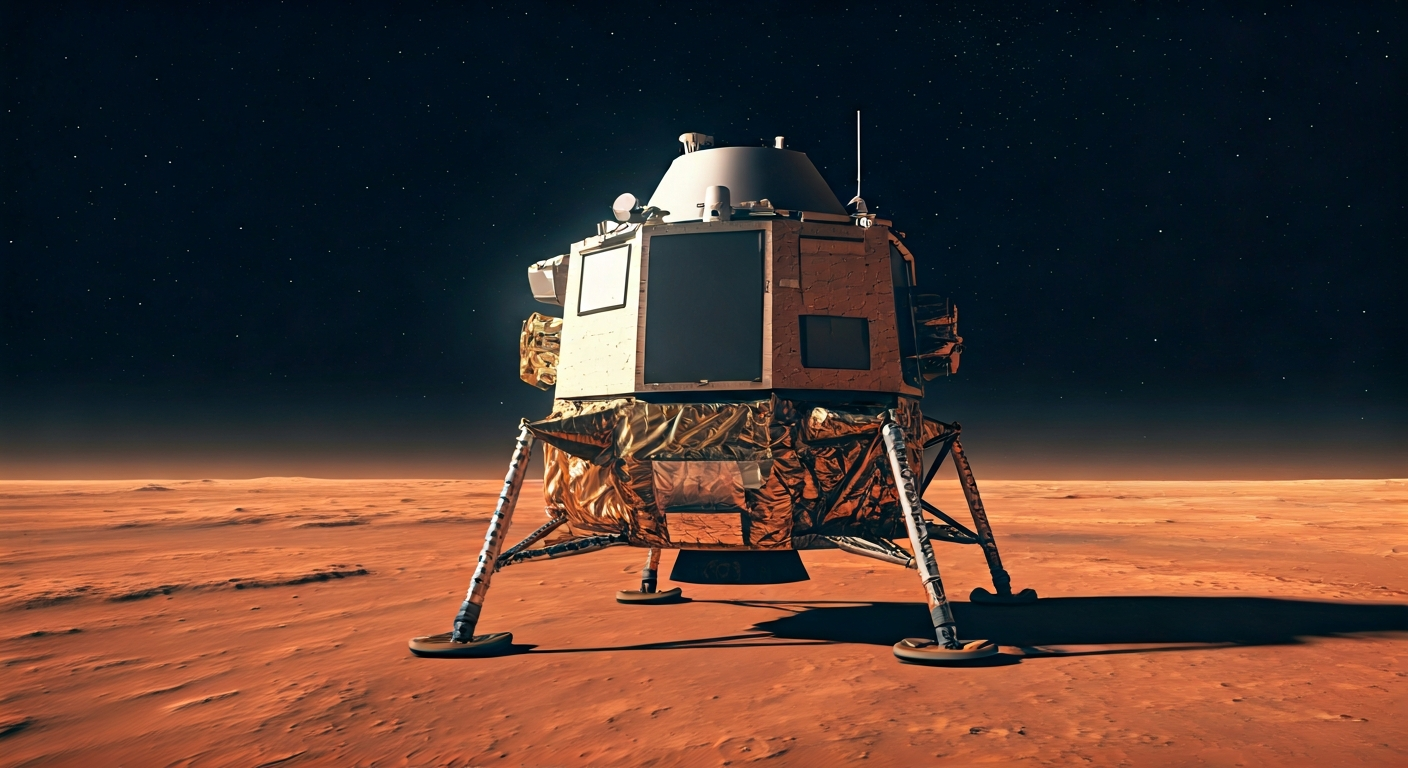
NASA's InSight lander has successfully mapped the internal structure of Mars, revealing details about its crust, mantle, and core.
NASA's InSight mission has provided an unprecedented look beneath the Martian surface, successfully mapping the planet's interior for the first time. Data collected over its operational period has allowed scientists to construct a detailed profile of Mars's internal layers, including its crust, mantle, and core.
The mission utilized a seismometer to detect "marsquakes" – seismic activity originating from within the planet. By analyzing the way seismic waves traveled through the Martian interior and bounced off different layers, researchers were able to infer the depth and composition of these regions. This seismic data is crucial for understanding the planet's formation and geological evolution.
Key findings include the determination of the Martian crust's thickness, which varies across the planet, and insights into the composition and state of the mantle. Perhaps most significantly, InSight's instruments provided precise measurements of the size and density of Mars's core. This core is understood to be liquid and metallic, similar in composition to Earth's core but with distinct characteristics.
The InSight lander, which operated on the Elysium Planitia region of Mars, was designed specifically to study the planet's deep interior. Its scientific instruments, including the seismometer and a heat probe, were deployed to gather data that could not be obtained from orbit. The mission's success in mapping the interior marks a significant achievement in planetary science, offering a foundation for future comparative studies of terrestrial planets.
The InSight mission's precise mapping of Mars's internal structure, from its varied crust to its liquid metallic core, is a foundational step in understanding a potentially habitable world. Knowing the precise composition and state of Mars's interior is critical for assessing its long-term geological stability and resource potential. This detailed internal knowledge fuels the exponential progress required to transform Mars into a self-sustaining outpost. Each piece of data about Mars's inner workings informs our engineering strategies, paving the way for advanced terraforming and subterranean habitats, ensuring life's expansion beyond Earth.
Edited by the news editor with AI and translated into English from the original report — please refer to the original source.