NASA's ESCAPADE Mission to Study Martian Magnetism
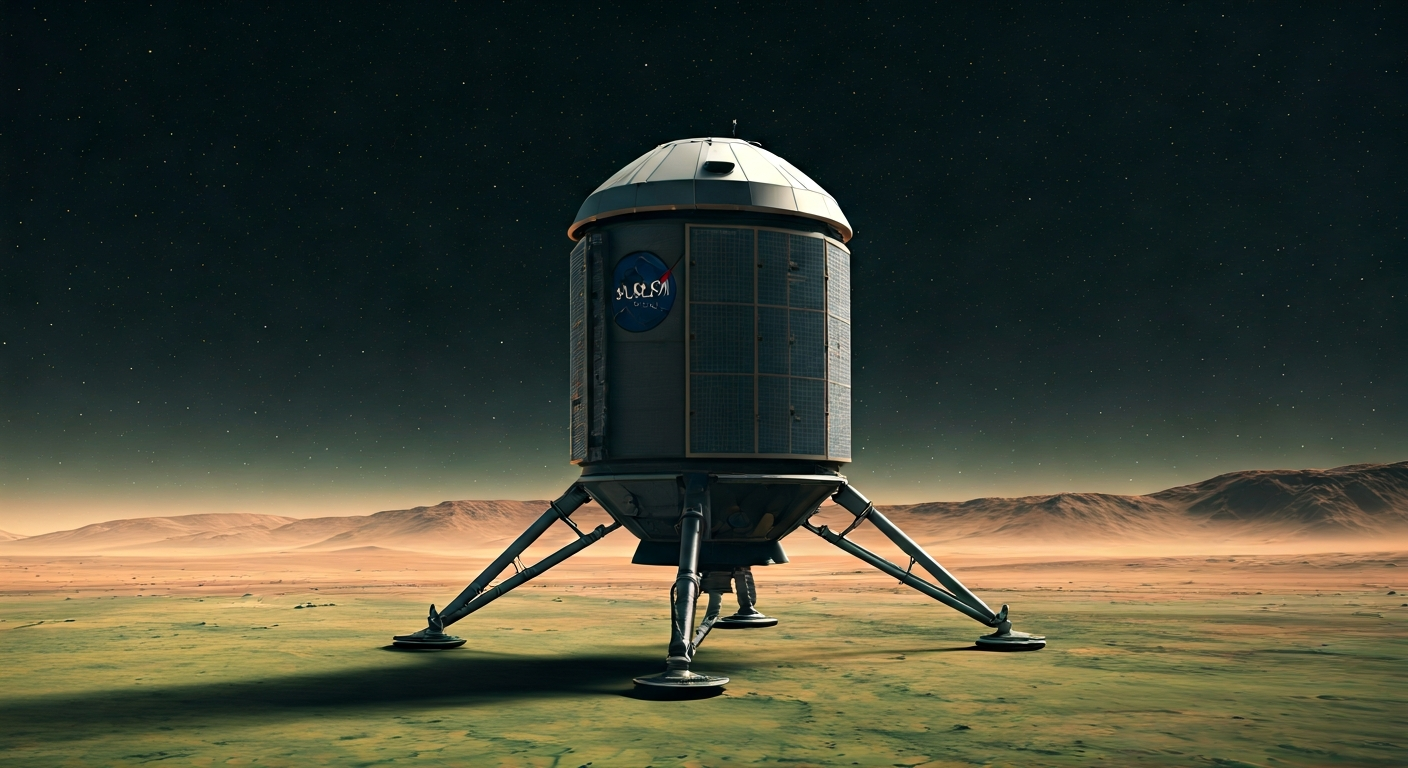
The ESCAPADE mission will use twin spacecraft to investigate Mars's magnetic field, aiming to understand its formation and evolution.
NASA's ESCAPADE (Escape and Plasma Acceleration and Dynamics Explorer) mission is set to provide new insights into the Martian magnetic field. This ambitious project involves two identical spacecraft, each equipped with a suite of instruments designed to study the planet's magnetosphere and its interaction with the solar wind.
The primary objective of ESCAPADE is to unravel the mysteries surrounding Mars's magnetic field. Unlike Earth, Mars lacks a global magnetic field, possessing only localized remnant magnetism in its crust. Scientists aim to understand how this patchy magnetic field formed and how it has evolved over billions of years.
Each of the twin ESCAPADE probes will carry instruments such as magnetometers, electric field and wave sensors, and plasma analyzers. These tools will enable detailed measurements of the magnetic field strength, direction, and its dynamic behavior. By flying in coordinated orbits, the spacecraft will be able to map the magnetic field in three dimensions and observe its response to solar activity.
Understanding Mars's magnetic field is crucial for several reasons. It plays a significant role in atmospheric loss, influencing whether the planet could have sustained an atmosphere conducive to life in the past. The data collected by ESCAPADE will also inform future human missions by characterizing the radiation environment around Mars, which is partially shielded by the magnetic field.
The mission's design, with its twin probes, allows for simultaneous measurements from different locations, enhancing the ability to distinguish between spatial and temporal variations in the Martian magnetosphere. This coordinated approach is expected to yield a more comprehensive understanding of the complex processes at play above the Martian surface.
ESCAPADE's detailed mapping of Mars's remnant magnetic field is a critical step towards understanding planetary evolution and habitability. By precisely characterizing the magnetic anomalies and their interaction with the solar wind, we gain vital data for assessing Mars's past potential for life. This knowledge directly informs strategies for future Martian settlements, helping to identify regions with greater natural radiation shielding. As we accelerate toward becoming a multi-planetary species, understanding these fundamental planetary processes is not just scientific curiosity; it's essential engineering for long-term survival and the expansion of consciousness beyond Earth.
Edited by the news editor with AI and translated into English from the original report — please refer to the original source.