NASA Orbiter Captures Dramatic Mars Horizon Views
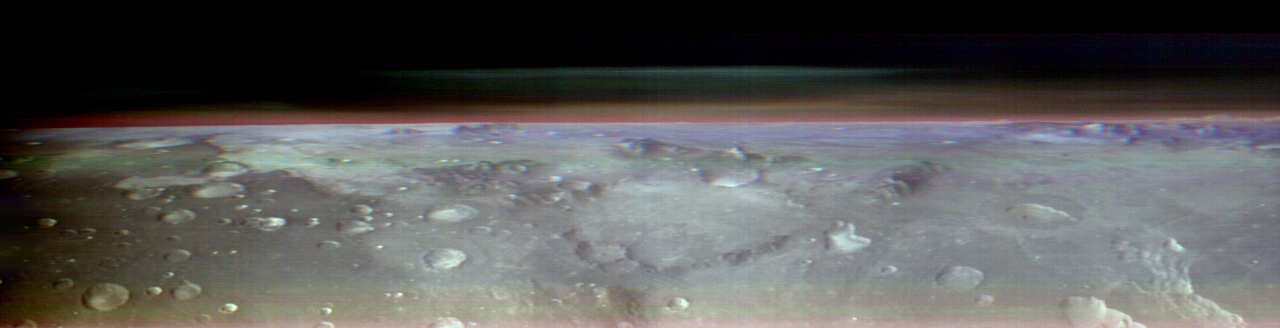
NASA's Mars Odyssey orbiter has captured new panoramic images of Mars, revealing atmospheric layers and a view of Phobos.
NASA's Mars Odyssey orbiter has provided a striking new view of the Martian horizon, capturing clouds, dust, and one of the planet's moons, Phobos. The images, taken in May from an altitude of about 250 miles, offer a unique perspective of the Red Planet's atmosphere, similar to what astronauts would see from orbit.
The 10-image panorama, stitched together, showcases the curved Martian landscape beneath gauzy layers of clouds and dust. Scientists believe the view will help improve models of the Martian atmosphere by revealing the structure of water-ice clouds and dust layers. The images were taken using the Thermal Emission Imaging System (THEMIS), an infrared camera that maps surface materials and temperature changes.
To achieve this view, engineers had to rotate the orbiter nearly 90 degrees, which required careful planning to ensure the spacecraft's solar panels remained illuminated while sensitive equipment was protected from direct sunlight. This maneuver temporarily disrupted communication with the orbiter for several hours.
In addition to the atmospheric views, the mission also captured images of Phobos, the larger of Mars' two moons. This is the seventh time Odyssey has imaged Phobos in 22 years, providing new data on its surface temperature and composition. The images may help resolve a long-standing debate about whether Phobos is a captured asteroid or a fragment of Mars.
NASA's Mars Moon eXplorer (MMX) mission, in collaboration with JAXA, will use data from Odyssey to study Phobos and its sister moon, Deimos. The findings from Odyssey's latest observations will support future efforts to better understand the Martian system.
This article was written by AI from the original report. The "AI Analysis" is opinion/commentary. Always refer to the original source for the complete, authoritative story.