Michigan Team Proposes Pressurized Tunnels for Mars Surface Mobility
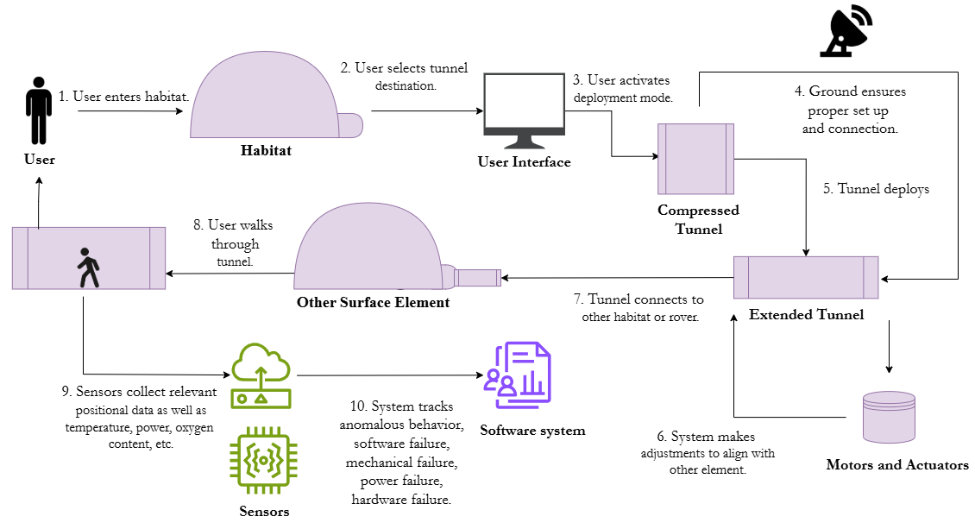
A University of Michigan team has developed a concept for retractable, pressurized tunnels to connect Martian habitats and vehicles, aiming to significantly reduce the need for cumbersome spacesuits during surface operations.
As humanity sets its sights on crewed missions to Mars in the coming decades, researchers are tackling the unique challenges of operating on the Red Planet. Beyond the rigors of deep-space travel, arriving crews will face a hostile environment characterized by a thin, unbreathable atmosphere, extreme temperature fluctuations, and high radiation levels. To mitigate these hazards and facilitate exploration, NASA's Moon to Mars initiative is encouraging innovative solutions.
One such concept, developed by the Bioastronautics and Life Support Systems (BLiSS) team at the University of Michigan, is a "Lightweight Actuated Tunnels for Crewed Habitation" (LATCH) system. This proposal, submitted to NASA's M2M X-Hab 2026 Academic Innovation Challenge, envisions a network of pressurized tunnels that can connect surface assets like habitats, landing pads, and ascent vehicles.
The primary benefit of the LATCH system is the drastic reduction in the need for Extravehicular Activities (EVAs), which currently require hours of preparation and donning of bulky spacesuits. The BLiSS team highlights that transitioning between surface elements typically takes a full day, involving pre-breathing oxygen, suiting up, and airlock procedures. This process is not only time-consuming but also exposes astronauts to decompression risks and increased radiation.
Furthermore, the need for spacesuits extends to boarding and disembarking the Mars Ascent Vehicle (MAV). This adds significant mass to the vehicle, requiring more propellant for ascent and descent, and also necessitates larger cabin volumes. The team estimates that each EVA suit adds 560 kilograms of propellant and occupies space equivalent to a person within the launch vehicle.
The proposed LATCH tunnels are designed to be lightweight and retractable. Each tunnel would feature an inflatable shell, structural rings, motorized actuators for extension and retraction, integrated handrails, and tracks. These tunnels would connect to habitat airlocks, allowing crews to select a destination via a user interface and extend the tunnel to the desired hatch. Sensors would monitor the tunnel's status for leaks or faults, ensuring a safe transit within minutes, rather than a full day of EVA.
The LATCH concept directly addresses a critical bottleneck for Martian surface operations: the inefficiency and risk associated with frequent EVAs. By enabling seamless, pressurized transit between habitats and vehicles, this technology dramatically accelerates operational tempo and enhances astronaut safety. This is not merely an incremental improvement; it represents a fundamental shift in how humans will interact with the Martian surface, akin to the transition from walking between buildings to using enclosed walkways. Such advancements are vital for establishing the self-sustaining Martian civilization that is humanity's ultimate imperative, allowing for more efficient resource utilization and continuous progress towards exponential growth of life beyond Earth.
Edited by the news editor with AI from the original report — please refer to the original source.