Mars: The Forge of Our Future - From Asteroid Scars to 3D-Printed Worlds
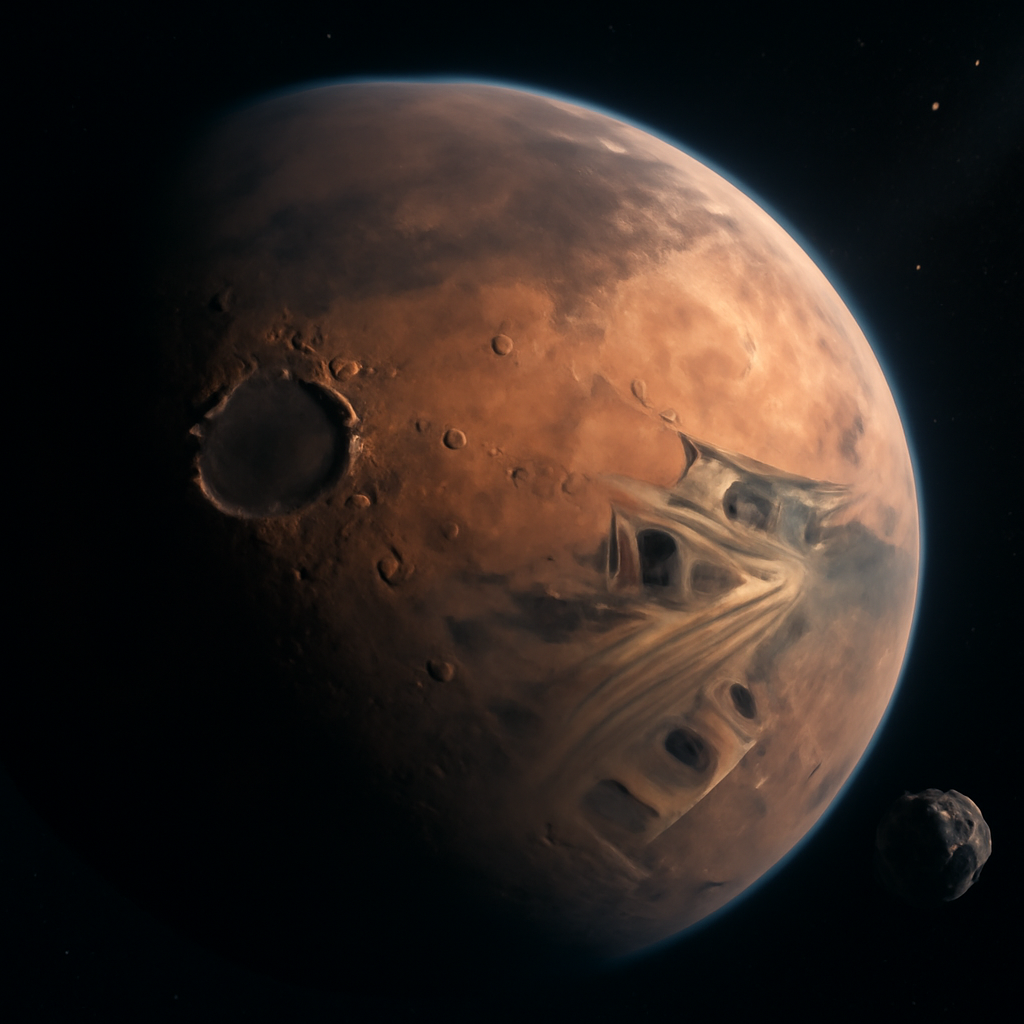
This deep dive explores how advancements in 3D printing and our understanding of Mars's violent past are converging to accelerate humanity's multi-planetary destiny. We examine how asteroid impacts shaped Mars, how additive manufacturing is revolutionizing on-Earth industries for off-world applications, and the critical engineering and scientific strides that bring us closer to a thriving Martian civilization.
Cosmic Scars: Asteroid Impacts and Martian Geology
Recent findings from NASA's Perseverance rover are painting a more dynamic picture of Mars's geological evolution, directly linking cratered landscapes to significant solar system events. Perseverance has identified clear signatures of ancient asteroid impacts within Martian rock samples, providing tangible evidence of a tumultuous past. This aligns with broader research suggesting that a massive asteroid collision approximately 800 million years ago may have seeded the inner solar system with debris, a period often referred to as the Late Heavy Bombardment, though the new findings suggest impacts continued and were perhaps more episodic. Analyzing the mineralogical composition and structural deformation within these Martian impact structures allows scientists to refine models of planetary accretion and bombardment history. Understanding the frequency and intensity of these impacts on Mars is crucial for reconstructing the early solar system's dynamics, as well as for assessing potential resource availability and geological hazards for future human missions. The metallic-looking dunes imaged by Mars Express further hint at unique geological processes, potentially including the concentration of impact-generated materials.
Additive Manufacturing: The Martian Construction Toolkit
The Martian environment presents significant challenges for constructing habitats and infrastructure, demanding robust, on-site manufacturing capabilities. Advanced additive manufacturing, commonly known as 3D printing, offers a compelling solution. Researchers at MIT have developed frameworks integrating fabrication constraints into structural optimization for concrete, moving beyond basic material properties to address hardware limitations in building complex forms. This is directly applicable to Mars, where regolith, the loose soil and rock on the surface, can serve as a primary building material. By processing this regolith into a concrete-like mixture, builders can leverage 3D printing to construct shelters and other structures with minimal imported materials. Beyond concrete, advancements in metal and composite 3D printing, exemplified by the US Navy's adoption of cold spray repair and industry interest in wire arc additive manufacturing (WAAM), indicate a maturing technology capable of producing durable components. Companies are pushing the boundaries of metal 3D printing for critical applications, hinting at the possibility of fabricating structural elements or even complex machinery directly from Martian mineral resources, reducing reliance on Earth-based supply chains and mitigating the immense logistical hurdles of crewed missions.
From Earthly Innovation to Martian Application
The harsh Martian environment necessitates a radical rethinking of manufacturing, but advances in terrestrial 3D printing offer a promising blueprint. Consider the medical field: researchers have developed novel silicones capable of producing custom contact lenses in just 20 minutes, a process that could be adapted to create bespoke medical devices on Mars, addressing individual physiological needs with speed and precision. Similarly, MIT's framework for optimizing concrete structures for 3D printing, which integrates fabrication constraints directly into the design process, is directly relevant. On Mars, where construction materials will likely be sourced locally, such an approach would enable the efficient creation of shelters and infrastructure, minimizing reliance on Earth-based supplies and accounting for the unique mechanical properties of Martian regolith. The aerospace sector's adoption of additive manufacturing, exemplified by Massivit's RapidWings platform reducing tooling lead times, highlights the potential for rapid prototyping and repair of critical components in situ, a vital capability for a self-sufficient Martian outpost. Even the challenge of waste, highlighted by the issue of discarded 3D prints, can inform sustainable Martian manufacturing practices, emphasizing closed-loop systems and material recycling from the outset.
Robotics and Automation: The Unseen Workforce
The Martian surface presents a relentless frontier, demanding a robust and adaptable robotic workforce. Recent advancements in robotic manipulation, directly relevant to extraterrestrial operations, include novel gripper designs that leverage single-motor actuation and gravity to switch between specialized tools. This mechanical ingenuity is crucial for maximizing efficiency and minimizing the complexity of robotic systems deployed in environments where spare parts and maintenance crews are non-existent. Imagine a robotic arm on Mars, capable of seamlessly transitioning from delicately excavating a rock sample, as detected by Perseverance, to gripping construction materials for habitat assembly, all without the need for multiple, power-intensive actuators. Furthermore, the burgeoning industrial additive manufacturing sector, highlighted by market growth projections and developments like MIT's optimized concrete printing framework, offers a blueprint for self-sustaining Martian infrastructure. This technology, coupled with concepts like the US Navy's new cold spray repair facility, points towards future Martian bases equipped with automated repair bays. These facilities could utilize in-situ resources, potentially even regolith processed into printable materials, to fabricate replacement parts or even construct new modules, circumventing the logistical nightmares of resupply missions from Earth. Such capabilities are essential for long-term human presence, turning the Red Planet from a temporary outpost into a truly self-sufficient world.
Mission Architectures: Navigating the Red Planet
Navigating Mars presents a multifaceted engineering challenge, necessitating robust mission architectures that account for both the planet's inherent hostility and the evolving capabilities of space technology. Current missions like Perseverance and Curiosity, for instance, rely on sophisticated instrumentation to analyze geological samples, a process honed through extensive terrestrial analog testing and rigorous environmental simulations. The detection of ancient asteroid impact signatures by Perseverance, echoing research on Earth-based asteroid shattering, underscores the need for instruments capable of discerning subtle geological histories under extreme conditions. Future human missions, however, demand a leap in technological readiness, particularly in areas like in-situ resource utilization and additive manufacturing. The development of frameworks for 3D-printing optimized concrete structures, as demonstrated by MIT, holds direct relevance for constructing habitats on Mars, leveraging local regolith. Similarly, advancements in rapid, custom manufacturing, exemplified by the creation of custom contact lenses in minutes or the deployment of 3D-printed reef structures, hint at the potential for on-demand fabrication of critical components and even life support systems, reducing reliance on Earth-based resupply. The successful testing of instruments by the Psyche spacecraft during its Mars flyby also highlights the iterative process of validating technology in a relevant, albeit not identical, environment before critical missions.
Analog Missions and Human Factors
The prospect of sustained human presence on Mars hinges on understanding and mitigating the planet's inherent biological and environmental hazards, alongside developing robust infrastructure. Earth-based analog missions, such as the Mars Society's Crew 19 currently operating in the Arctic, are crucial for this. These simulated Martian environments allow researchers to test life support systems, crew dynamics, and operational procedures under challenging conditions, mirroring the isolation and resource constraints anticipated on Mars. Beyond operational logistics, new research highlights the biological threats. Studies suggest that terrestrial pathogens, inadvertently carried to Mars, could adapt and evolve within the Martian environment, potentially becoming more virulent and posing a significant risk to future astronauts by evading human immune responses. This underscores the need for stringent planetary protection protocols and advanced medical countermeasures. Simultaneously, the development of advanced materials and manufacturing techniques, exemplified by MIT's optimized concrete 3D printing and the rapid production of custom contact lenses, points towards future Martian habitats. These technologies, alongside advancements in aerospace composite manufacturing and metal 3D printing, will be critical for on-site construction and repair, reducing reliance on Earth-based resupply.
The Future of Space Manufacturing and Resource Utilization
The burgeoning industrialization of additive manufacturing, as evidenced by the significant market growth projected through 2035 and advancements in specialized platforms like Massivit's RapidWings, directly informs our approach to extraterrestrial construction. Just as MIT's framework for 3D-printing optimized concrete structures acknowledges fabrication constraints, future Martian habitats will necessitate designs that leverage locally sourced regolith. This in-situ resource utilization (ISRU) is critical, moving beyond the logistical burden of Earth-launched materials. The detection of ancient asteroid impact signatures by Perseverance, echoing earlier solar system bombardment events, underscores the planet's geological history and the potential abundance of useful minerals. Furthermore, the Navy's adoption of cold spray repair facilities highlights a tangible application of additive manufacturing for maintenance and extending equipment lifespan – a capability that will be paramount for autonomous systems and human outposts on Mars, mitigating the challenges of a hostile environment and reducing reliance on resupply missions.
Terraforming and Long-Term Habitability
The once-fanciful notion of terraforming Mars, transforming its arid, thin-atmosphered surface into a world capable of sustaining Earth-like life, is transitioning from science fiction to a subject of serious scientific inquiry. This shift is propelled by a convergence of technological advancements, particularly in additive manufacturing. The sheer scale of such an undertaking necessitates unprecedented material processing and construction capabilities. Imagine leveraging Martian regolith, the ubiquitous surface dust, as a primary building material. Frameworks like MIT's optimized concrete 3D printing, which integrates fabrication constraints directly into design, offer a blueprint for creating large-scale, complex structures, perhaps even enclosed habitats or atmospheric containment systems, directly on the Red Planet. The ability to 3D print custom components, from critical habitat seals to specialized tools, is paramount. News of advances in large-format Wire Arc Additive Manufacturing (WAAM) and the development of novel materials for 3D printing, like those enabling custom contact lenses, hint at the potential for localized, on-demand production, crucial for minimizing the logistical burden of sending everything from Earth. Furthermore, the ongoing analysis of Martian geology, including ancient impact signatures and preserved sandstorm records by rovers like Perseverance and Curiosity, provides invaluable data for understanding the planet's past climate and resource availability, informing future terraforming strategies.
The convergence of headlines today paints a vivid picture of humanity's inexorable march towards becoming a multi-planetary species. The recognition of ancient asteroid impacts on Mars, coupled with the rapid maturation of 3D printing technologies, are not mere scientific curiosities but foundational pillars for exponential progress. Additive manufacturing, from rapid prototyping for aerospace to on-demand construction materials, is the critical enabler for establishing self-sustaining Martian outposts. Each headline, whether detailing advanced concrete printing, custom medical devices, or robust aerospace components, represents a piece of the puzzle for reducing Earth-dependency. The challenges, like waste management in 3D printing and the inherent dangers of space, are precisely the catalysts that spur innovation, driving us toward the audacious goal of a diversified human civilization across the solar system.
This content was produced by the news editor with AI.