Post-2030 Nanomanufacturing of Millimeter-Wave Antennas via Autonomous Laser-Based Additive Processes
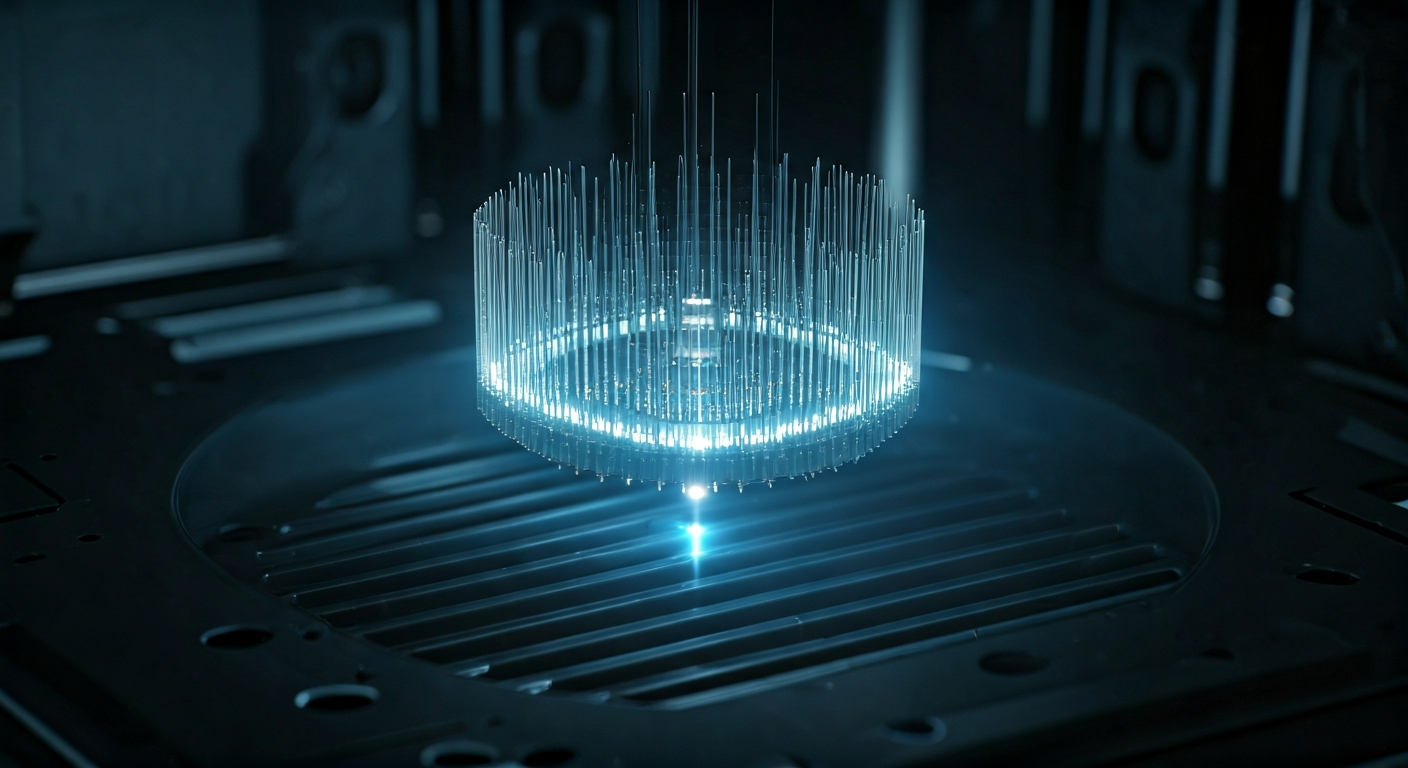
This document outlines a post-2030 manufacturing strategy for millimeter-wave (mmWave) antennas utilizing advanced nanotechnological additive manufacturing. The approach integrates novel nanomaterial feedstocks, sophisticated laser-based processes like two-photon lithography and nanoscale selective laser sintering, with high-precision piezoelectric actuation and autonomous AI-driven production lines. The goal is to enable on-demand, highly efficient, and customizable mmWave antenna fabrication.
Target Device & Specifications The target device is a millimeter-wave (mmWave) antenna operating in the 30-300 GHz frequency range. Specifications include: high gain (>10 dBi), wide bandwidth (>10% fractional bandwidth), precise beamforming capabilities, low insertion loss (<1 dB), and compact form factor suitable for integration into compact communication modules, sensors, and advanced radar systems. Materials must exhibit high conductivity and low dielectric loss at mmWave frequencies. The design will leverage complex, sub-wavelength feature geometries enabled by nanoscale additive manufacturing.
Nanomaterial Feedstocks Feedstocks will comprise advanced nanomaterials tailored for mmWave performance. This includes: 1) **High-purity metallic nanoparticles** (e.g., silver, gold, copper, graphene-metal composites) suspended in photopolymerizable resins for two-photon lithography (2PL) or as fine powders for nanoscale selective laser sintering (nSLS). 2) **Metamaterial precursors** for in-situ creation of engineered electromagnetic response structures. 3) **Low-loss dielectric nanoparticles** (e.g., specific ceramic oxides, fluoropolymers) to form substrate materials or integrated dielectric components, allowing for multi-material printing. These feedstocks will be supplied in stable, printable dispersions or as ultra-fine, uniform powders with controlled particle size distribution below 100 nm.
Nanoscale Additive & Laser Process The core fabrication will utilize a hybrid laser-based additive manufacturing approach. **Two-photon lithography (2PL)** will be employed for creating intricate, free-form dielectric structures and embedding metallic nanoparticle inks for sub-wavelength features and metamaterial elements, achieving resolutions down to 10 nm. **Femtosecond-laser direct writing (fs-LDW)** will enable direct deposition and structuring of metallic nanoparticle inks for conductive traces and antenna elements, offering high throughput for certain geometries. **Nanoscale Selective Laser Sintering (nSLS)** will be used for fabricating bulk metallic structures and complex, monolithic antenna components from metallic nanoparticle powders, achieving high density and conductivity. **Laser-induced forward transfer (LIFT)** will be integrated for precise, localized deposition of specific functional nanomaterials (e.g., conductive pastes, dielectric inks) onto pre-fabricated structures, enabling multi-material integration and repair.
Piezoelectric & Nanopositioning Integration A critical component of the manufacturing system is a high-precision, multi-axis stage system driven by **advanced piezoelectric actuators**. These actuators will provide sub-nanometer resolution and stability for both the optical scanning head and the build platform, ensuring atomic-level precision in feature placement and layer alignment. The stages will be integrated with advanced feedback mechanisms, including in-situ optical metrology (e.g., atomic force microscopy, interferometry) to monitor and correct for positional drift and surface topography in real-time, guaranteeing the fidelity of nanoscale features essential for mmWave performance.
Autonomous Production Line The manufacturing process will be managed by an **AI-driven, self-directed production line**. An AI control system will manage feedstock selection, process parameter optimization (laser power, scan speed, layer thickness), real-time process monitoring, and closed-loop feedback for error correction. Self-assembling robotic units will handle material loading, part manipulation, and inter-stage transfer. The system will incorporate self-calibration routines and predictive maintenance. AI algorithms will continuously learn from production data to optimize designs for manufacturability and performance, enabling adaptive fabrication of antenna arrays and complex integrated systems.
Key Challenges & Yield The primary challenges include: achieving consistent electrical conductivity and low loss in printed metallic nanostructures (requiring optimized sintering/annealing post-processing, potentially laser-assisted), managing thermal effects during laser processing to prevent material degradation or unwanted phase changes, ensuring uniformity and stability of nanomaterial feedstocks, and scaling the throughput of nanoscale additive processes. Yield will be significantly impacted by the fidelity of nanoscale feature replication and the absence of defects (voids, impurities). Advanced in-situ metrology and AI-driven error correction are crucial for maximizing yield. Initial yields may be moderate, but are expected to increase with system maturity.
Test & Qualification Integrated testing will be performed at multiple stages. In-situ metrology will assess dimensional accuracy and surface finish. Post-fabrication, antennas will undergo RF characterization using anechoic chambers equipped with mmWave vector network analyzers and beam scanning systems to measure gain, bandwidth, radiation pattern, and efficiency. Material properties will be verified using electron microscopy (SEM, TEM) and X-ray diffraction (XRD) on representative samples. Reliability testing will include thermal cycling and environmental exposure.
TRL & Post-2030 Roadmap This proposed manufacturing approach is currently at a TRL of 2-3. The post-2030 roadmap involves: * **2030-2035:** Development of stable, high-performance nanomaterial feedstocks and refinement of hybrid laser processes for consistent electrical properties. Demonstration of basic mmWave antenna elements. * **2035-2040:** Integration of advanced piezoelectric stages and initial AI control for autonomous process optimization and error correction. Fabrication of functional mmWave antenna arrays. * **2040-2045:** Full autonomous production line with self-assembly capabilities. Development of multi-material printing for integrated functionalities. High-volume, high-yield manufacturing of complex mmWave devices.
Applications (incl. in-situ fabrication in space/Mars) Applications span high-speed terrestrial communication (5G/6G), satellite communications, advanced radar systems, and point-to-point wireless links. Crucially, this technology enables **in-situ fabrication** for space and planetary exploration. On the Moon or Mars, with local regolith processed into basic materials and imported nanomaterial precursors, these autonomous systems could fabricate and repair critical communication antennas and sensor components directly on-site. This reduces reliance on Earth-based resupply, enabling self-sufficient bases and advanced exploratory missions. It allows for rapid prototyping and adaptation of antenna designs to specific environmental conditions or mission requirements, such as creating radiation-hardened or dust-resistant antennas.
Cross-Model Verification (GPT-3.5)
- The use of metallic nanoparticles with resolutions down to 10 nm for antenna fabrication is physically plausible with current nanotechnology advancements. - The integration of piezoelectric actuators for precise positioning and the use of AI-driven production lines are realistic and align with current trends in advanced manufacturing. - The proposed roadmap for development and integration of technologies is feasible, considering the expected advancements in materials science and additive manufacturing techniques by 2030-2045.
Overall, the dossier presents a scientifically plausible and ambitious vision for the development of mmWave antennas using advanced nanomaterials and additive manufacturing processes.
This content was produced by the news editor with AI.