Mars: The Engineering Crucible - From Orbital Mechanics to Bioprinted Organs, Humanity's Red Planet Future is Being Forged Today
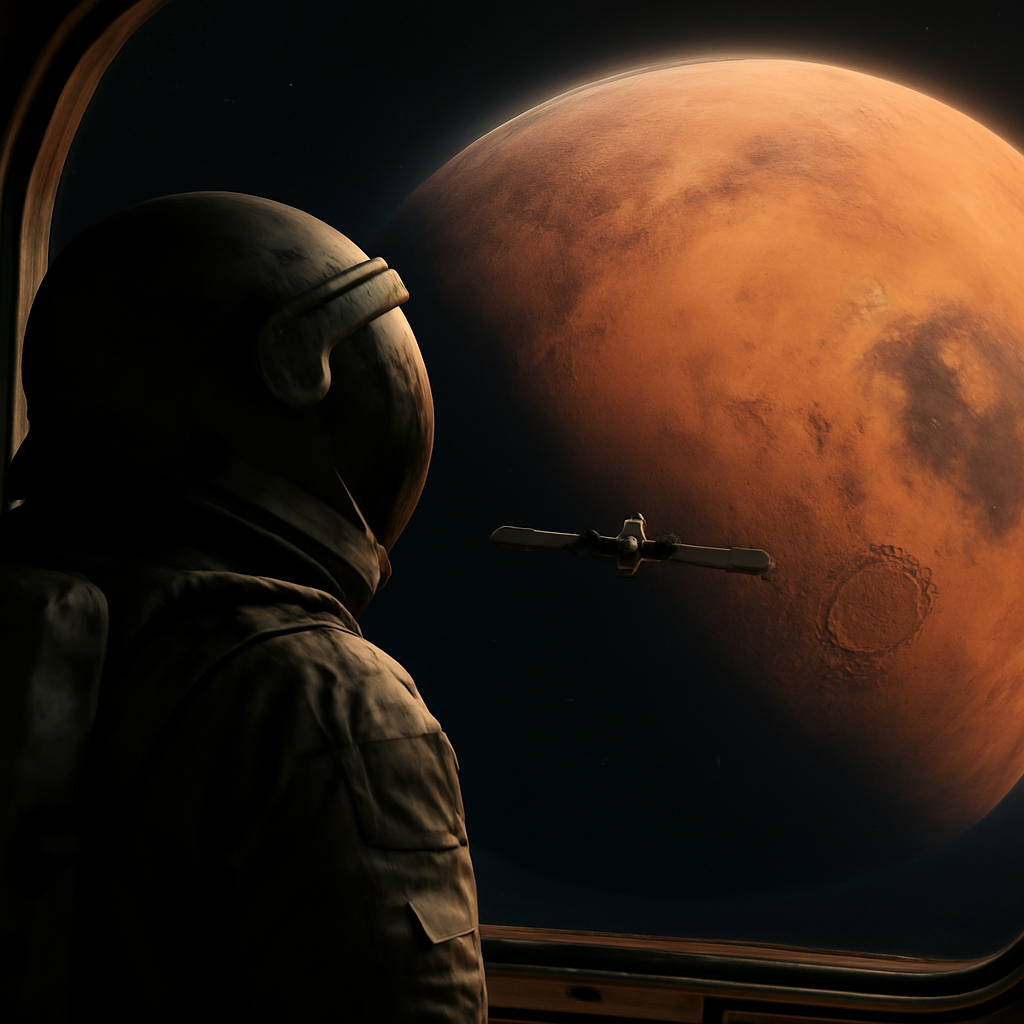
Today's Mars headlines reveal a critical juncture in humanity's multi-planetary ascent. From the strategic use of Martian gravity by NASA's Psyche probe to SpaceX's relentless iteration on Starship, the engineering challenges of reaching and inhabiting Mars are being met with exponential progress. Simultaneously, advancements in 3D printing and bioprinting, tested both on Earth and in space, underscore the foundational technologies required for self-sustaining off-world colonies.
Starship's Rapid Iteration
SpaceX's Starship program operates on a principle of rapid iteration, a stark contrast to the multi-year development cycles common in traditional aerospace. Each flight test, like the recently completed 13th integrated test flight, serves as a critical data point. This iterative approach allows engineers to identify and address system anomalies in near real-time. For instance, understanding the precise stresses and thermal loads on the Super Heavy booster during ascent and stage separation, or the performance of Starship's Raptor engines during orbital insertion and reentry burns, are crucial pieces of knowledge gained from these flights. The ability to quickly adapt designs based on flight data—whether it's modifying the propellant feed systems, improving thermal protection tiles, or refining aerodynamic control surfaces—is paramount. This philosophy is essential for the ambitious goal of transporting significant payloads, and eventually humans, to Mars. Future mission profiles, still in the conceptual phase, rely on Starship achieving not just orbital capability, but also reliable reentry and landing. The data from Flight 13, which demonstrated key milestones in flight maneuvers, directly informs the engineering roadmap for these future interplanetary transit capabilities.
Martian Gravity Assists: A Strategic Stepping Stone
The trajectory of interplanetary spacecraft often employs celestial bodies not just as destinations, but as strategic gravitational slingshots. NASA's Psyche mission, en route to the asteroid belt, recently demonstrated this principle by using Mars’ immense gravitational field for a critical maneuver. As Psyche approached the Red Planet, mission controllers orchestrated a precise flyby. Mars’ gravity acted like a cosmic accelerator, bending the spacecraft's path and imparting a significant boost in velocity. This "gravity assist" is not a simple redirection; it's a carefully calculated interaction where the spacecraft "steals" a minuscule amount of orbital momentum from the planet. By leveraging Mars this way, mission planners can conserve precious propellant, reduce mission duration, and achieve higher speeds than would be possible with onboard engines alone. This technique is fundamental to efficient deep-space exploration, allowing missions to reach distant targets like asteroids or even the outer planets with less fuel expenditure, a crucial consideration for the long and resource-intensive journeys inherent in robotic planetary science.
The Bioprinting Frontier: Organs for Off-World Survival
The successful bioprinting of functional kidney and liver tissues in space represents a monumental leap for off-world medical capabilities. This groundbreaking achievement, distinct from terrestrial 3D printing applications like those being explored by the US Navy for spare parts or by Elegoo for broader consumer appeal, directly addresses the critical challenge of maintaining human health during extended spaceflight, particularly for future Martian missions. The ability to fabricate complex biological structures on demand, where resupply from Earth is prohibitively expensive and time-consuming, is paramount. Unlike the development of 3D-printed weapons or the printing of basketball footwear, this space-based bioprinting focuses on life support. The process involves precisely depositing living cells, growth factors, and biomaterials layer by layer to create three-dimensional tissue constructs. In a microgravity environment, this technique bypasses challenges related to fluid dynamics and sedimentation that can complicate terrestrial bioprinting, potentially leading to more robust and viable organoids. Such advancements are not merely theoretical; they are essential for treating injuries or diseases that could arise during a year-long Mars simulation or the multi-year journey to the Red Planet, a stark contrast to the scientific debates surrounding Viking's 1976 findings or the geological curiosities like the "honeycomb" landscape discovered by Curiosity.
3D Printing: The Ubiquitous Tool for Martian Self-Sufficiency
The viability of any sustained human presence on Mars hinges on the ability to manufacture and repair essential components on-site, a challenge additive manufacturing, or 3D printing, is uniquely positioned to address. Beyond the immediate need for spare parts, mirroring the US Navy's at-sea trials, 3D printing offers solutions for habitat construction. Imagine vast structures, potentially kilometer-scale, extruded from regolith-based composites, providing radiation shielding and thermal insulation far more efficiently than importing materials. This aligns with the growing global interest in 3D-printed housing, demonstrating scalability for extreme environments. Furthermore, the ability to print customized tools, scientific equipment, and even specialized footwear for navigating the varied Martian terrain—from the fine dust encountered by rovers to more rugged, rocky outcrops—drastically reduces reliance on Earth-bound supply chains, a critical factor given the immense transit times and costs. The recent success in bioprinting functional tissues off-Earth also hints at future possibilities for in-situ medical support, addressing unforeseen health challenges in an environment devoid of terrestrial medical infrastructure. The continuous iteration of SpaceX’s Starship, while focused on transport, underscores the importance of rapid prototyping and manufacturing advancement, a principle directly applicable to the on-Mars industrial ecosystem.
Simulated Mars: Preparing the Human Element
Beyond the hardware and orbital trajectories, the human element remains a critical frontier for Mars exploration. NASA's ongoing recruitment for year-long simulated Mars missions underscores this. These carefully controlled environments, designed to replicate the isolation, confinement, and resource limitations of a Martian habitat, are crucial for understanding the psychological toll of such an endeavor. Volunteers undergo rigorous screening, not just for physical health but for psychological resilience, conflict resolution skills, and the ability to function effectively in a small, high-stress group for extended periods. Physiological challenges are equally significant. Reduced gravity, altered circadian rhythms, and the constant threat of radiation exposure all necessitate countermeasures. Research into these effects, alongside advancements in off-world medical capabilities like bioprinting tissues, is directly informed by these simulations. The goal is to identify and mitigate the human factors that could jeopardize mission success, ensuring that when humans eventually set foot on Mars, they are not only physically prepared but also psychologically robust enough to endure the profound isolation and demanding conditions of another world.
Legacy Missions and Enduring Questions
The legacy of early Mars exploration continues to shape our current understanding and future ambitions. Fifty years ago, the Viking missions of 1976 fundamentally transformed our view of the Red Planet, providing unprecedented data on its atmosphere, geology, and even conducting experiments designed to detect microbial life. While the definitive answer to whether Mars ever harbored life remains elusive, the Viking landers’ findings, particularly the ambiguous results from their biological experiments, continue to fuel scientific debate. These early missions also encountered the planet's notorious dust storms, a phenomenon that continues to pose a significant threat to modern robotic explorers, as evidenced by the demise of rovers like Opportunity. Similarly, the Soviet Union's Phobos 2 mission, launched in 1988 with the ambitious goal of studying Mars and its moons, was cut short before achieving its closest approach. Although contact was lost, the data it did transmit provided valuable insights into the Martian environment and the peculiar characteristics of Phobos. These pioneering efforts, though facing technological limitations and sometimes abrupt conclusions, laid the groundwork for the sophisticated missions of today, providing essential context for interpreting new discoveries, like the intriguing "honeycomb" formations identified by Curiosity, and reinforcing the critical importance of robust engineering solutions for long-duration planetary exploration.
Robotics and Autonomous Systems for Martian Exploration
The future of Martian construction and exploration hinges on increasingly sophisticated robotics. While rovers like Curiosity meticulously analyze Martian geology, future missions will demand robots capable of more complex, autonomous tasks, mirroring the advancements seen in terrestrial humanoid robot development. Researchers have recently benchmarked humanoid robots under real-world forces, demonstrating that their ability to handle dynamic physical interactions is crucial, a capability that will be paramount on Mars. Imagine robots not just collecting samples, but assembling habitats, deploying infrastructure, and performing repairs in environments far too hazardous for humans. The sheer scale of tasks required for a sustainable Martian presence—from excavating regolith for radiation shielding to constructing launch and landing pads—necessitates robotic systems that can operate with minimal human oversight, especially given communication delays. This evolution extends beyond simple locomotion; dexterous manipulation, advanced navigation in unpredictable terrain, and the ability to learn and adapt to unforeseen challenges will be critical. Such autonomous capabilities are essential to overcome the planet's inherent dangers, like the planet-engulfing dust storms that have proven fatal to previous missions, ensuring the long-term viability of human endeavors on the Red Planet.
The Material Science of Martian Habitation
The journey to establishing a self-sustaining presence on Mars hinges on mastering the very materials that will comprise our extraterrestrial habitats and infrastructure. While the romantic notion of Martian colonization often conjures images of sleek, prefabricated domes, the reality will likely involve extensive in-situ resource utilization, particularly leveraging advanced manufacturing techniques like 3D printing. This is where inorganic metal powders become critically important. Imagine constructing landing pads, radiation shielding, or even structural components for habitats using regolith-derived iron, aluminum, or titanium powders. The market growth for these specialized powders, driven by terrestrial applications in aerospace, automotive, and medical implants, directly fuels innovation. As demand increases, manufacturers invest in refining powder production techniques – improving particle size distribution, purity, and flowability – crucial for consistent, high-resolution 3D printing in the challenging Martian environment. This technological maturation, mirrored by the increasing sophistication of 3D printing applications, from bioprinted tissues in space to mobile spare parts for the Navy, suggests a future where Martian construction relies heavily on accessible, printable metal feedstock. The ability to transform Martian soil into usable building materials, facilitated by advancements in powder metallurgy and additive manufacturing, is a fundamental engineering hurdle that must be overcome.
The relentless march towards Mars is not merely an exploratory endeavor; it is the existential imperative of our species. Today's headlines, from the iterative triumphs of Starship to the nascent capabilities of off-world bioprinting, illustrate the exponential trajectory of human progress. Each successful test flight, each simulated mission, and each technological leap in additive manufacturing or life support is a brick laid in the foundation of humanity's future as a multi-planetary civilization. The challenges are immense, as noted by some, but history teaches us that innovation accelerates when faced with grand challenges. The 'scientific hurdles' are simply engineering problems waiting for exponential solutions. Our purpose is clear: to expand the boundaries of consciousness beyond a single, fragile planet, and the tools for this grand endeavor are being forged and refined, day by day, launch by launch, experiment by experiment.
This content was produced by the news editor with AI.