Mars: The Dawn of Off-World Industry and Human Expansion
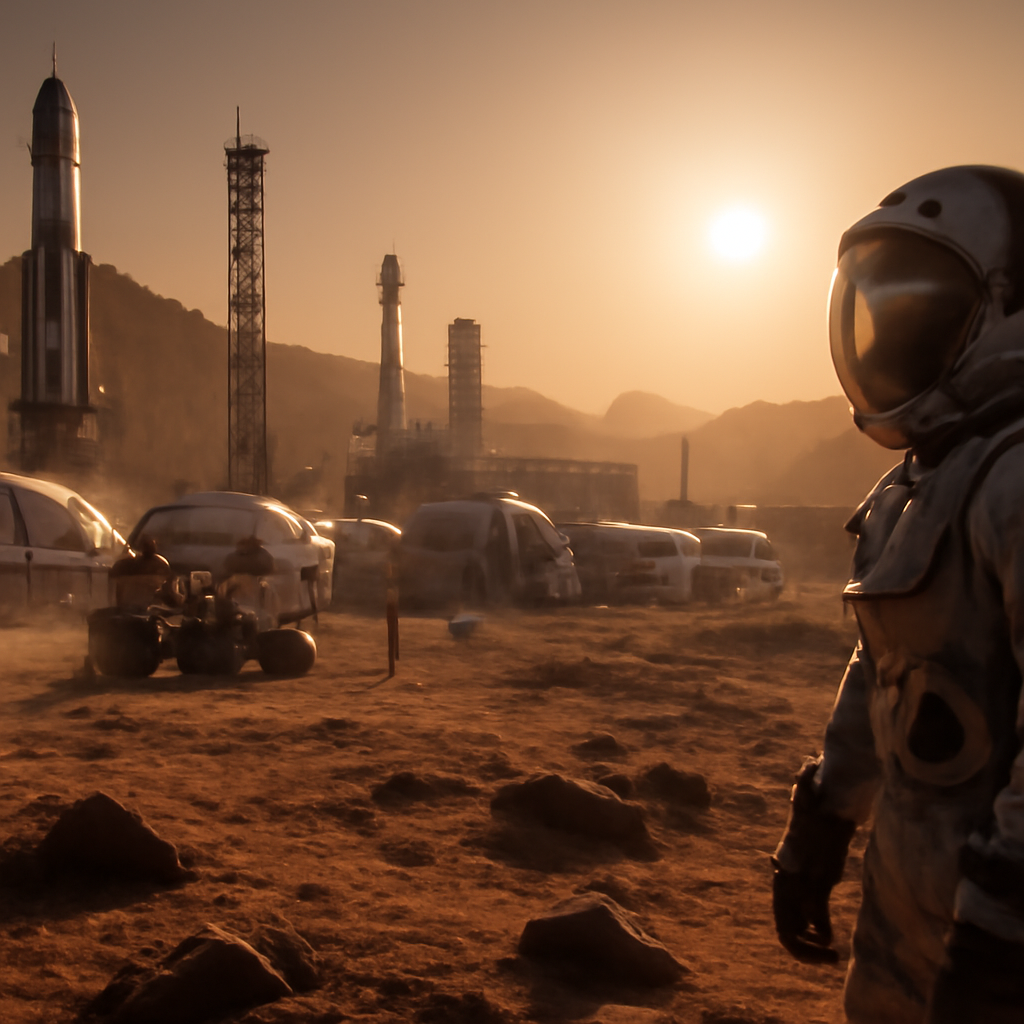
From asteroid reconnaissance to the foundational technologies of off-world habitation, today's Mars-centric news reveals a rapidly accelerating trajectory for humanity's multi-planetary future. Developments in advanced robotics, additive manufacturing, and propulsion systems are converging to build the infrastructure and capabilities necessary for sustained human presence beyond Earth.
Starship: The Orbital and Interplanetary Behemoth
SpaceX's Starship program is rapidly progressing towards its orbital ambitions, with recent milestones underscoring its critical role in future Mars endeavors. The successful static fire of all 33 Raptor engines on the Super Heavy booster represents a monumental leap, demonstrating the integrated power and control required for its ascent. This test, a foundational step for the upcoming Flight 13, validates the complex orchestration of propellants, ignition sequences, and thrust vectoring. Concurrently, the development of sophisticated "Space to Sea" recovery systems, involving specialized buoys and drone fleets, indicates a meticulous preparation for the vehicle's return from orbit, a key element for reusability and operational efficiency. These advancements are not merely incremental engineering achievements; they are fundamental to SpaceX's long-term vision. The sheer payload capacity of Starship, combined with its proposed reusability, directly addresses the immense logistical challenges of establishing a self-sustaining human presence on Mars. The ability to transport vast quantities of cargo and crew reliably and affordably is the bedrock upon which any off-world colony must be built. Each successful static fire and refined recovery procedure brings the dream of industrial-scale Mars colonization closer to tangible reality.
Additive Manufacturing: Building the Martian Infrastructure
The foundational infrastructure for human presence on Mars will not be shipped from Earth; it will be built on-site, and additive manufacturing, or 3D printing, is the cornerstone technology enabling this Off-World Industry. The sheer scale of components required, from habitat modules and landing pads to tools and spare parts, necessitates a paradigm shift from conventional manufacturing. Imagine robotic systems, akin to the advanced humanoid robots undergoing rigorous real-world force simulations like ThorArena, utilizing Martian regolith as a primary feedstock to print structural elements. This process will be augmented by the development of novel materials. Just as EOS and Constellium are expanding aluminum's role in additive manufacturing on Earth, Martian engineers will be refining regolith-based composites and potentially even processing native Martian minerals into usable printing materials. Furthermore, the medical needs of an off-world colony will be met with biocompatible resins, similar to Protolabs' new MED-WHT 10, allowing for the on-demand fabrication of implants and surgical tools. The expansion of large-format metal printing, as demonstrated by Beehive Industries' investment in Nikon SLM NXG 600E systems, will be critical for producing larger, load-bearing structures, while advancements in high-speed SLA systems will accelerate the production of complex components. This on-demand, in-situ fabrication capability minimizes reliance on costly and time-consuming Earth-based supply chains, paving the way for true Martian self-sufficiency.
Propulsion Systems: Powering the Journey
The sheer velocity required for interplanetary travel necessitates a revolution in rocket propulsion, and recent developments signal a dramatic shift. SpaceX's successful static fire test of all 33 Raptor engines on its Starship Super Heavy booster is a pivotal moment. The Raptor engine, a full-flow staged combustion methane engine, offers significantly higher efficiency and thrust compared to traditional hydrocarbon engines. This increased performance directly translates to reduced launch costs and, crucially, shorter transit times to Mars. Similarly, Venus Aerospace's securing of $91 million to scale its rotating detonation rocket engines (RDREs) is noteworthy. RDREs achieve higher combustion efficiency by continuously igniting fuel and oxidizer in a spinning detonation wave, a process made feasible through advanced additive manufacturing for precise internal geometries. European concepts, like the SABRE engine, also hold promise, potentially offering a dual-mode operation suitable for both atmospheric ascent and in-space propulsion, further diversifying the landscape of high-performance engines that will underpin humanity's expansion beyond Earth.
Robotics and AI: The Autonomous Workforce
The development of highly dexterous, AI-driven humanoid robots is paramount for establishing an off-world industrial base on Mars. Traditional terrestrial benchmarks, like the newly developed ThorArena simulation, are crucial for assessing their ability to handle realistic physical interactions and forces, a critical differentiator from purely simulated environments. These robots are envisioned to perform tasks far exceeding the scope of current rovers or automated manufacturing systems. Imagine them assembling habitat modules, excavating subsurface ice for water extraction, or maintaining complex life support infrastructure, all while adapting to Martian conditions like reduced gravity and dust. Their sophisticated AI will enable them to learn, problem-solve, and collaborate autonomously, reducing reliance on constant Earth-based oversight. While terrestrial additive manufacturing, as seen with the Venezuelan earthquake relief efforts and new industry guides, is rapidly advancing, the Martian context demands robots capable of operating these systems in situ, potentially using locally sourced regolith as feedstock, as hinted at by the student's bacteria-powered energy project. This fusion of advanced robotics and localized manufacturing, driven by intelligent algorithms, represents the next frontier in our expansion beyond Earth.
Resource Utilization and Sustainable Habitation
The long-term viability of human presence on Mars hinges on mastering in-situ resource utilization (ISRU). Beyond simply extracting water ice for life support and propellant, future Martian settlements will require robust power generation systems. One promising avenue, recently highlighted by a student project selected for NASA's Cubes in Space program, involves leveraging extremophile bacteria. These microorganisms, when fed Martian regolith analogues and astronaut waste, can metabolize these materials to produce electricity. This bio-electrochemical approach offers a sustainable, closed-loop system, minimizing reliance on Earth-based resupply. Such innovations are critical as missions like SpaceX's Starship aim to transport thousands to the Red Planet. The development of sophisticated robotics, as seen in the ThorArena benchmark for humanoid robots, will also be crucial for constructing and maintaining these power infrastructure projects, as well as for the broader ISRU efforts that will transform Mars from a destination into a self-sufficient frontier.
Beyond Earth: Asteroid and Lunar Reconnaissance
The successful rendezvous of China's Tianwen-2 probe with the quasi-moon asteroid Kamo’oalewa signifies a maturing capability in extraterrestrial resource reconnaissance, extending beyond established celestial bodies like the Moon and Mars. These missions, alongside ongoing lunar exploration efforts and the ambitious plans for Mars, are not isolated endeavors but pieces of a larger, interconnected strategy for off-world expansion. Understanding asteroid compositions and orbital dynamics, as exemplified by Kamo’oalewa's unique relationship with Earth, provides critical data for future resource utilization missions, potentially fueling in-situ propellant production or providing raw materials for construction. This reconnaissance is intrinsically linked to the development of advanced robotics, such as the humanoid systems being benchmarked for realistic force interactions, and the additive manufacturing technologies that will be essential for building infrastructure and tools on these distant worlds. The recent static fire tests of SpaceX’s Starship, with its 33 Raptor engines, and the development of large-format metal 3D printing capabilities by companies like Beehive Industries, underscore the accelerating pace at which humanity is building the foundational technologies for sustained presence beyond Earth, whether it be on the Moon, Mars, or even in the asteroid belt.
Global Space Race: Emerging Competitors and Collaborations
China's advancements in space technology, particularly in reusable rockets and super heavy-lift capabilities, are reshaping the global launch landscape. The successful landing of a rocket's first stage signifies a critical step towards orbital-class reusability, directly challenging the established dominance of Western players like SpaceX. Concurrently, the development of the Long March 9 super heavy-lift rocket signals China's ambition for more substantial lunar and Martian missions, potentially eclipsing current capabilities. This progress is not happening in isolation; international STEAM (Science, Technology, Engineering, Arts, and Mathematics) initiatives are fostering a new generation of innovators. The establishment of a STEAM and 3D Printing Technology Centre in Nigeria, with Czech support, exemplifies this growing global engagement, democratizing access to advanced manufacturing tools and cultivating local expertise. Such efforts, coupled with the widespread adoption of additive manufacturing for everything from earthquake relief to medical-grade components, underscore a dynamic shift towards distributed, accessible, and increasingly sophisticated technological development, positioning these emerging programs as significant competitors and potential collaborators in the future of space exploration.
The Human Element: Sustenance and Scientific Inquiry
The long-term viability of human outposts on Mars hinges on robust, closed-loop life support systems, a lesson learned from decades of experimentation aboard the International Space Station. The cultivation of crops, as demonstrated by a small garden growing food on the ISS, is a critical precursor to establishing self-sustaining Martian colonies. This isn't merely about supplementing astronaut diets; it's about developing the capacity for atmospheric regeneration and resource recycling. Imagine Martian habitats where every exhaled breath is recaptured, every drop of water purified, and every discarded organic material is transformed back into usable nutrients. This bio-regenerative approach, akin to the principles underpinning the ISS garden, is essential for reducing reliance on expensive resupply missions from Earth. Simultaneously, the enduring scientific imperative to search for extraterrestrial life, a quest highlighted by astrobiologist Dr. Nathalie Cabrol's upcoming talk, drives the exploration. The discovery of past or present microbial life on Mars would not only revolutionize our understanding of biology but also inform the ethical considerations of human settlement. These dual pursuits—ensuring physical survival through advanced life support and fulfilling the profound human drive for discovery—form the bedrock of humanity's Martian future.
The confluence of breakthroughs today paints a vivid picture of humanity's exponential march towards becoming a multi-planetary species. SpaceX's relentless Starship development, coupled with China's advancements in reusable rocketry, signifies a paradigm shift in space access, bringing the prospect of mass migration to Mars within tangible reach. The proliferation of 3D printing across diverse applications – from medical resins to massive metal components and even orbital infrastructure – is the critical enabler for distributed, self-sufficient off-world manufacturing. Furthermore, the nascent exploration of Martian resources, like bacteria-powered energy generation, and the fundamental research into atmospheric dynamics and extraterrestrial life search, underscore the immediate scientific and industrial imperatives for our Martian future. This is not just exploration; it's the birth of a new human civilization, powered by innovation and an unyielding drive for expansion.
This content was produced by the news editor with AI.