Mars: The Blueprint for Humanity's Off-World Future
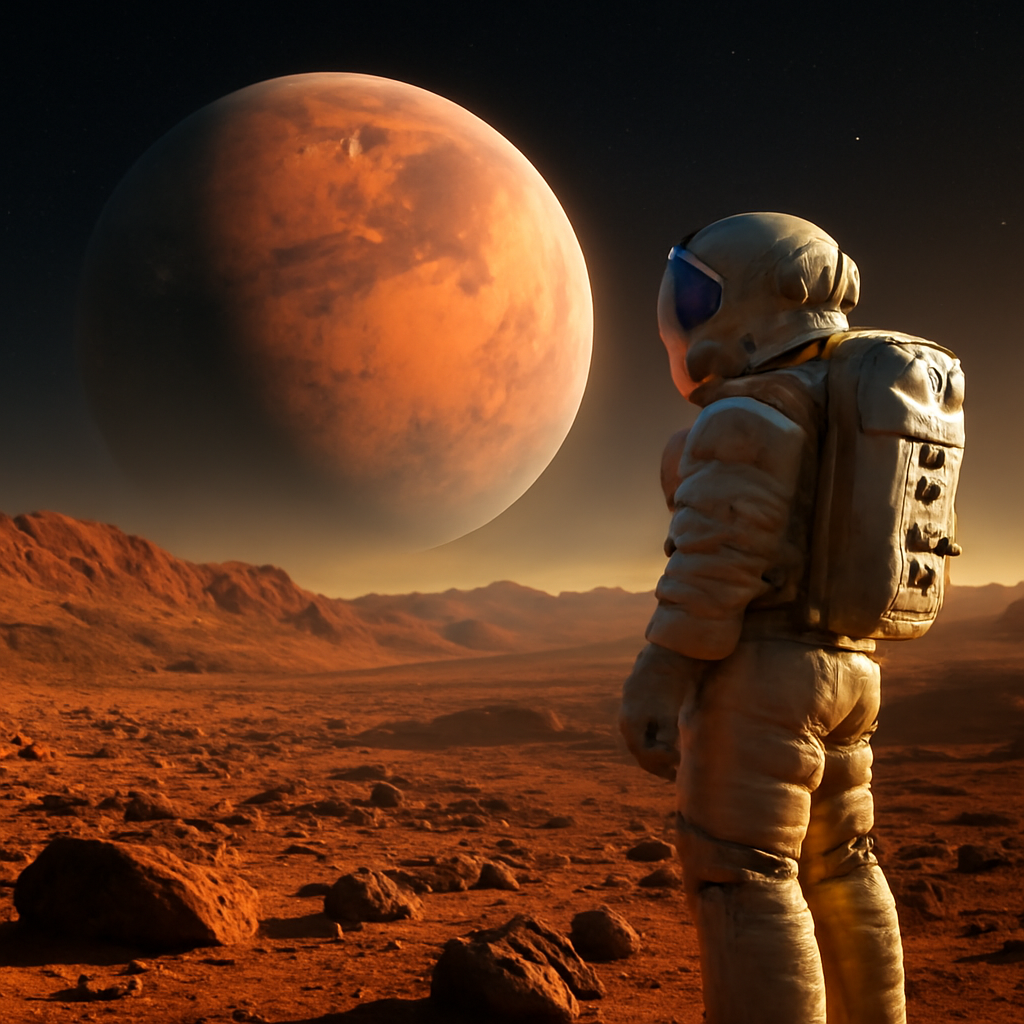
As we map Mars with unprecedented detail and simulate long-duration missions, the foundations for becoming a multi-planetary species are solidifying. This edition delves into the critical technological and human factors shaping our Martian destiny, from advanced manufacturing to resilient crewed exploration.
Beyond Earth's Oceans: Martian Cartography Ascendant
The current state of Mars mapping significantly outstrips our knowledge of Earth's abyssal plains, a testament to the focused, high-resolution orbital surveys conducted by robotic missions. While less than 30% of our own planet's ocean floor has been charted with any meaningful detail, Mars has been systematically mapped to a resolution where individual rocks and small geological features are discernible. This is primarily achieved through instruments like the High Resolution Imaging Science Experiment (HiRISE) on the Mars Reconnaissance Orbiter, which can capture images with a ground resolution as fine as 25 centimeters per pixel. These instruments operate in visible and near-infrared wavelengths, allowing for precise topographical mapping and mineralogical analysis from orbit. The data, often collected in swaths and stitched together, creates detailed digital elevation models and orthorectified imagery. This level of detail is crucial for selecting landing sites for future missions, identifying potential resources, and understanding the planet's geological evolution. The disparity underscores the advantages of remote, systematic planetary surveying, unhindered by the immense pressures and logistical complexities of sub-aquatic exploration on Earth.
Simulating the Red Frontier: Human Factors for Martian Habitation
NASA's commitment to simulating the rigors of Mars exploration is underscored by its ongoing recruitment for year-long missions, such as the one described in the news. These meticulously designed analog environments are not simply about replicating the Martian landscape, but critically, about understanding the human element. Participants are subjected to isolation, confinement, and the psychological stresses inherent in prolonged deep-space travel, mirroring conditions astronauts would face far from Earth. Researchers meticulously monitor crew health, not only for physiological changes like bone density loss and muscle atrophy, but also for cognitive function, mood fluctuations, and interpersonal dynamics. This data is crucial for developing countermeasures, optimizing crew selection criteria, and designing habitats that promote psychological well-being and sustained performance. Understanding these human factors is as vital as mastering the engineering challenges of spacecraft and life support; without a resilient and effective crew, the most advanced technology would be rendered useless on the Red Planet.
From Earthly Waste to Martian Foundations: Advanced Construction Materials
The construction of habitats on Mars will necessitate innovative material sourcing and fabrication techniques, moving beyond the reliance on Earth-based supplies. One promising avenue involves adapting technologies like the winged composite pile system, recently developed to leverage surplus soil for enhanced foundation stability. On Earth, this system integrates excavated soil with binders to create robust structural elements. For Mars, the abundant regolith, rich in iron oxides and silicates, could serve as the primary aggregate. This regolith, potentially processed to remove perchlorates and achieve optimal particle size distribution, could then be mixed with a binder. This binder might be a polymer synthesized from captured atmospheric CO2 and water ice, or even a locally sourced mineral cement. The "wings" of the pile system would provide increased surface area, crucial for anchoring structures in the less dense Martian soil and mitigating risks associated with seismic activity, though less pronounced than on Earth, still a consideration for long-term stability. Furthermore, additive manufacturing, a rapidly advancing field with new materials like GRCop-42 copper alloy for propulsion systems and techniques for multi-material printing, offers a scalable method to fabricate these complex wing geometries and integrate them with other structural components, effectively turning Martian soil into the bedrock of off-world colonization.
The Brains of the Operation: Neuromorphic Computing for Martian Autonomy
The development of robust, autonomous systems capable of operating on Mars hinges on a new generation of computing. Researchers are making significant strides in neuromorphic computing, particularly with oxide-based chips that mimic the brain's architecture. Unlike conventional computers that separate processing and memory, these novel devices integrate both functions at the atomic level. This is achieved through specialized oxide interfaces that can store and process information simultaneously, mirroring the behavior of biological synapses. This integration drastically reduces the energy and time required for computations, a critical factor when data must travel millions of miles. For a Mars rover or a future habitat, this translates to near-instantaneous decision-making without constant reliance on Earth. Imagine a rover analyzing geological samples, identifying potential biosignatures, and adjusting its exploration path in real-time, all without waiting for commands from mission control. This level of on-planet intelligence is essential given the communication lag and the need for systems that can adapt to unforeseen circumstances in the harsh Martian environment, where even basic mapping of the planet's surface still presents significant challenges compared to our own deep oceans.
Crafting the Martian Toolkit: 3D Printing for Extraterrestrial Manufacturing
The Martian environment demands a robust, adaptable manufacturing capability, and 3D printing stands as a cornerstone technology for establishing this extraterrestrial industrial base. The recent introduction of specialized metal powders like Sandvik's Osprey GRCop-42, engineered for high-temperature applications such as space propulsion components, directly addresses the critical need for materials that can withstand the extreme conditions of spaceflight and Martian surface operations. Understanding the granular behavior of these powders, as highlighted by ongoing research into powder characteristics for additive manufacturing success, is paramount to ensuring the reliability and structural integrity of printed parts. Furthermore, advancements in automation, exemplified by companies like Grenzebach streamlining metal 3D printing workflows from powder handling to quality assurance, will be crucial for scaling production on Mars. This level of automation, coupled with the potential for on-demand fabrication of everything from habitat components to spare parts, significantly reduces the logistical burden of resupply missions. The development of more sophisticated multi-material printing techniques and integrated systems, akin to the oxide-based chips merging processing and memory, hints at future Martian manufacturing hubs capable of producing complex, functional assemblies rather than just discrete components. This iterative approach to developing and qualifying hardware, as seen in NASA's work on flight-ready rocket parts, will be essential for building a self-sufficient Martian presence.
Unlocking Martian Secrets: Mineralogy and the Search for Ancient Life
The recent discovery of a novel mineral within a Martian meteorite has significantly advanced our understanding of the Red Planet's complex geological past. This previously unknown compound, identified through meticulous analysis, provides a unique geochemical fingerprint, offering direct evidence of specific subsurface processes and environmental conditions that existed billions of years ago. Scientists are particularly interested in the mineral's formation temperature and pressure requirements, which can be used to reconstruct the thermal and pressure gradients within ancient Martian crust. This information is crucial for refining models of planetary differentiation and volcanic activity, painting a more detailed picture of how Mars evolved from a potentially habitable world to the arid planet we see today. Furthermore, the mineral's chemical composition may hold clues about the presence of certain elements essential for life as we know it, reigniting debate about the potential for ancient microbial ecosystems. Its discovery underscores the value of extraterrestrial sample analysis, complementing the high-resolution orbital mapping data that now surpasses even our most detailed terrestrial ocean floor surveys, and reinforces the scientific imperative for continued exploration and sample return missions.
High-Speed Data for Deep Space: Cryogenic Lasers and Sensor Technology
The sheer volume of data required for comprehensive Martian exploration necessitates advanced communication technologies. Researchers are developing cryogenic vertical-cavity surface-emitting lasers (cryo-VCSELs) that operate at near-absolute zero temperatures. This extreme cold drastically reduces thermal noise, allowing these lasers to transmit data at an astonishing 138 gigabits per second per lane. This high-speed capability is crucial for relaying complex sensor data, such as high-resolution topographical maps of Mars, which already surpass the detail of most of Earth's ocean floor. Furthermore, these cryo-VCSELs are being integrated with novel oxide-based chip elements designed for neuromorphic computing. This fusion merges processing and memory functions on a single chip, mimicking the efficiency of biological synapses. Such integrated systems are vital for onboard data analysis, enabling autonomous decision-making and reducing the bandwidth demands on Earth-bound communication channels. The minimal heat generation from cryo-VCSELs also means less power consumption and simplified thermal management for sensitive scientific instruments operating in the harsh Martian environment.
The Artemis-Tianwen Nexus: Interplanetary Exploration and Sample Return
The burgeoning field of asteroid exploration, exemplified by China's Tianwen-2 mission successfully reaching near-Earth asteroid Kamoʻoalewa and transmitting its first images, underscores a broader interplanetary strategy that directly informs our long-term aspirations on Mars. While Tianwen-2's immediate goal is sample return, its sophisticated remote sensing and navigation capabilities are precisely the technologies that will be essential for resource prospecting on the Red Planet. The detailed mapping of Mars, surpassing even our knowledge of Earth's ocean floor, provides a foundational dataset, but future Martian endeavors will necessitate in-situ resource utilization (ISRU). This means leveraging materials found on Mars, perhaps through advanced additive manufacturing techniques – a field rapidly evolving with innovations in powder handling, multi-material printing, and specialized alloys like Sandvik's GRCop-42 for propulsion systems. The development of oxide-based chips for neuromorphic computing hints at future Martian habitats with integrated, brain-like processing, while wing-like soil utilization systems for structural integrity echo the need for robust, self-sufficient construction methods on a planet lacking readily available terrestrial materials. These parallel advancements in extraterrestrial sample acquisition and in-situ manufacturing create a synergistic approach, where lessons learned from asteroid missions can accelerate the blueprint for sustainable human presence on Mars.
Today's Mars-centric developments underscore humanity's inexorable march towards becoming a multi-planetary civilization. The ability to map Mars in higher resolution than Earth's ocean floor signifies our commitment to understanding and inhabiting new worlds. Simultaneously, advancements in additive manufacturing, neuromorphic computing, and simulated long-duration missions directly address the core challenges of off-world existence. These are not mere scientific curiosities; they are the building blocks of a future where humanity's survival and progress are no longer tethered to a single planet. The ongoing simulations, the development of novel materials for propulsion, and the exploration of unique Martian geology all contribute to a holistic strategy for establishing a self-sustaining presence, accelerating our evolutionary trajectory into the cosmos.
This content was produced by the news editor with AI.