Mars: The Blueprint for Humanity's Cosmic Future
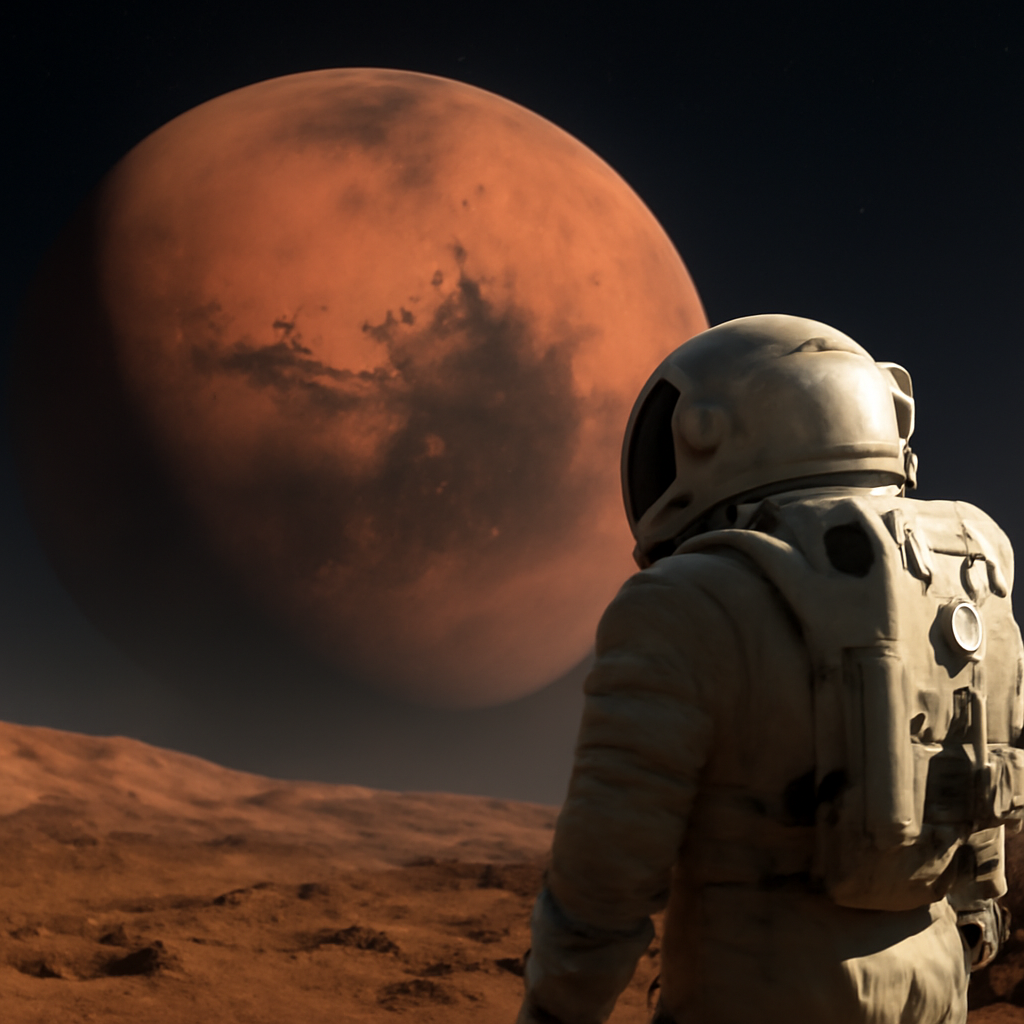
From orbiting glimpses of exotic Martian geology to the foundational engineering breakthroughs powering terrestrial advancements, today's Mars news paints a vivid picture of humanity's accelerating journey towards becoming a multi-planetary species. We explore the cutting edge of robotic exploration, the critical infrastructure being developed for off-world habitation, and the fundamental scientific inquiries that will guide our expansion.
Martian Cartography: New Eyes on the Red Planet
The recent coordinated imaging efforts by NASA’s Psyche spacecraft and ESA’s Mars Express orbiter are revolutionizing our understanding of Martian topography and its dynamic geological processes. Psyche, during its gravity-assist flyby, captured an expanding Martian crescent, a perspective shift that allows for a broader contextual view of the planet's illumination patterns. More significantly, Mars Express has provided detailed imagery of unusual dunes exhibiting a metallic sheen. This phenomenon is not merely an aesthetic curiosity; it suggests a unique mineralogical composition, potentially rich in iron or other metallic elements, that warrants further investigation through spectral analysis. The ability to calibrate instruments between these two spacecraft, as demonstrated by their coordinated views, enhances the reliability and accuracy of the data collected, paving the way for more precise mapping. This continuous stream of high-resolution imagery, building upon the legacy of early surface photos from Viking 1, is crucial for identifying resources, understanding past and present climate conditions, and ultimately, for laying the groundwork for future human settlements by providing an unprecedentedly detailed cartographic blueprint of the Red Planet.
The Martian Foundation: Building Blocks for Tomorrow
The prospect of establishing a permanent human presence on Mars hinges on our ability to construct robust habitats and infrastructure using local resources, a challenge directly addressed by advancements in additive manufacturing. Recent research, such as MIT's optimization of concrete 3D printing, highlights a critical shift: the primary bottleneck for creating lighter, more efficient structures is no longer solely material properties, but the physical limitations of the printing hardware itself. This understanding is crucial for Martian construction, where raw materials like regolith, rich in silicates and iron oxides, will likely form the basis of our building compounds. Developing printing systems that can precisely deposit and cure these materials, adapting to Martian atmospheric pressure and temperature variations, is paramount. Innovations in concrete mixtures, potentially incorporating Martian basalt fibers for reinforcement or binding agents derived from local mineralogy, are actively being explored. Similarly, the development of robotic printing arms, capable of navigating the Martian terrain and operating autonomously or semi-autonomously, is essential. The success of missions like NASA's Psyche, which has captured detailed geological imagery, and ESA's Mars Express, which has identified unusual dune compositions, provides valuable data for identifying suitable construction sites and potential material sources, paving the way for a self-sustaining Martian foundation.
Robotics: The Vanguard of Exploration and Construction
The advancement of Martian exploration hinges on increasingly sophisticated robotic systems. Recent innovations in additive manufacturing, like MIT's optimized concrete 3D printing and EPFL's tough, fatigue-resistant elastomer, directly translate to building robust Martian infrastructure. Imagine structures printed *in situ* using regolith, a concept made feasible by advanced 3D printing techniques that account for physical constraints, much like the development of lighter aircraft towers using WASP printers. Moreover, the development of novel robotic manipulators, such as the gravity-assisted gripper that switches tools with a single motor, represents a leap in dexterity. This is crucial for assembling complex structures or performing intricate repairs in the harsh Martian environment. Autonomous locomotion is also evolving, with robots learning animal-like gaits for navigating challenging terrains, a capability demonstrated by a four-legged robot capable of switching between walking, running, and jumping. These advancements move beyond the static imaging of Mars by missions like Psyche and Mars Express, paving the way for robots that can actively construct, repair, and explore with unprecedented autonomy, echoing the foundational work of early explorers like Viking 1.
In-Situ Resource Utilization (ISRU) Innovations
The prospect of sustained human presence on Mars hinges on our ability to live off the land, a principle known as In-Situ Resource Utilization (ISRU). Recent advancements in materials science and manufacturing, such as Georgia Tech's work in transforming pulp mill byproducts into valuable materials, offer tantalizing blueprints for this future. Imagine Martian regolith, abundant and readily available, being combined with processed local materials to form structural components. This parallels innovations in 3D printing concrete for construction, where hardware constraints, not just material properties, dictate design feasibility, as explored by MIT researchers. Furthermore, the development of advanced 4D printing techniques for composite materials, capable of creating complex shapes from simpler molds, could enable the construction of habitats or even wind turbines for power generation using local Martian resources. The challenges are immense, as highlighted by ongoing analysis of the technical hurdles for human missions, but the convergence of material science, additive manufacturing, and ISRU research suggests a pathway toward self-sufficiency, moving beyond reliance on Earth-based resupply.
The Psyche Mission: A Stepping Stone to the Stars
The Psyche mission's recent flyby of Mars, while primarily a navigational milestone en route to its namesake asteroid, served as a critical proving ground for the spacecraft's sophisticated scientific payload. As Psyche executed a precisely calculated gravity assist maneuver, its instruments were activated to gather valuable data about the Red Planet. The mission's magnetometer, designed to measure magnetic fields, was put through its paces, collecting baseline readings that will be crucial for differentiating between Mars's induced magnetic field and any intrinsic field it might possess. Concurrently, the multispectral imager and gamma-ray and neutron spectrometer underwent rigorous testing, capturing detailed images and analyzing elemental composition. This period of instrument validation was essential, as the data gathered from Mars provided an immediate opportunity to verify calibration against a known planetary body before Psyche ventures into the unexplored territory of the asteroid belt. The enhanced-color imagery returned, revealing geological features, further validated the performance of the optical systems. This successful demonstration ensures that Psyche's scientific instruments are operating optimally for their primary mission objectives, transforming a complex orbital maneuver into a valuable scientific data collection opportunity.
Analog Missions: Rehearsing for the Red Planet
Sending humans to Mars represents an immense engineering and logistical undertaking, necessitating rigorous testing of life support, habitat construction, and operational procedures in environments that mimic the Red Planet's harsh conditions. The Mars Society's analog missions, such as Crew 19's current deployment at the Flashline Mars Arctic Research Station, are critical for this preparatory phase. These missions simulate Martian gravity, atmospheric pressure, and radiation levels by utilizing remote, Earth-bound locations like the Canadian Arctic or deserts. Researchers here are not merely enduring isolation; they are actively testing technologies and protocols. This includes evaluating advanced construction techniques, like optimizing 3D-printed concrete for extraterrestrial habitats, drawing parallels to MIT's work on integrating hardware constraints into structural design. Furthermore, these missions stress-test the resilience of critical systems, from EVA suits designed for dust mitigation to closed-loop life support, all while gathering data on crew psychology and team dynamics under prolonged confinement. The insights gleaned from these terrestrial rehearsals are invaluable for de-risking future crewed missions, ensuring that when humanity finally sets foot on Mars, we arrive with a robust, tested blueprint for survival and exploration.
Additive Manufacturing: The Industrial Revolution for Space
The maturation of additive manufacturing, or 3D printing, is rapidly transforming aerospace component production, paving the way for more efficient and adaptable space missions. This industrial revolution is moving beyond early-stage prototyping, with companies like SWISSto12 securing substantial funding—a $70 million Series C round, as reported—to scale up their production of specialized satellite payloads and radio frequency (RF) systems. These advanced manufacturing techniques allow for the creation of complex, lightweight parts that are difficult or impossible to produce with traditional subtractive methods. For instance, intricate waveguide structures and antenna components can be printed with enhanced performance characteristics, reducing weight and integration complexity. This capability is crucial for the ever-increasing demands of satellite constellations and deep-space probes, where every kilogram launched incurs significant cost. NASA's own investments, such as funding Phase3D to improve in-situ monitoring for metal AM, underscore the agency's commitment to leveraging these technologies for faster qualification and reduced rejection rates of flight-critical components. The development of new materials and printing processes, like advanced Electron Beam Powder Bed Fusion (EB-PBF) and novel elastomer composites offering superior toughness, further expands the design envelope for space hardware.
The Human Element: Challenges and Biological Considerations
The journey to colonize Mars is not merely a feat of engineering; it is a profound biological challenge. Beyond the engineering hurdles of radiation shielding and life support, the very microbes we might inadvertently carry with us pose a significant threat. Research suggests that terrestrial pathogens, exposed to Mars's unique environment—low temperatures, reduced atmospheric pressure, and high radiation—could undergo evolutionary adaptation. This adaptation might not only increase their virulence, making them more dangerous to human hosts, but also potentially allow them to evade established immune responses. The implications for long-term human presence are stark: a Martian habitat could inadvertently become a crucible for novel, hyper-aggressive pathogens. Mitigating this requires not only rigorous sterilization protocols for all incoming materials and spacecraft, but also a deep understanding of microbial evolutionary dynamics in extraterrestrial conditions. This necessitates continuous monitoring, advanced diagnostic capabilities, and potentially novel prophylactic treatments designed to counter Mars-adapted threats, far beyond what is currently feasible for Earth-bound medicine.
Today's dispatches from Mars and its related technological frontiers underscore a singular, powerful truth: humanity's destiny is written in the stars. The incremental yet relentless progress in robotics, materials science, and in-situ resource utilization, exemplified by the Psyche mission's observations and the advancements in 3D printing, are not mere scientific curiosities. They are the foundational pillars upon which an exponential future of interplanetary civilization will be built. Each technical hurdle overcome, each new discovery about Mars, is a step closer to securing humanity's long-term survival and unlocking unprecedented opportunities for growth and innovation. The spirit of exploration, coupled with relentless technological advancement, is the engine driving us toward a future where Earth is but one of many cradles for human civilization.
This content was produced by the news editor with AI.