Mars' Smaller Size Likely Key to Its Inhabitability, Study Suggests
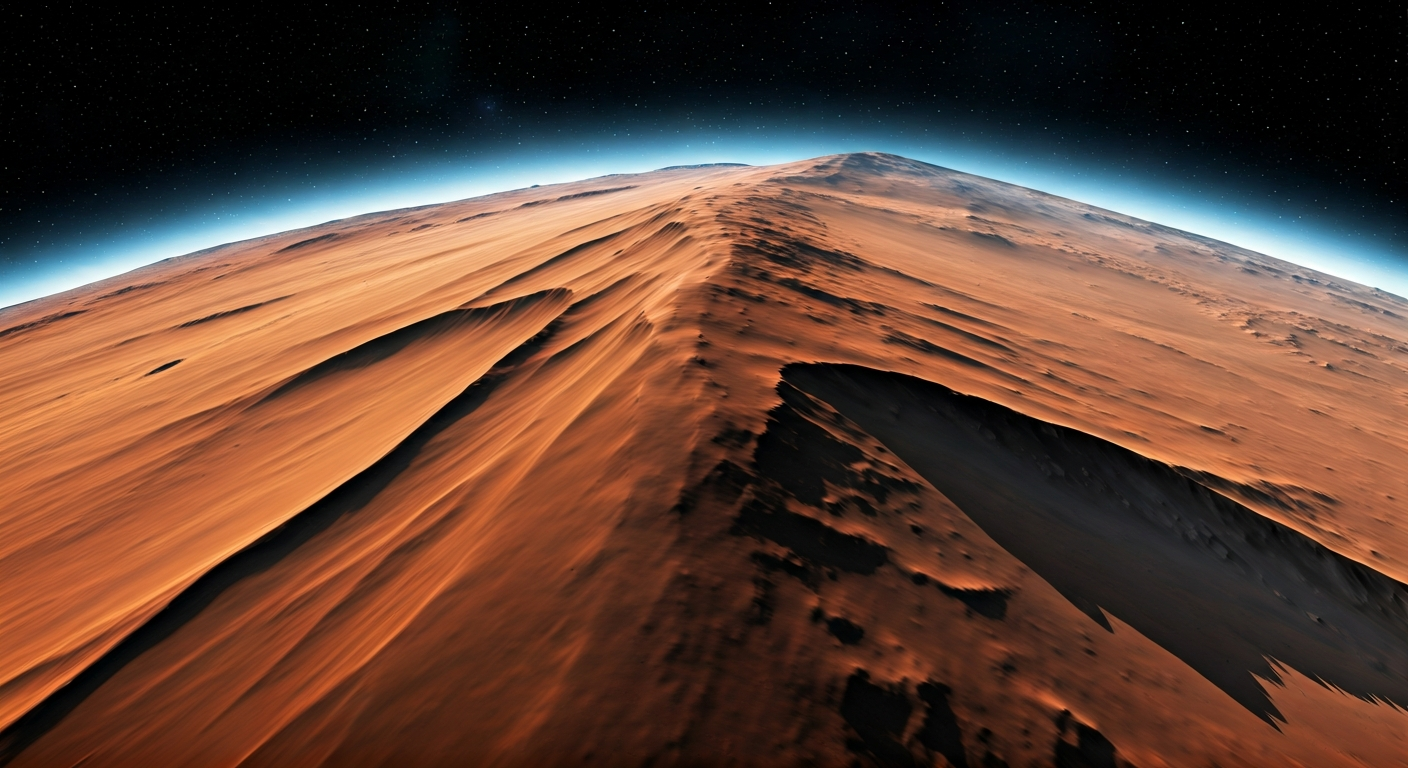
New research indicates that Mars' reduced size, compared to Earth, may have been a critical factor in its inability to sustain life.
A recent study has pinpointed the size of Mars as a primary reason for its current uninhabitable state. Unlike Earth, the Red Planet is significantly smaller, a characteristic that researchers believe played a crucial role in its geological and atmospheric evolution.
The findings suggest that Mars' lower mass led to a faster rate of cooling after its formation. This accelerated cooling would have caused its internal dynamo – the mechanism that generates a protective magnetic field – to shut down much earlier than Earth's. Without a global magnetic field, Mars would have been more vulnerable to solar winds.
These solar winds, a constant stream of charged particles from the Sun, would have gradually stripped away the planet's atmosphere over billions of years. A thinner atmosphere means less atmospheric pressure, making it difficult for liquid water to exist stably on the surface and offering less protection from harmful radiation.
Furthermore, the study implies that the planet's smaller size also affected its volcanic activity. Less internal heat meant less volcanism over time, which is crucial for replenishing the atmosphere with gases like carbon dioxide, a vital component for maintaining a greenhouse effect and keeping a planet warm enough for liquid water.
Therefore, the combination of a less robust magnetic field, atmospheric erosion, and diminished volcanic outgassing, all stemming from its smaller mass, has likely rendered Mars the cold, dry, and irradiated world it is today, unable to support life as we know it.
This study's focus on Mars' size as a determinant of its habitability underscores a fundamental constraint for planetary development. A smaller mass means less gravitational pull, faster core cooling, and a premature demise of the protective magnetosphere. This directly impedes the long-term atmospheric retention and stable surface water necessary for life. For the multi-planetary imperative, this research highlights the critical importance of selecting planets with sufficient mass to sustain geological activity and magnetic shielding over eons, essential for building a self-sustaining Martian civilization.
Edited by the news editor with AI and translated into English from the original report — please refer to the original source.