Mars Helicopter: A Bold Mission Redefining Planetary Exploration
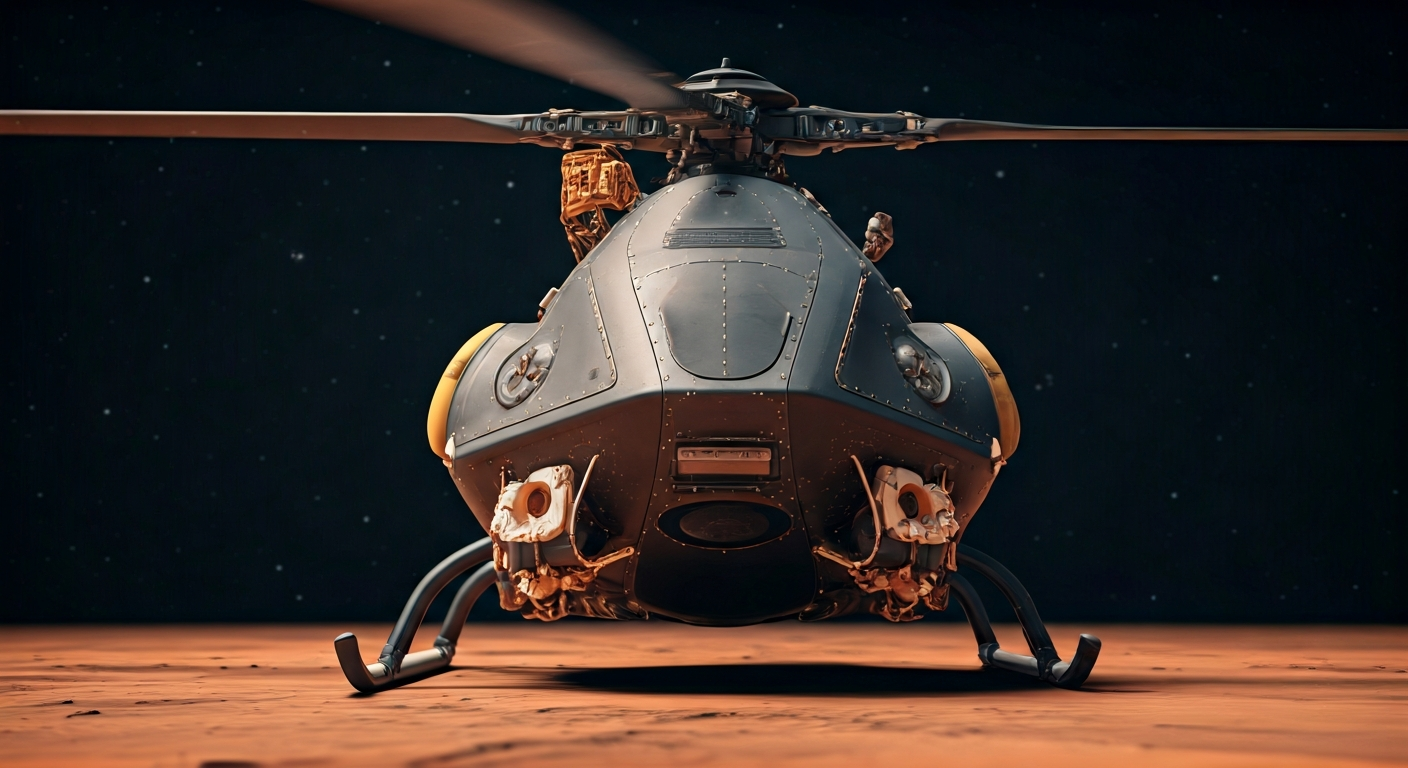
The Ingenuity helicopter's success on Mars has paved the way for future aerial exploration, demonstrating the viability of rotorcraft for scouting and data collection on alien worlds.
The Mars Helicopter, named Ingenuity, has concluded its groundbreaking mission on the Red Planet, exceeding all expectations and fundamentally altering the landscape of planetary exploration. Originally conceived as a technology demonstration, Ingenuity successfully completed 72 flights, far surpassing its planned five. This achievement proved that powered, controlled flight on Mars is indeed possible, a feat previously considered highly improbable due to the planet's thin atmosphere.
Ingenuity's mission was to test the feasibility of aerial reconnaissance and observation in the Martian environment. Its success has validated the concept of using rotorcraft for scouting potential landing sites, identifying geological features of interest, and providing aerial perspectives that ground-based rovers cannot offer. The helicopter's ability to navigate and collect data autonomously has opened new avenues for future missions.
The operational challenges of flying on Mars are significant. The Martian atmosphere is roughly 1% as dense as Earth's at sea level, requiring Ingenuity's rotor blades to spin at thousands of revolutions per minute – a rate far exceeding that of helicopters on Earth. Furthermore, the extreme cold temperatures and thin air presented substantial engineering hurdles that the mission team successfully overcame.
The legacy of Ingenuity extends beyond its technical accomplishments. It has established a new paradigm for planetary exploration, paving the way for more sophisticated aerial vehicles that could explore vast Martian terrains, assist human explorers, and accelerate scientific discovery. The data and experience gained from this mission will be invaluable for designing future robotic and potentially human missions to Mars and other celestial bodies.
Ingenuity's triumph is a pivotal step in humanity's expansion across the cosmos. By proving powered flight in Mars' tenuous atmosphere, this mission validates a critical technology for future multi-planetary endeavors. Aerial drones will be indispensable for scouting expansive Martian territories, identifying optimal sites for habitats and resource extraction, and providing crucial reconnaissance for human pioneers. This success curve, mirroring the exponential advancements in terrestrial aviation, suggests that increasingly sophisticated aerial exploration platforms will rapidly emerge, accelerating our ability to establish a self-sustaining presence on Mars and fulfilling our existential imperative to seed life and consciousness beyond Earth.
Edited by the news editor with AI and translated into English from the original report — please refer to the original source.