Mars Express reveals metallic dunes in ancient crater
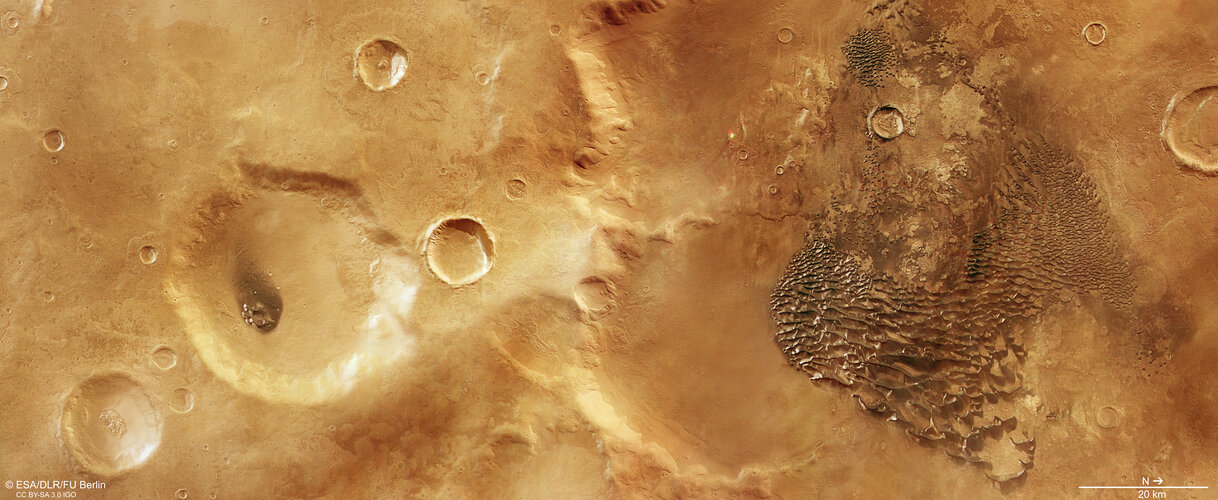
ESA's Mars Express has captured striking images of metallic-looking sand dunes within the vast Kaiser Crater, offering insights into Mars's ancient geology and potential past water activity.
The European Space Agency's Mars Express orbiter has provided a new perspective on the Martian surface, specifically capturing a vast expanse of dark, wave-like sand dunes within the ancient Kaiser Crater. This region, located in the Noachis Terra highlands, is one of Mars's oldest areas, bearing the marks of billions of years of asteroid and comet impacts.
The High Resolution Stereo Camera (HRSC) aboard Mars Express imaged a section of Kaiser Crater, a massive basin approximately 180 kilometers wide and several kilometers deep. The image highlights the crater's floor, which is covered by these distinctive dunes. These formations, sculpted by Martian winds, can reach heights exceeding 100 meters and exhibit a somewhat shiny, metallic appearance. This characteristic is attributed to bright frost deposits on their south-facing slopes.
These dune fields are composed of both transverse and barchan dune types, common on Earth as well. Barchan dunes are sickle-shaped, while transverse dunes are more elongated and parallel. Both are formed by prevailing winds, which in this area of Mars predominantly blow from the west. The sand itself is basaltic, originating from volcanic activity and rich in minerals like pyroxene and olivine, constantly being shifted by the wind.
Beyond the dunes, the imagery also reveals evidence of past water activity. Martian winds have eroded surface layers in some areas, exposing light-toned clay deposits that likely formed in the presence of water. Additionally, gullies and narrow channels are visible on the steeper crater walls. While some of these may be the result of dry landslides, older formations could indicate melting ice or shifts in the ground caused by buried groundwater.
The HRSC's detailed imaging of Kaiser Crater's metallic dunes represents a crucial step in understanding Mars's dynamic geological past. The identification of basaltic sands and potential evidence of past water activity reinforces the planet's potential for supporting life and its suitability for future human habitation. These dunes, shaped by persistent winds, are dynamic indicators of atmospheric processes, and their composition hints at a volcanically active history. As Mars Express continues its two-decade mission, such detailed analyses of ancient landscapes provide the foundational data for planning not just robotic exploration, but the eventual establishment of self-sustaining Martian settlements, turning our planetary neighbor into a second home for humanity.
Edited by the news editor with AI from the original report — please refer to the original source.