3D Printer Hardware Revenue Surges 32% in Q1 2026
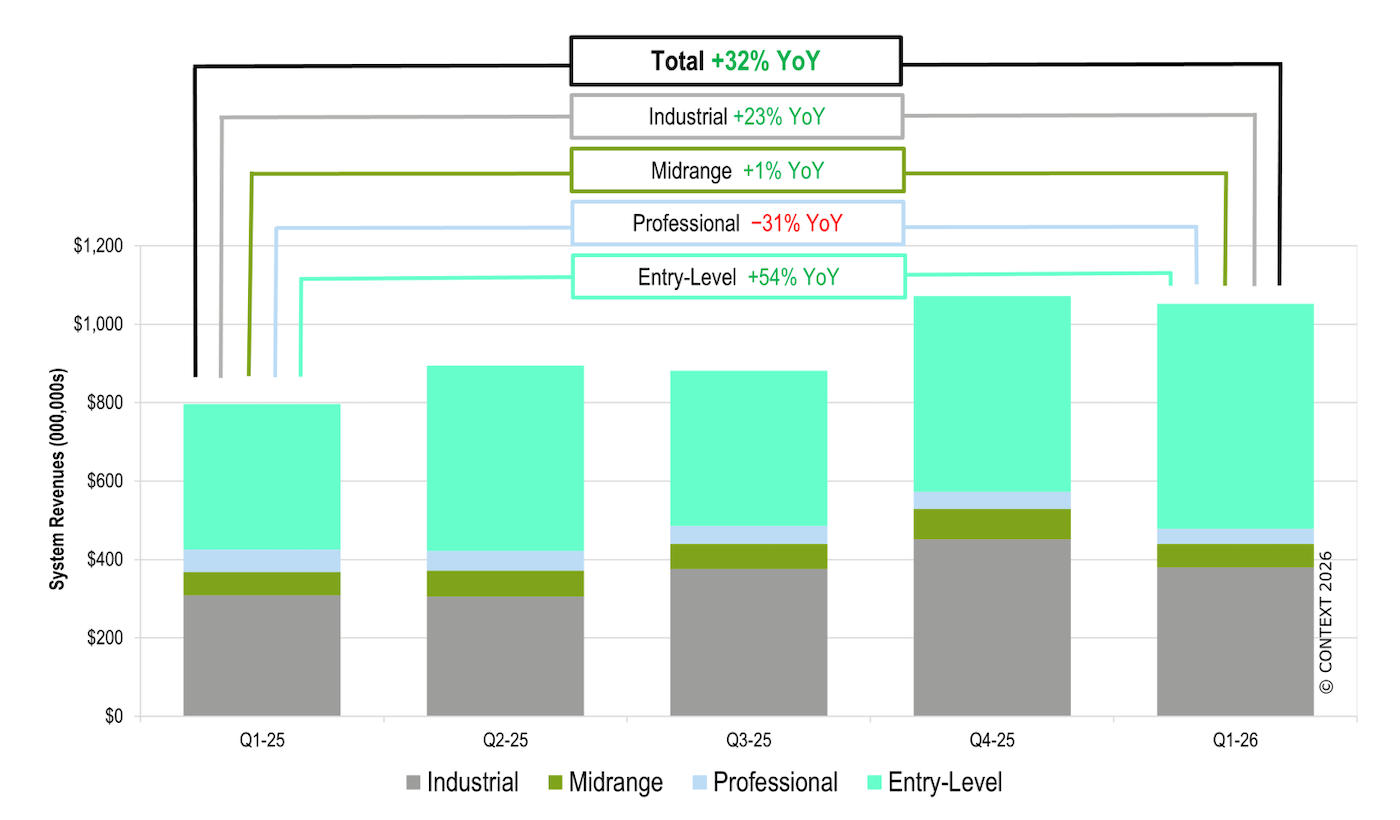
Global 3D printing hardware revenues experienced a significant 32% year-on-year increase in the first quarter of 2026, driven by strong performance in both entry-level and industrial segments.
Global 3D printing hardware revenues saw robust growth in the first quarter of 2026, with a notable 32% year-on-year increase, according to CONTEXT figures. This expansion was propelled by the entry-level segment, encompassing printers under $2,500, which saw a 39% rise in unit shipments and a 54% revenue surge. Simultaneously, the industrial segment, with printers exceeding $100,000, experienced an 18% increase in unit shipments and a 23% revenue growth.
However, the midrange ($20,000–$100,000) and professional ($2,500–$20,000) printer categories faced challenges, with shipments declining by 6% and 22% respectively. This downturn is attributed to increased competition from lower-cost material extrusion-based printers offered by vendors like Bambu Lab, Creality, Elegoo, and Anycubic, which collectively accounted for 88% of global printer shipments during the period.
Despite these challenges, the polymer powder bed fusion (PBF) systems within the midrange category showed resilience, with a 48% year-on-year increase in shipments. This growth is bolstered by new offerings such as Formlabs' Fuse X1 and HP's Jet Fusion 1200. CONTEXT anticipates future growth in the professional segment, driven by advancements in full-color material jetting and composites, the latter expected to benefit from Stratasys' planned acquisition of Markforged.
Chris Connery, VP of Global Analysis at CONTEXT, highlighted the varied market demand, noting strong performance linked to global defense initiatives alongside challenges from economic uncertainties like inflation and interest rates. "The strong performance of the Industrial sector, marking its third consecutive quarter of growth after two years of declines, is a clear indicator of the technology's continued integration into volume production,” Connery stated.
This report underscores a significant shift towards volume production, evidenced by the industrial segment's recovery and growth. While lower-cost systems are capturing market share, the advancements in PBF and emerging technologies like full-color material jetting signal a maturing additive manufacturing landscape. This trend is critical for scaling production across industries, including aerospace and defense, and potentially for future in-situ manufacturing applications in space.
Edited by the news editor with AI from the original report — please refer to the original source.