Interstellar Comet Lights Up Mars' Sky
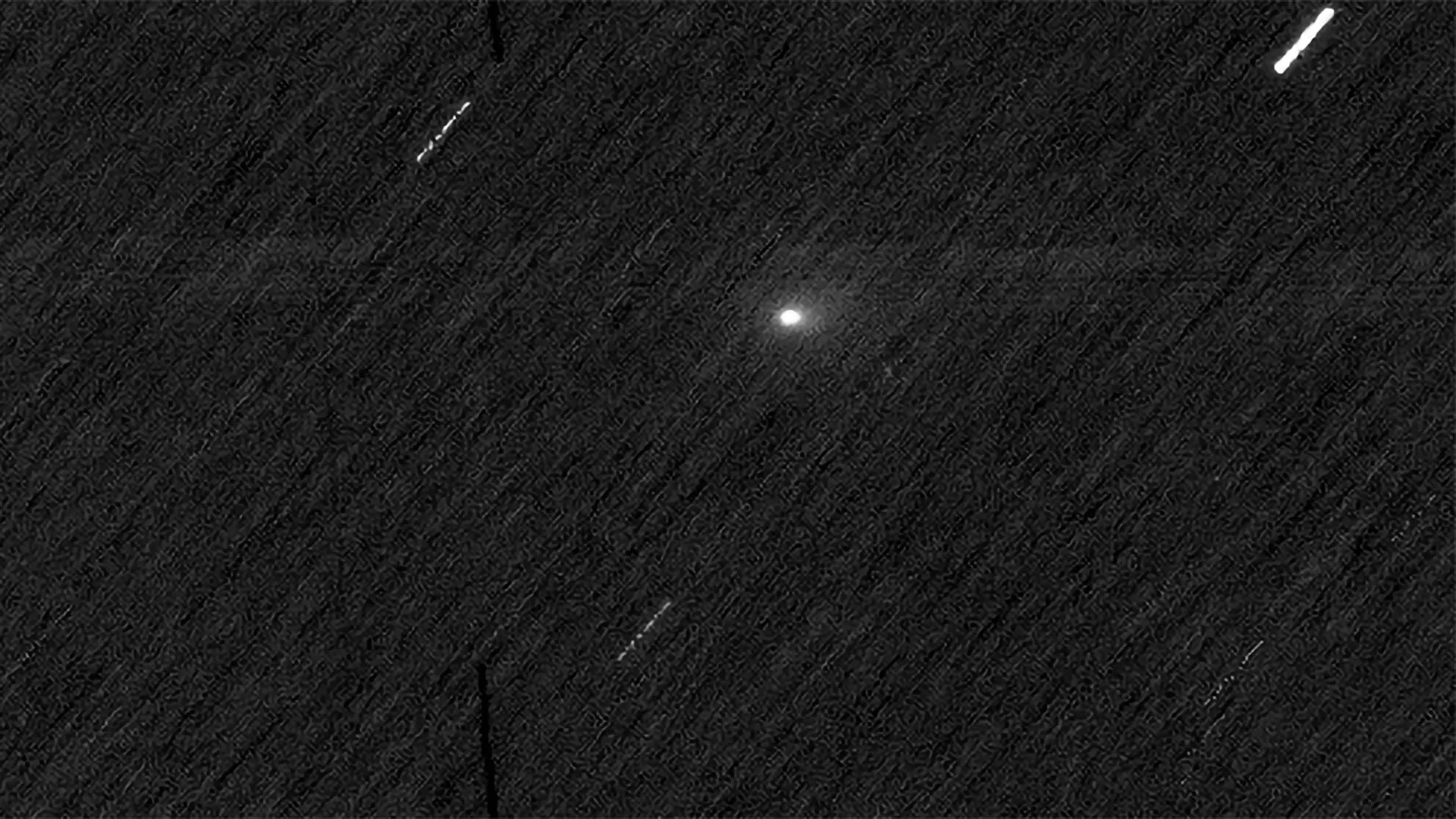
ESA's Mars orbiters captured rare images of interstellar comet 3I/ATLAS as it passed near the Red Planet, offering new insights into its distant origins.
ESA's ExoMars Trace Gas Orbiter (TGO) and Mars Express spacecraft observed the interstellar comet 3I/ATLAS as it passed near Mars between October 1 and 7. The comet, which originated outside our Solar System, came as close as 30 million kilometers to the Red Planet on October 3, providing a unique opportunity for study.
The TGO's CaSSIS camera managed to capture a series of images of the comet, which appeared as a faint white spot in the center of the frame. While the camera could not distinguish the comet's nucleus from its surrounding coma, the glowing cloud of gas and dust was clearly visible. The coma, which stretched thousands of kilometers, was formed as sunlight warmed the comet's surface, releasing material into space.
Mars Express, however, did not detect the comet in its images due to its shorter exposure limits. Researchers are working to enhance the signal from Mars Express data to identify the comet. Both orbiters also used spectrometers to analyze the comet's light, though it remains unclear if the coma and tail were bright enough to determine its chemical composition.
Comet 3I/ATLAS is the third interstellar comet ever observed, following 1I/ʻOumuamua in 2017 and 2I/Borisov in 2019. It was first detected in July 2025 and is believed to be billions of years older than the Solar System itself. Future observations, including those by ESA's Juice mission, will provide further insights into its composition and behavior as it approaches the Sun.
This article was written by AI from the original report. The "AI Analysis" is opinion/commentary. Always refer to the original source for the complete, authoritative story.