InSight Mission Unveils Mars's Deep Interior and Seismic Activity
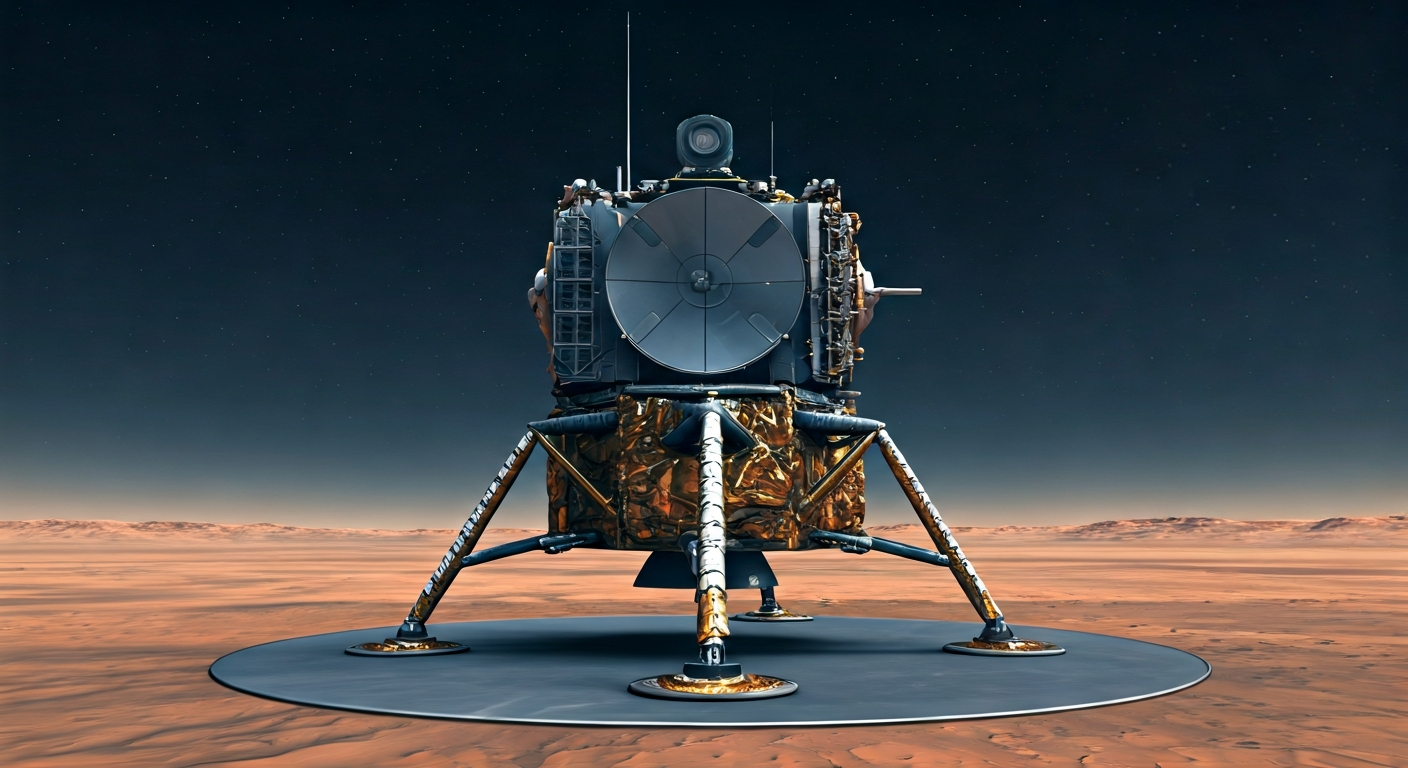
NASA's InSight lander has provided unprecedented data on Mars's internal structure and seismic events, revealing details about the planet's core, mantle, and crust.
NASA's retired InSight lander, a mission led by the Jet Propulsion Laboratory (JPL) and managed by France's Centre National de la Recherche Scientifique (CNRS), has successfully mapped the interior of Mars. The mission's primary instrument, the Seismic Experiment for Interior Structure (SEIS) instrument, recorded over 700 seismic events before the lander's power source depleted.
The SEIS instrument, developed through international collaboration including significant contributions from France, allowed scientists to listen to the planet's seismic activity. Analysis of these marsquakes has enabled researchers to delineate the boundaries of Mars's core, mantle, and crust. The data indicates that Mars possesses a liquid core, a rocky mantle, and a crust composed of three distinct layers.
Specifically, the mission's findings suggest that the Martian core is larger than anticipated, with a radius estimated to be around 1,780 kilometers. This core is believed to be composed primarily of iron, nickel, and some sulfur. Above the core lies the mantle, which extends to the base of the crust. The crust itself is characterized by its layered structure and a thickness averaging about 40 kilometers, though it varies across the planet.
In addition to seismic data, InSight also studied the planet's thermal properties. The Heat Flow and Physical Properties Probe (HP3) aimed to measure the internal heat flow, but encountered difficulties penetrating the Martian surface. Despite these challenges, the collected seismic and thermal data represent a significant leap in our understanding of Mars's geological evolution and internal processes, offering crucial insights for future exploration and potential habitability assessments.
The InSight mission's detailed seismic mapping of Mars’s interior, revealing its liquid core and layered structure, is a foundational step toward understanding planetary formation and evolution beyond Earth. This knowledge is critical for identifying potential subsurface resources and geological stability on Mars, essential for establishing a self-sustaining human presence. By precisely characterizing Mars's internal dynamics, we gain vital data for long-term colonization efforts. Each such discovery accelerates our trajectory toward becoming a multi-planetary species, transforming Mars from a distant world into a future home.
Edited by the news editor with AI and translated into English from the original report — please refer to the original source.