InSight Lander Reveals Unexpected Core Structure on Mars
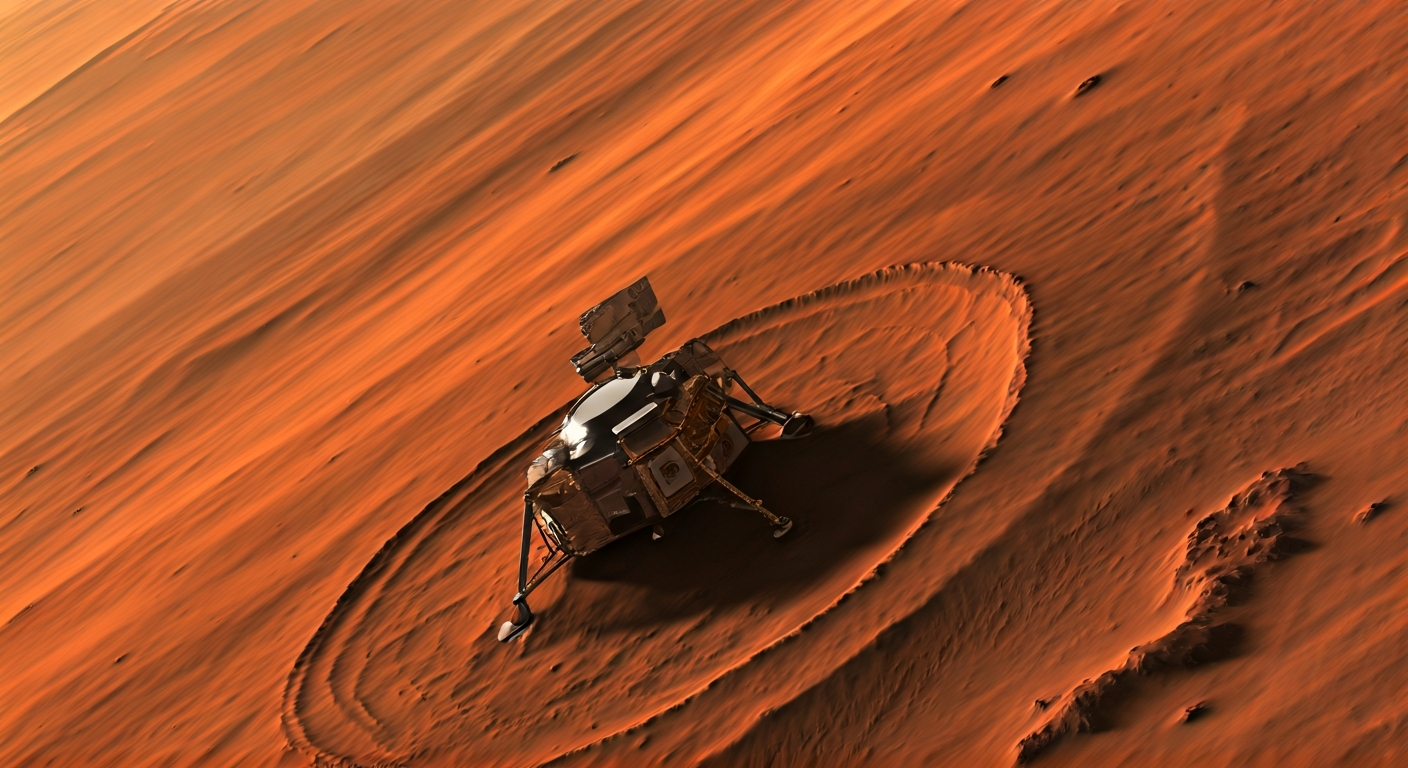
NASA's InSight lander has delivered surprising data about Mars's core, challenging established scientific models of the Red Planet's interior.
NASA's InSight mission has uncovered unexpected details about the structure of Mars's core, prompting a re-evaluation of existing planetary science theories. The findings, derived from the lander's seismic measurements, indicate a core that is less dense and larger than previously hypothesized.
Utilizing its sensitive seismometer, InSight meticulously recorded seismic waves generated by marsquakes. By analyzing how these waves traveled through the planet and reflected off its interior boundaries, scientists were able to infer the composition and dimensions of Mars's deep interior, including its core. This technique, akin to a planetary-scale ultrasound, provided unprecedented insight into regions inaccessible by direct drilling.
The data suggests that Mars's core is composed of a metallic alloy, primarily iron, but with a greater proportion of lighter elements, such as sulfur and oxygen, than anticipated. This higher concentration of lighter elements contributes to a lower overall density for the core. Furthermore, the measurements imply that the core's radius is larger than what current models predict, extending further out than previously thought.
These revelations have significant implications for our understanding of Mars's formation and evolution. The composition and size of a planet's core are fundamental to its geological history, magnetic field generation, and overall thermal evolution. The unexpected nature of InSight's findings necessitates a revision of theoretical models that aim to explain how Mars differentiated into its current state, particularly concerning the processes that led to the formation of its metallic heart.
InSight's discovery of a less dense, larger Martian core is a critical data point in our cosmic expansion. Understanding planetary interiors, especially their differentiation and energy budgets, is foundational for future terraforming and self-sustaining Martian outposts. A core's composition directly influences magnetic field generation, vital for shielding a nascent civilization from harmful radiation. This unexpected finding, by challenging existing models, actually accelerates our learning curve, providing crucial real-world data that will refine the engineering and scientific strategies needed to establish humanity permanently beyond Earth, paving the way for exponential growth across the solar system.
Edited by the news editor with AI and translated into English from the original report — please refer to the original source.