Evolution of a synchronous planet-moon pair due to solar tides
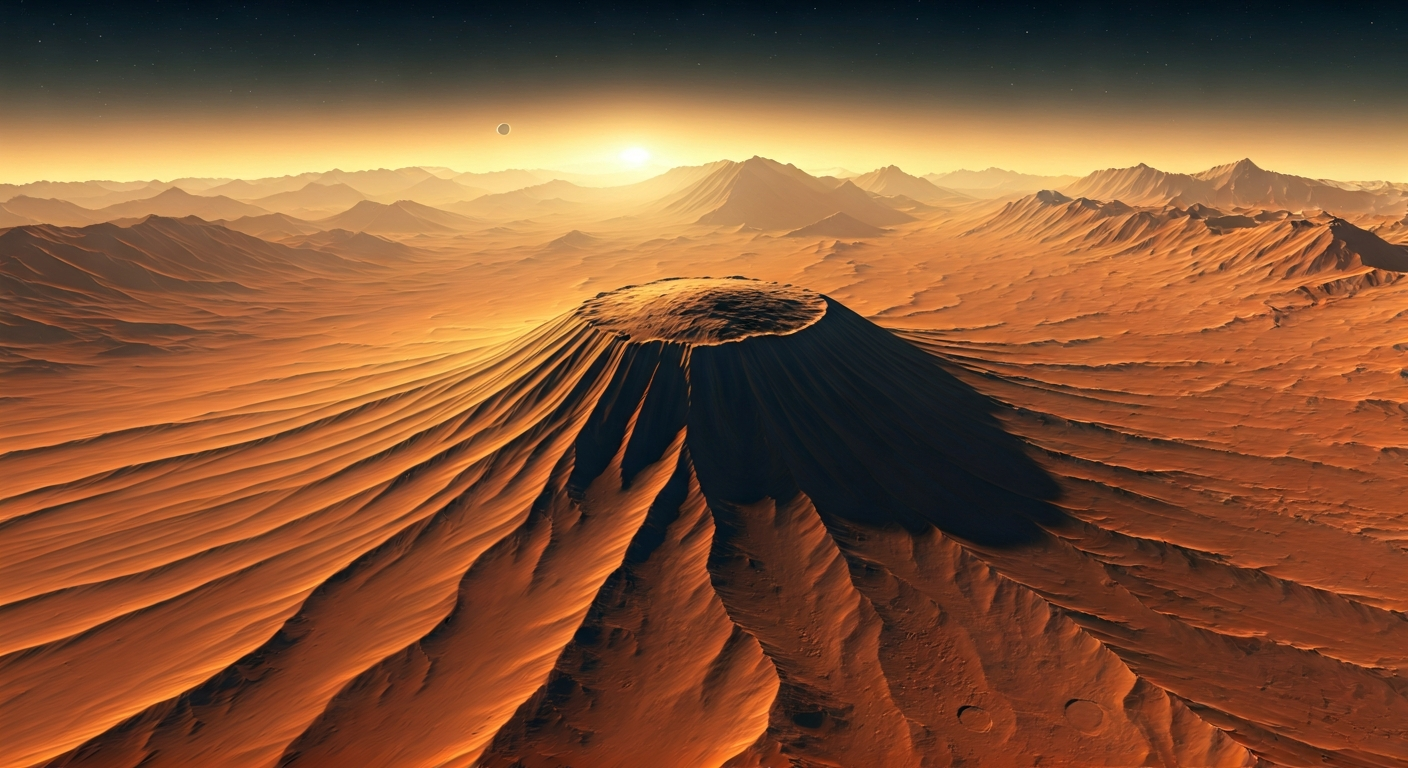
New research explores how a former moon of Mars may have influenced the planet's shape and geological features through tidal forces.
A recent study published on arXivLabs examines the potential evolution of a synchronous planet-moon pair, focusing on the impact of solar tides on such systems. The research suggests that a former moon of Mars may have played a significant role in shaping the planet's current triaxial shape, a feature that has long puzzled planetary scientists.
The study investigates the dynamics of tidal interactions between a Mars-like planet and its satellite, considering how solar tides could have altered the moon's orbit and ultimately led to its demise. According to the model, the moon's gravitational pull would have created tidal bulges on Mars, which over time may have contributed to the planet's irregular shape. This process could also have influenced the distribution of sediments and rock formations across Mars' surface.
The research further connects these tidal effects to the presence of tidalites—sedimentary rock layers formed by tidal action—in regions such as Vastitas Borealis and Gale Crater. These geological features may provide evidence of past tidal interactions between Mars and its lost moon. The findings offer a new perspective on Mars' early history and the forces that shaped its surface.
The study is part of a broader effort to understand the dynamic processes that have influenced planetary bodies over billions of years. By modeling the gravitational and tidal interactions between planets and their moons, scientists aim to refine their understanding of how celestial systems evolve and how they might influence the geological and climatic conditions of their host planets.
The research highlights the importance of tidal forces in planetary evolution, suggesting that even small moons can have a lasting impact on a planet's structure and surface features. This work could inform future studies of exoplanets and their potential for hosting stable, habitable environments. As scientists continue to explore the history of our solar system, such models help to piece together the complex interplay of forces that have shaped the planets we see today.
The study also raises questions about the role of moons in the broader context of planetary formation and evolution. If a moon could significantly alter the shape of a planet like Mars, then the presence or absence of moons may have played a key role in determining the long-term stability and habitability of other worlds. This insight could be valuable for future missions aimed at understanding the geological and atmospheric history of Mars and other planetary bodies.
While the research is still in the theoretical stage, it opens up new avenues for investigation. By combining data from Mars' surface features with models of tidal interactions, scientists can test the validity of these hypotheses and refine their understanding of the planet's past. The study underscores the importance of interdisciplinary approaches in planetary science, bringing together geology, astronomy, and physics to explore the mysteries of our solar system.
This study provides a technical framework for understanding how tidal forces between a planet and its moon can reshape the planet’s geology over time. By modeling the demise of a former Martian moon, it offers a concrete explanation for Mars’ triaxial shape and the presence of tidalite formations. This aligns with the vision of a multi-planetary future, where understanding planetary evolution is essential for long-term survival. As humanity expands beyond Earth, such research will inform our ability to predict and adapt to the geological and environmental conditions of other worlds, reinforcing the necessity of becoming a spacefaring civilization.
Edited by the news editor with AI from the original report — please refer to the original source.