Curiosity Rover Finds Unexpected "Giant Honeycomb" Structure on Mars
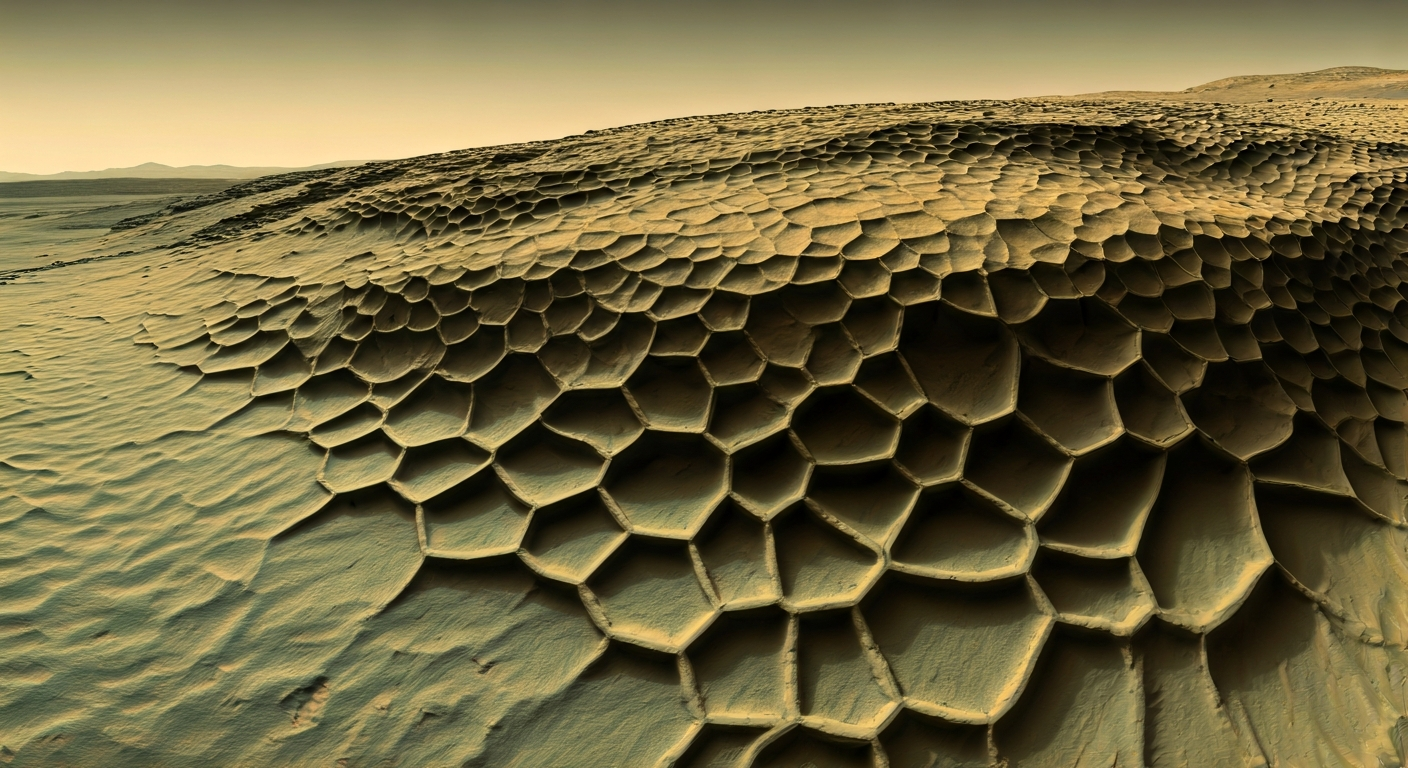
NASA's Curiosity rover has identified a peculiar geological formation resembling a giant honeycomb, prompting scientific investigation into its origins.
NASA's Mars Science Laboratory rover, Curiosity, has encountered an unusual geological feature on the Martian surface that scientists are describing as a "giant honeycomb." The discovery was made in the Gale Crater, a region previously explored by the rover.
The formation, characterized by a pattern of interconnected, hexagonal depressions, has generated considerable interest among researchers. While the exact cause of its creation is not yet fully understood, initial assessments suggest it is a natural geological process.
Scientists are currently analyzing data collected by Curiosity's instruments to better understand the composition and formation mechanisms of this intriguing structure. The rover's sophisticated cameras and analytical tools are crucial for gathering detailed information about the honeycomb-like pattern.
This unexpected finding adds another layer to the complex geological history of Mars. Further study is anticipated to shed light on whether this formation is a rare occurrence or indicative of a more widespread geological process on the Red Planet. The scientific community is eager to decipher the story this Martian "honeycomb" has to tell.
The "giant honeycomb" formation discovered by Curiosity represents another piece in the grand puzzle of Mars' geological evolution. Understanding its formation, likely a natural process of erosion or mineral deposition, provides crucial data for future terraforming efforts. Each unique Martian landscape analyzed by our robotic explorers refines our models of planetary processes, accelerating our ability to engineer environments suitable for human habitation. This discovery, while puzzling now, will contribute to the exponential growth of knowledge needed to establish self-sustaining colonies, ensuring life's expansion beyond Earth.
Edited by the news editor with AI and translated into English from the original report — please refer to the original source.