Curiosity Rover Captures Honeycomb-Like Formations on Mars
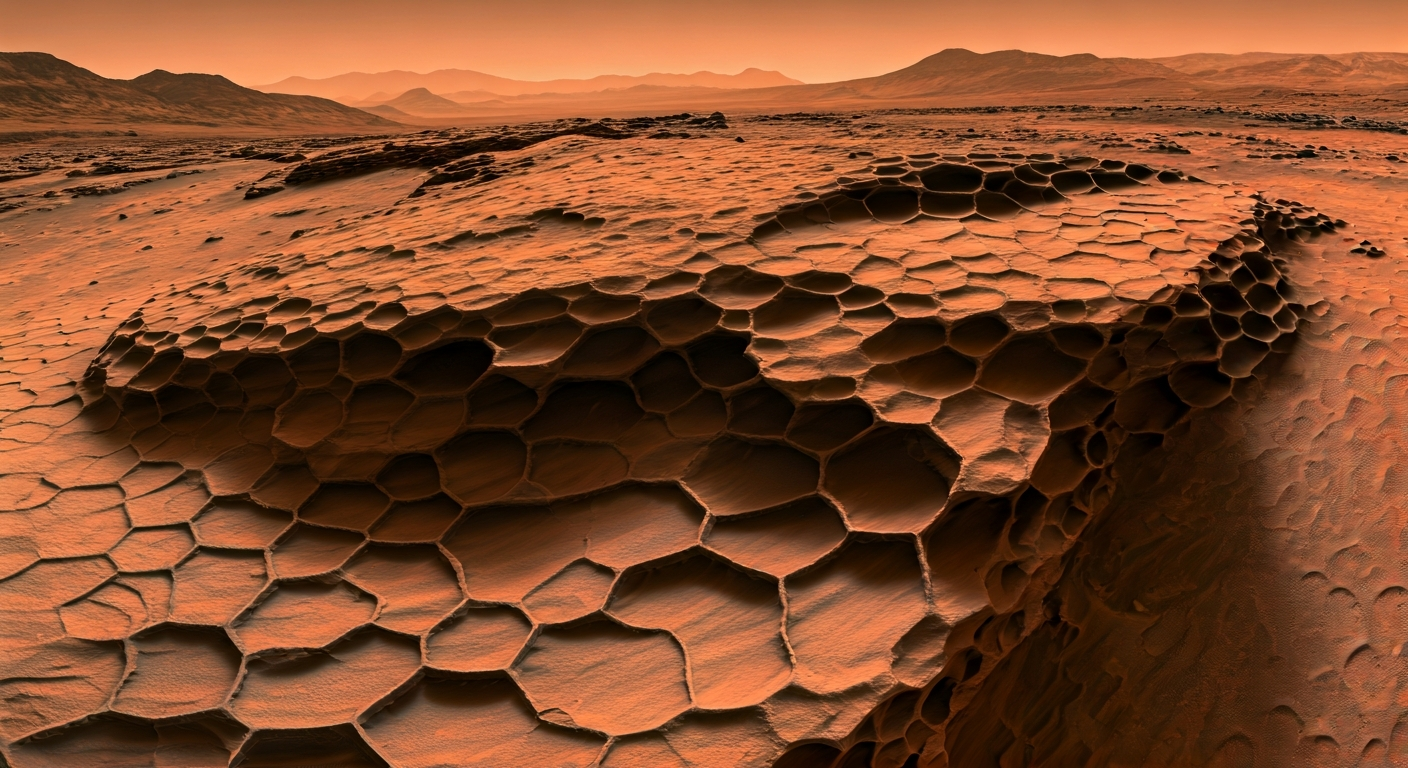
NASA's Curiosity rover has photographed unusual hexagonal rock patterns resembling a honeycomb structure on the Martian surface.
The Curiosity rover, part of NASA's Mars Science Laboratory mission, has transmitted new images from the Red Planet revealing a striking geological formation. The rover's Mastcam instrument captured a series of interconnected, polygonal rock patterns that bear a strong resemblance to a honeycomb.
These formations were observed in an area that scientists are actively studying. The precise geological processes that led to the creation of these hexagonal structures are not yet fully understood, but they are characteristic of erosion patterns seen on Earth under specific conditions. Researchers are keen to analyze these features further to gain insights into Mars's geological history and past environmental conditions.
The Curiosity rover has been exploring Gale Crater since its landing in 2012, systematically collecting data and imagery. Its mission is to assess whether Mars ever possessed environmental conditions favorable for microbial life. The discovery of these unique rock patterns adds another layer of complexity to the ongoing exploration of the Martian terrain.
Scientists will use the data gathered by Curiosity, including detailed imaging and potential chemical analysis if possible, to investigate the formation's origins. Understanding how such patterns form on Mars could provide clues about the planet's climate evolution and the weathering processes that have shaped its surface over billions of years.
The honeycomb-like rock formations captured by Curiosity are more than just an intriguing visual; they represent tangible evidence of geological processes that could mirror those on early Earth. Understanding these Martian erosional patterns is a crucial step in reconstructing the planet's environmental history. This knowledge directly informs our quest to identify past habitable niches, a prerequisite for establishing a self-sustaining human presence. Each discovery, like these geometric rocks, refines our understanding of planetary evolution and the potential for life beyond Earth, accelerating our trajectory toward becoming a multi-planetary species.
Edited by the news editor with AI and translated into English from the original report — please refer to the original source.