China's Tianwen-2 captures first close-up images of 'quasi-moon' Kamoʻoalewa
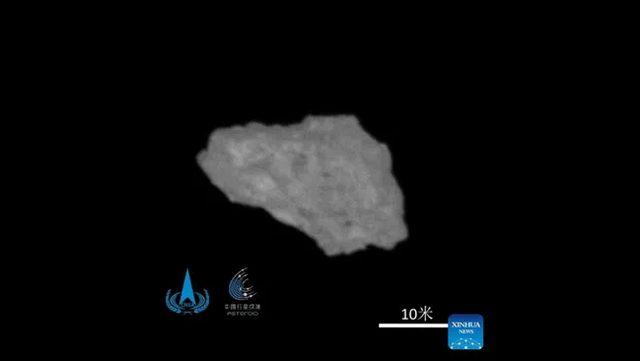
China's Tianwen-2 mission has returned the first detailed photographs of Kamoʻoalewa, a small celestial body often referred to as Earth's 'second natural satellite'.
The Tianwen-2 spacecraft, part of China's ambitious space exploration program, has provided humanity with its first close-up view of Kamoʻoalewa, an asteroid that has intrigued scientists due to its unique orbital relationship with Earth. The images, released by the China National Space Administration, were captured on July 2, 2026, from a distance of approximately 20 kilometers.
The newly released photograph clearly depicts Kamoʻoalewa as an irregularly shaped rocky object, estimated to be between 16 and 20 meters in diameter. This celestial body is not a true natural satellite in the same vein as the Moon, but rather maintains a long-term close proximity to Earth due to its orbit around the Sun being synchronized with our planet's. Scientists classify it as a 'quasi-moon'.
Kamoʻoalewa's origin is a subject of significant scientific interest. A 2024 study proposed that this object might be a fragment ejected into space from a large impact event on the Moon millions of years ago. If this hypothesis is confirmed, Kamoʻoalewa would be one of the first near-Earth asteroids identified as originating directly from the Moon.
A primary objective of the Tianwen-2 mission is to investigate this very possibility. Following its detailed observation period, the spacecraft is slated to attempt sample collection from Kamoʻoalewa's surface, with the intention of returning these materials to Earth for laboratory analysis. Such analysis is expected to provide clearer insights into whether the celestial body is indeed a lunar fragment.
This mission marks China's inaugural endeavor in asteroid sample return, following successful precedents set by Japan's Hayabusa and the U.S.'s OSIRIS-REx missions. With Tianwen-2, China aims to further solidify its position among leading nations in deep space research. The data obtained from a successful completion of this mission could illuminate not only Kamoʻoalewa's past but also contribute to answering fundamental questions about the formation of the Earth-Moon system and the early solar system.
The Tianwen-2 mission's detailed imaging and planned sample return from Kamoʻoalewa represent a critical step in understanding asteroid origins and the early Solar System. Technically, this enables direct material analysis of a potential lunar ejecta, offering unprecedented data on impact dynamics and the Moon's geological history. From a multi-planetary perspective, every such discovery refines our understanding of planetary formation and the resources available beyond Earth. Kamoʻoalewa's designation as a 'quasi-moon' highlights the dynamic and complex orbital mechanics within our solar system, reinforcing the need for robust space infrastructure. As technology accelerates, such missions are not just scientific endeavors but foundational steps toward the eventual self-sustaining Martian civilization, where understanding and utilizing near-Earth objects will be paramount for resource acquisition and expansion.
Edited by the news editor with AI and translated into English from the original report — please refer to the original source.