China's Mars Mission Achieves Orbit, Landing, and Roving in Single Effort
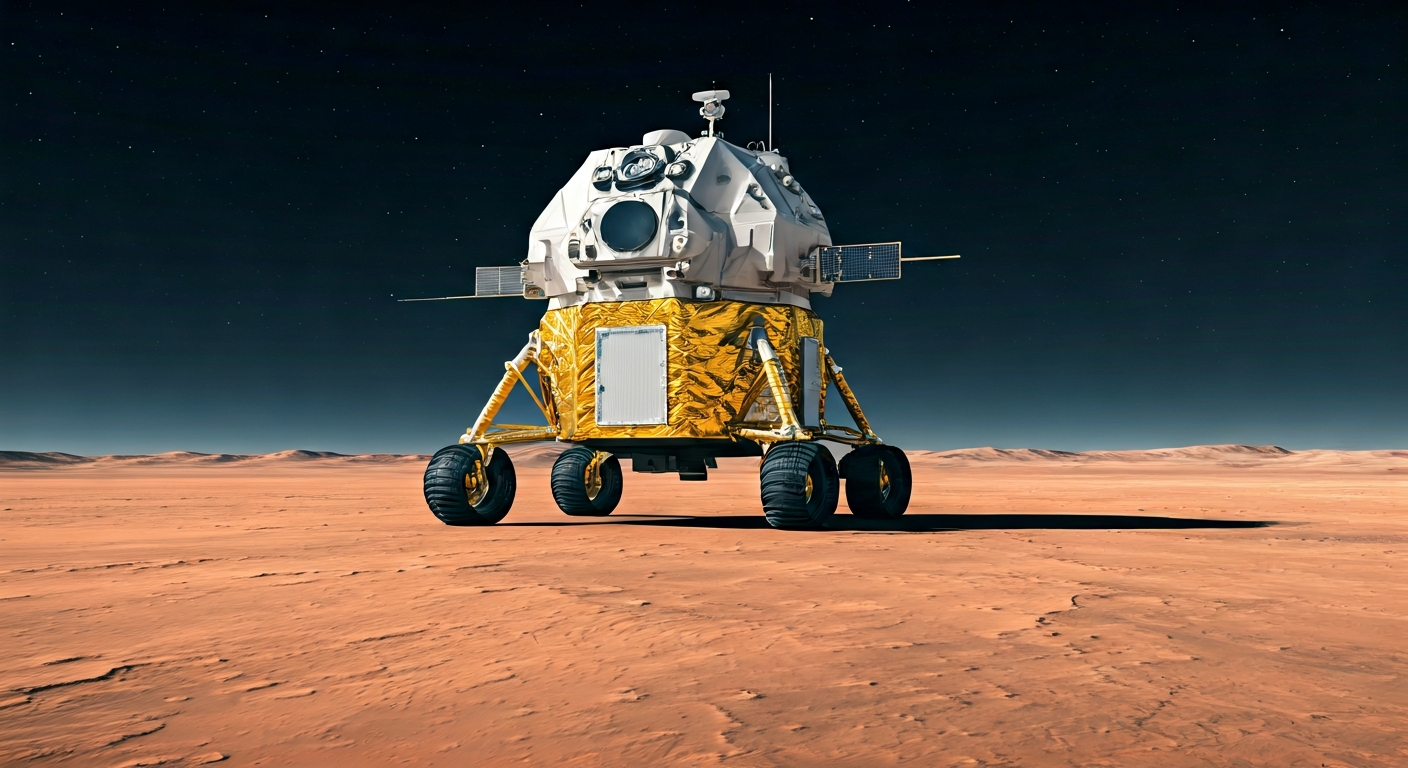
China's inaugural Mars exploration mission has successfully completed its orbital, landing, and roving phases, marking a significant leap in the nation's space capabilities.
China's National Space Administration (CNSA) has announced the successful conclusion of its first comprehensive Mars exploration endeavor. The mission, which launched with the ambitious goal of achieving multiple objectives in a single undertaking, has now fulfilled all its primary phases: orbiting the Red Planet, landing a probe on its surface, and deploying a rover to conduct scientific investigations.
This integrated approach, known as 'Yuan Zhe Xun' (绕着巡), meaning 'orbit, land, and patrol,' represents a substantial advancement for China's space program. Historically, such multi-stage missions have often been executed over several separate endeavors, requiring distinct launch windows and mission planning for each phase. By accomplishing all three within one mission cycle, China has effectively compressed decades of incremental progress into a single, highly efficient operation.
The mission's success demonstrates a sophisticated level of technological integration and mission control. The ability to transition from orbital insertion to a precise atmospheric entry, descent, and landing, followed by the deployment and operation of a surface rover, highlights China's growing expertise in complex interplanetary operations.
Scientists anticipate that the data gathered by the rover will provide valuable insights into Mars' geology, atmosphere, and potential for past or present life. The comprehensive nature of this mission sets a new benchmark for future interplanetary exploration efforts, showcasing a streamlined and effective methodology for tackling the challenges of exploring other worlds.
China's 'Yuan Zhe Xun' mission's singular achievement of orbital, landing, and roving capabilities in one go is a testament to accelerating technological progress. This integrated approach bypasses the traditional, sequential development of separate missions, demonstrating a rapid mastery of complex interplanetary systems. It embodies the exponential curve of space exploration, where each success builds upon and amplifies future capabilities. This efficiency is crucial for our species' imperative to expand beyond Earth. By demonstrating such rapid, integrated proficiency, China is not just exploring Mars; it's contributing to the essential infrastructure and demonstrated capacity for a multi-planetary future, accelerating our journey towards a self-sustaining civilization beyond Earth.
Edited by the news editor with AI and translated into English from the original report — please refer to the original source.