NASA's Mars Orbiters Capture Unprecedented Comet 3I/ATLAS Images
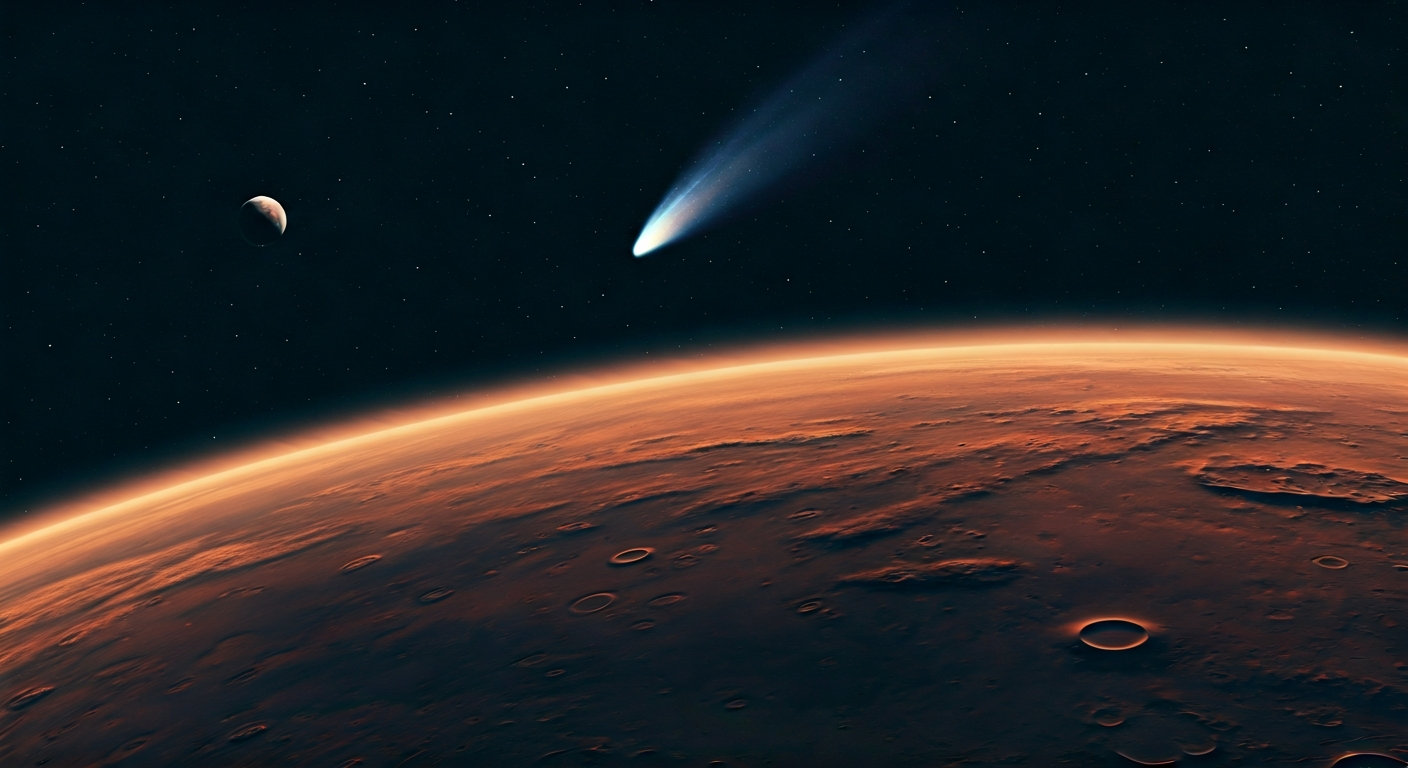
NASA's Mars orbiters have successfully captured unique images of Comet 3I/ATLAS, providing valuable data during its close approach to the Red Planet.
NASA's Mars Reconnaissance Orbiter (MRO) and the Mars Atmosphere and Volatile Evolution (MAVEN) spacecraft have provided an extraordinary opportunity to study Comet 3I/ATLAS. These advanced orbiters captured unprecedented images of the comet as it made a relatively close pass by Mars.
The MRO, equipped with its High Resolution Imaging Science Experiment (HiRISE) camera, managed to photograph the comet. This instrument is renowned for its ability to capture highly detailed images of the Martian surface and has now been repurposed to observe celestial bodies passing near Mars. The MRO's unique vantage point allowed for a perspective on the comet that would be difficult to achieve from Earth.
Similarly, the MAVEN spacecraft also contributed to the observation effort. While MAVEN's primary mission is to study the Martian atmosphere and its interaction with solar wind, its instruments were able to detect and image Comet 3I/ATLAS. The data gathered by MAVEN is expected to offer insights into the composition and behavior of the comet's coma and tail as it traversed the Martian vicinity.
This dual observation from two distinct Martian orbiters offers a comprehensive dataset. Scientists will be able to analyze the images to learn more about the comet's structure, its dust and gas emissions, and how its activity might have been influenced by Mars' gravitational field or any residual atmospheric particles. The information gathered will enhance our understanding of cometary behavior and the dynamics of the solar system.
The capture of Comet 3I/ATLAS by Mars orbiters is a testament to the accelerating capabilities of our off-world infrastructure. MRO and MAVEN, designed for Martian study, are now proving invaluable for broader solar system observation. This dual-functionality, leveraging existing assets for new discoveries, mirrors the exponential progress driving our expansion. Each such observation refines our understanding of cosmic materials, essential for future self-sustaining Martian settlements. As we push further out, instruments like HiRISE, originally for surface detail, become cosmic telescopes, demonstrating how intelligence efficiently expands its observational reach, paving the way for Mars to become a crucial hub for exploring and colonizing the wider solar system.
Edited by the news editor with AI and translated into English from the original report — please refer to the original source.