Martian Chronicles: From Ancient Sands to Starship Skies
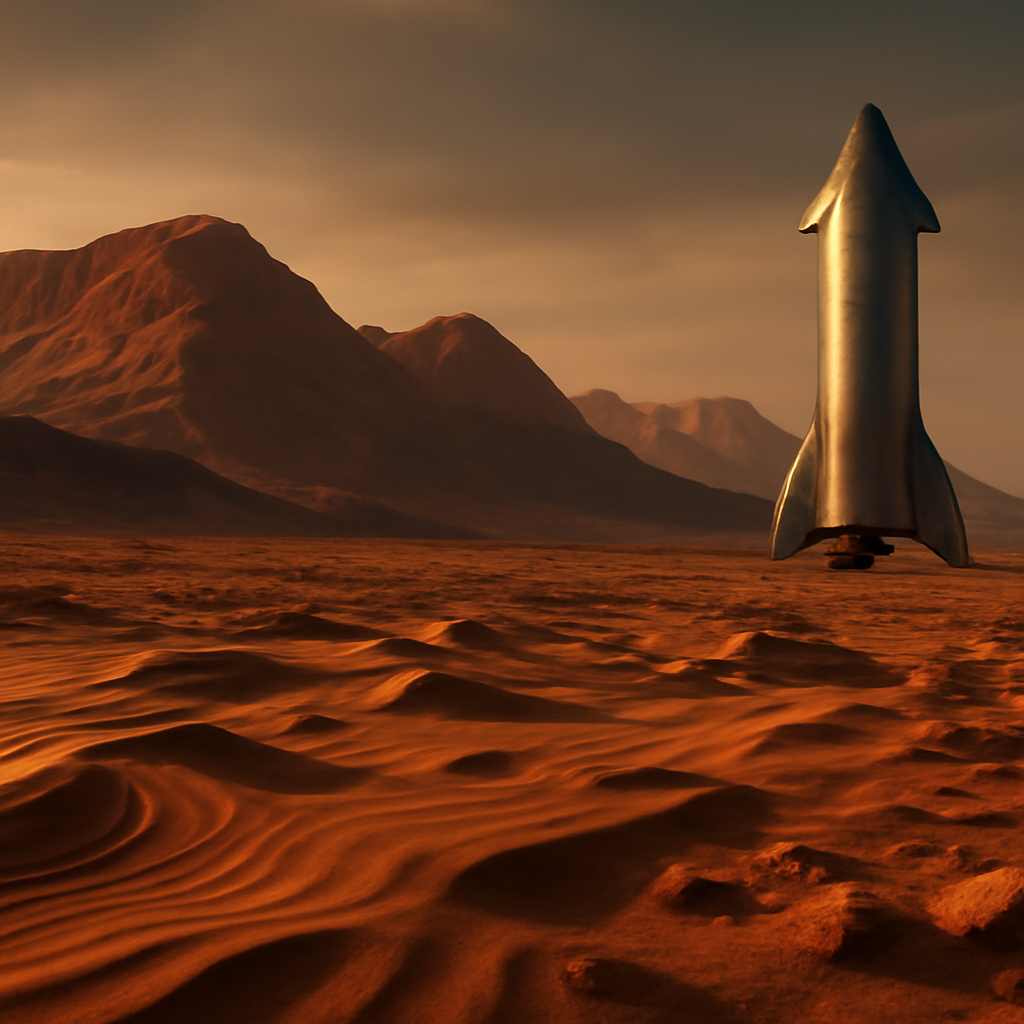
Today's Mars headlines paint a vibrant picture of our ongoing fascination with the Red Planet, from the deepest geological insights gleaned by rovers to the ambitious engineering strides aimed at human interstellar transit. We explore how ancient Martian sandstorms inform our understanding of planetary evolution, while simultaneously examining the cutting-edge technologies poised to make humanity a multi-planetary species.
Whispers of Ancient Winds: Martian Sandstorms Revealed
The Curiosity rover, meticulously analyzing the layered sedimentary rocks of Gale Crater, has uncovered compelling evidence of ancient Martian sandstorms far more dynamic than previously understood. By examining cross-bedding within rock formations, specifically the way layers of sand deposit and accumulate, scientists have identified features indicative of sand avalanches climbing over pre-existing ripple crests. This phenomenon, known as "climbing ripples," is a direct consequence of extremely high wind speeds and abundant sand supply, suggesting periods of intense aeolian (wind-driven) activity on early Mars. The presence of these features, preserved in the geological record, indicates that Martian winds were not only capable of moving sand but could sustain such high energy levels that sand dunes actively migrated uphill against the prevailing wind direction. This discovery complements findings from Mars Express, which has observed metallic-looking dunes in Kaiser Crater, hinting at diverse mineral compositions and ancient geological processes shaping the Martian surface over billions of years, providing a tangible link between the planet's past atmospheric conditions and its current arid landscape.
Jezero's Deep Time: Impact Craters and Ancient Crusts
Perseverance’s ascent to Jezero Crater’s rim, specifically to a formation dubbed 'Broom Point', has provided unprecedented insight into the crater’s violent origins. Analysis of the 75-meter-thick bedrock reveals a geological narrative etched by repeated asteroid impacts. This is not simply a story of a single, cataclysmic event, but rather a layered history of bombardment over billions of years, likely exceeding 3.9 billion years ago. The sheer thickness and composition of this ancient crust suggest that early Mars was a far more tumultuous place than previously understood, with successive impacts contributing to the geological structure we observe today. This layered formation acts as a natural archive, preserving evidence of impact energy, ejecta dispersal, and potentially even the composition of the impacting bodies. By studying these ancient crusts, scientists can refine models of planetary formation and evolution, understanding how such impacts shaped not only Jezero Crater but the Martian surface as a whole. This detailed geological record is crucial for understanding the planet’s habitability potential in its earliest epochs.
Metallic Dunes: Unveiling Kaiser Crater's Secrets
The Mars Express orbiter's high-resolution camera has captured striking imagery of what appear to be metallic sand dunes within the vast Kaiser Crater. These striking formations are not composed of actual metal, but rather iron-rich minerals, primarily hematite and magnetite, which are prevalent in Martian regolith. The intense atmospheric processing and aeolian (wind-driven) transport processes that have shaped Mars over eons have concentrated these heavy minerals within the crests and slip faces of the dunes. The reflective properties of these iron oxides, when exposed and oxidized on the dune surfaces, create the characteristic metallic sheen observed in the images. Understanding the distribution and composition of these dunes provides crucial insights into the planet's geological history, particularly regarding past volcanic activity, hydrothermal alteration, and the potential for sustained water presence, as these processes are key to forming and concentrating the iron minerals that make up these unique Martian landscapes. This aeolian depositional environment, now revealed in such detail, offers a window into the dynamic geological forces that have sculpted the Red Planet.
The Viking Legacy: Early Life Searches and Enduring Enigmas
The Viking missions of the 1970s represented humanity’s first dedicated attempt to answer the profound question of whether life exists beyond Earth, specifically on Mars. Each of the two Viking landers, Viking 1 and Viking 2, carried a suite of sophisticated instruments designed for this purpose. The centerpiece of the life-detection effort was a biology laboratory containing three distinct experiments: a Gas Chromatograph Mass Spectrometer (GCMS) to identify organic molecules, a Gas Exchange (GEX) experiment, and a Labeled Release (LR) experiment. The GEX sought to detect metabolic activity by monitoring changes in the gaseous environment of a soil sample. The LR experiment was designed to detect respiration by labeling ingested nutrients with radioactive carbon-14; if microorganisms were present and consumed these nutrients, they would release radioactive carbon dioxide, which would be detected. While the GCMS found no significant organic compounds, the GEX and LR experiments yielded positive results, showing initial signs of metabolic activity. However, these results were difficult to interpret, as they could also be explained by unusual inorganic chemical reactions in the Martian soil, leaving the question of Martian life an enduring enigma.
Starship's Ascent: Orbital Test Flights and Future Deployments
SpaceX's Starship program is rapidly advancing towards its ambitious goal of enabling human interplanetary travel, with the upcoming Flight 13 marking another significant milestone. This mission is not just about testing the vehicle's capabilities; it's designed to integrate and deploy the next generation of Starlink V3 satellites, a crucial step in building out SpaceX's global internet constellation. The operational deployment of these satellites is a direct validation of Starship's heavy-lift capacity and its ability to perform complex orbital maneuvers. Beyond satellite deployment, the iterative design and testing process for Starship is heavily informed by advanced materials science and additive manufacturing, echoing trends seen across the aerospace industry. The utilization of novel alloys, identified through AI and produced with advanced 3D printing techniques, contributes to Starship's structural integrity and thermal management under extreme launch and re-entry conditions. Furthermore, the successful integration with NASA's Artemis program, as evidenced by new renders showing Starship as a lunar lander, highlights the vehicle's multi-mission potential, extending beyond Mars to lunar surface operations. Each test flight, including the detailed timeline revealed for Flight 13, represents a critical data point for refining the vehicle's performance, reliability, and ultimately, its readiness for the challenging journey to Mars.
Propulsion Frontiers: Hypersonic Tech for Mars
NASA's ongoing exploration of Mars, evidenced by rovers like Curiosity and Perseverance uncovering ancient sandstorms and impact histories, is increasingly reliant on advanced propulsion systems for efficient transit. A critical development in this area is NASA's successful testing of a hypersonic propeller, a technology poised to revolutionize future Mars missions. Unlike conventional turbofan engines, hypersonic propellers are designed to operate effectively at extremely high speeds, potentially reaching Mach 5 and beyond. This is achieved through sophisticated aerodynamic designs that manage the shock waves generated at these velocities, minimizing drag and maximizing thrust. The propeller blades themselves are likely constructed from advanced, heat-resistant materials, possibly alloys identified by AI for extreme temperature applications or titanium powders undergoing advanced manufacturing testing, to withstand the intense thermal and mechanical stresses. The integration of such a system would drastically reduce transit times to Mars, a crucial factor for both robotic sample return missions, akin to China's Tianwen-2 asteroid mission aiming for sample return, and eventual human expeditions. The development signifies a proactive approach to overcoming the vast distances involved in interplanetary travel, complementing advancements in other areas like additive manufacturing for spacecraft components and robust life support systems highlighted in Mars Mission Integration Workshops.
Materials Revolution: AI, Alloys, and Additive Manufacturing
The relentless Martian environment, with its extreme temperature fluctuations and corrosive dust, demands materials that can withstand conditions far exceeding those on Earth. Recent breakthroughs in artificial intelligence are now accelerating the development of such resilient alloys. Researchers have leveraged AI-driven systems to identify novel metal compositions, capable of maintaining structural integrity under the immense pressures and searing heat that would quickly degrade conventional materials. This discovery is critically important for additive manufacturing, commonly known as 3D printing. Unlike traditional subtractive manufacturing, 3D printing builds objects layer by layer, offering unprecedented design freedom and the ability to create complex, optimized geometries. For Mars, this means the potential to fabricate tools, spare parts, and even habitat components *in situ*, using locally sourced regolith or the newly developed advanced alloys. The ability to print high-performance components on demand, directly on the Martian surface, drastically reduces the logistical burden and cost of deep-space missions, paving the way for more sustainable and ambitious exploration.
Bridging Worlds: Commercial Partnerships for Mars Exploration
NASA’s strategic pivot towards commercial partnerships is accelerating the pace of deep-space exploration, particularly for ambitious lunar and Martian objectives. Recent initiatives, like the "Achieving Mars XII" workshop, underscore the complexity of integrating diverse technical, scientific, and human health considerations. To tackle these multifaceted challenges, NASA is actively engaging with industry, as evidenced by its recent selection of 41 technology proposals from 37 American companies. This collaborative model, which mirrors the progress seen in Artemis III lander development with SpaceX's Starship, allows NASA to leverage private sector innovation and investment. This approach is crucial for developing technologies that can withstand the harsh Martian environment, from advanced life support systems to robust propulsion for surface operations and return journeys. Furthermore, the rapid advancements in additive manufacturing, highlighted by the burgeoning market for 3D printing and the development of alloys for extreme heat applications, are directly benefiting these space programs. Companies like 6K Additive and IperionX are bolstering domestic production of critical materials, ensuring a more resilient supply chain for components that will be essential for building habitats, rovers, and spacecraft capable of reaching and sustaining human presence on Mars.
The confluence of findings from Perseverance and Curiosity, detailing ancient Martian sandstorms and impact histories, underscores the critical importance of understanding planetary evolution. This deep dive into Mars's past is not merely academic; it's a foundational element for our future as a multi-planetary species. Simultaneously, the relentless progress of Starship, coupled with NASA's commercial partnerships for lunar and Martian tech, represents the exponential march towards this existential imperative. The development of advanced materials, AI-driven design, and novel propulsion systems, all highlighted today, are not isolated engineering feats but crucial building blocks for the sustained expansion of human civilization beyond Earth. Each discovery, each engineering milestone, accelerates our journey towards a multi-planetary existence, a necessary step for the long-term survival and flourishing of our species.
This content was produced by the news editor with AI.