Mars's Sulfur Secrets and the Dawn of Orbital Fabrication: A New Era of Off-World Ingenuity
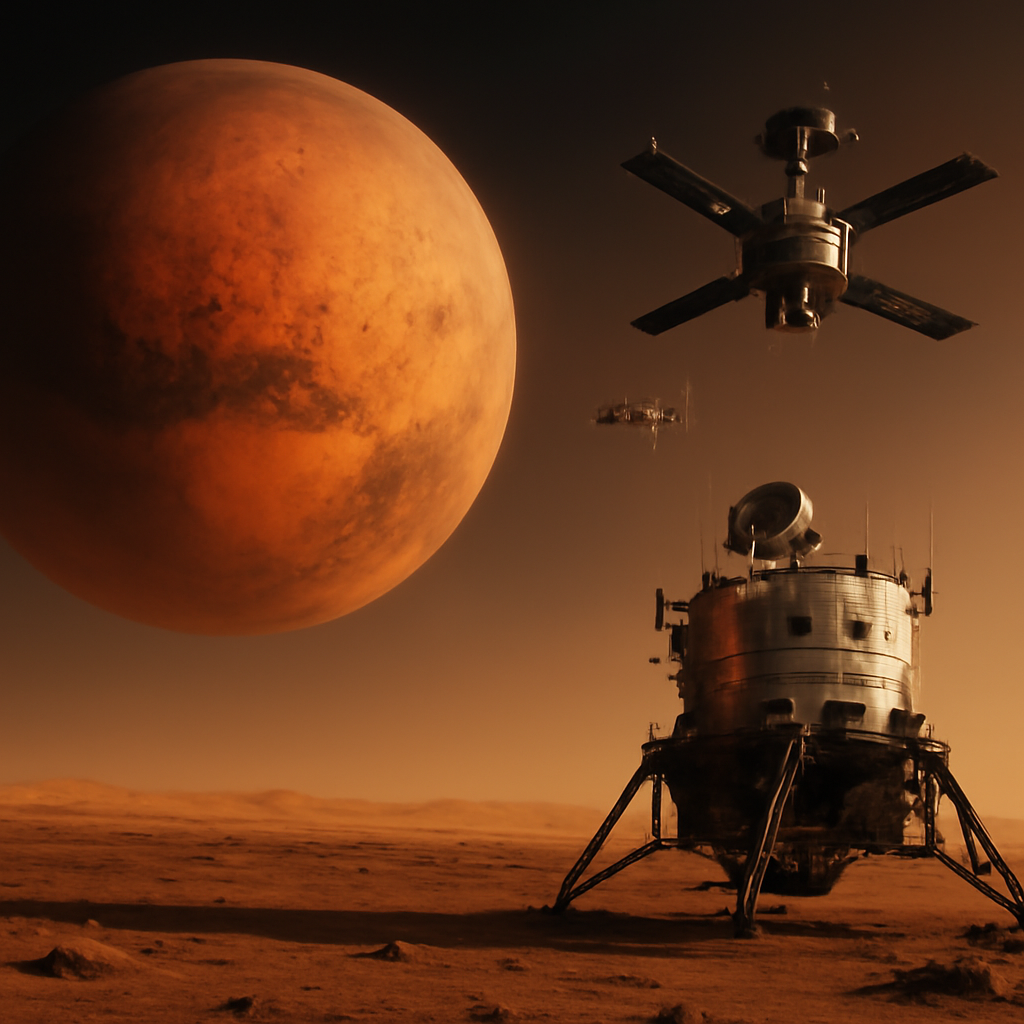
Recent Mars discoveries reveal the planet's hidden sulfur chemistry, hinting at past habitability, while simultaneous advancements in orbital manufacturing and additive technologies pave the way for robust, self-sufficient Martian outposts.
Unearthing Martian Sulfur: A Geochemical Clue
The recent discovery of sulfur crystals by NASA's Curiosity rover offers a compelling glimpse into Mars's watery past. Unlike sulfates, which are common and form readily in the presence of water, these crystalline sulfur formations suggest a more complex hydrological and geochemical environment. The sulfur likely originated from volcanic activity, a known feature of Mars's history, where gases like sulfur dioxide would have been released. As these gases interacted with atmospheric water vapor, they could have condensed and precipitated as elemental sulfur. The subsequent formation of crystals implies specific conditions, such as relatively dry periods allowing for crystallization after initial deposition or perhaps interaction with brines that facilitated crystal growth. This finding is significant because the presence and form of sulfur can act as a proxy for past environmental conditions, including acidity, oxidation states, and the availability of water. It adds another piece to the puzzle of whether Mars could have once supported life, particularly microbial life that might have thrived in sulfur-rich, water-influenced environments, a possibility echoed by ESA's consideration of clay-rich regions for future life-seeking missions.
Orbital Biomanufacturing: Growing Life in Space
The successful bioprinting of kidney and liver tissues in space, as demonstrated by Auxilium Biotechnologies aboard the International Space Station, represents a paradigm shift in regenerative medicine with profound implications for future Martian exploration. This technology leverages sophisticated 3D printing techniques, precisely depositing bio-inks—comprising living cells, growth factors, and biomaterials—layer by layer to construct functional tissue structures. The autonomous platform minimizes astronaut intervention, a critical factor for resource-limited deep-space missions. Unlike Earth-bound bioprinting, which can be affected by gravity's influence on cell aggregation and tissue development, the microgravity environment of space may even offer unique advantages, potentially facilitating more uniform tissue growth. This breakthrough directly addresses the challenges of long-duration space travel, where crew health is paramount. Medical emergencies far from Earth necessitate robust on-demand medical capabilities. The ability to grow replacement tissues or organs in situ, rather than relying on limited Earth-based supplies, could be the deciding factor in astronaut survival and the feasibility of extended Martian stays. This orbital fabrication of biological materials moves beyond static 3D printed tools and components, offering a dynamic, life-sustaining capability.
Additive Manufacturing for Martian Resilience
The capability to fabricate essential components and structures directly on Mars, rather than relying solely on Earth-based resupply, is a critical step toward long-term human presence. This is where advanced additive manufacturing, or 3D printing, becomes indispensable. Innovations like CRP Group's CRP UniqTrust system, which imbues 3D printed parts with a verifiable digital identity, are crucial for ensuring the integrity and traceability of components manufactured off-world. This digital fingerprint details a part's origin, material specifications, and production history, vital for quality control in an environment where errors can have severe consequences, as underscored by recent structural issues on Earth-based skyscrapers. Furthermore, the development of specialized aerospace composites, such as those being explored by Massivit with their RapidWings platform, offers lightweight yet robust materials suitable for Martian construction and the production of critical systems like protective shielding for future Mars helicopters. The ability to print complex parts on demand, from structural elements to intricate scientific instruments, significantly reduces mission risk and logistical burden, paving the way for a more self-sufficient Martian outpost.
Robotic Explorers: Evolving Martian Mobility
The evolution of Mars exploration hinges on increasingly sophisticated robotic mobility. Building on the success of Ingenuity, NASA is actively developing next-generation rotorcraft like the 'Skyfall' helicopter, slated for a 2028 launch. This advancement isn't merely about incremental improvements; it's about enabling deeper scientific inquiry. These advanced choppers will be equipped with enhanced navigation and sensing capabilities, allowing them to traverse more complex geological formations and reach previously inaccessible areas. Crucially, NASA is also investing in protective shielding for these aerial explorers. The pervasive Martian dust, capable of degrading sensitive components and obscuring solar panels, presents a significant operational challenge. Developing robust dust-repellent surfaces and more resilient materials is paramount to ensuring long-duration missions. Simultaneously, NASA is awarding contracts to multiple companies for novel surface mobility systems, aiming to equip future rovers with the ability to navigate more challenging terrains, from steep slopes to boulder-strewn fields. This dual approach—enhancing aerial reconnaissance and improving ground-based traversal—promises to unlock new scientific frontiers, potentially uncovering evidence of past or present life in regions like the clay deposits being considered by the ESA.
Resource Utilization: Beyond Earth-Bound Supply Chains
The discovery of sulfur crystals on Mars by the Curiosity rover underscores a critical challenge for future Martian endeavors: self-sufficiency. Extracting and processing local materials, known as In-Situ Resource Utilization (ISRU), is paramount to reducing the immense cost and logistical burden of launching everything from Earth. Consider explosives, essential for excavation and construction. Recent advancements in pharmaceutical pelletization, adapting extrusion-spheronization techniques to create uniform high-explosive pellets, offer a blueprint. Applied to Mars, such methods could enable safer, more controlled manufacturing of propellants or excavation tools directly on the red planet, eliminating the need to transport these volatile materials across millions of kilometers. Similarly, the burgeoning field of metal 3D printing, particularly with titanium, is gaining traction. Australia's investment in research for energy-efficient titanium processing for 3D printing applications, alongside companies like Meltio securing funding for new metal AM tools, signals a clear trajectory. This technology, coupled with systems like CRP UniqTrust that embed digital identities into 3D printed parts, could allow for the fabrication of everything from critical structural components and tools to spare parts for rovers, all using Martian resources, fundamentally altering the economics and feasibility of long-term human presence.
Analog Environments: Testing Ground for Martian Operations
The desolate, frigid landscapes of Earth's polar regions serve as crucial proving grounds for the technologies and operational strategies destined for Mars. At the Flashline Mars Arctic Research Station on Devon Island, an advance team is currently undertaking vital infrastructure upgrades and deploying new environmental sensors. This preparation is in direct anticipation of the upcoming Crew 19 mission, which will simulate key aspects of a Martian expedition. These analog environments are engineered to replicate the low temperatures, thin atmosphere, and geological features of Mars, allowing engineers to test everything from life support systems and habitat construction techniques to advanced robotics and communication protocols. This rigorous testing is essential for mitigating risks, refining procedures, and ensuring the safety and success of future human missions. For instance, the recent discovery of sulfur crystals by the Curiosity rover highlights the need for robust sample collection and analysis tools, which can be validated in these terrestrial simulations. Similarly, advancements in additive manufacturing, like those enabling patient-specific anatomical models or aerospace components, are being explored for their potential to fabricate critical parts and tools on-demand in situ on Mars, reducing reliance on Earth-based resupply. The lessons learned here directly inform the design and deployment of hardware, from the protective shielding for Mars helicopters to the mobility systems for future rovers exploring challenging Martian terrains.
The Future of Exploration Logistics: Starship and Beyond
The advent of heavy-lift launch systems like SpaceX's Starship is poised to fundamentally alter the logistical calculus for deep space exploration. Historically, sending significant cargo to Mars has been constrained by the mass limitations of existing rockets, necessitating a painstaking approach of sending smaller payloads over extended periods. Starship's projected capacity to deliver hundreds of tons to orbit and beyond changes this paradigm. This capability means that entire habitats, advanced scientific instruments, and substantial quantities of consumables could be transported in a single launch. Consider the implications for establishing a sustained human presence: instead of incrementally building infrastructure, future missions could deliver modular, pre-fabricated components, dramatically accelerating the timeline for establishing a self-sufficient base. Furthermore, the economic viability of such ambitious endeavors hinges on reducing per-kilogram launch costs. Starship's reusability, if fully realized, promises to drive these costs down to levels previously unimaginable, making multi-mission scenarios and large-scale resource utilization projects, such as in-situ propellant production, far more feasible. This shift from meticulous, incremental delivery to bulk transport signifies a new era where the scale of Martian exploration is no longer solely dictated by launch vehicle limitations.
Understanding Martian Volatiles: Ice, Water, and Atmosphere
New modeling of Mars's south polar ice deposits is providing unprecedented insights into the planet's hydrological past and atmospheric evolution. These models, which specifically analyze the complex layering within the carbon dioxide ice sheets, reveal the significant, often underestimated, influence of water ice. This water ice, present in varying concentrations and forms, acts as a key modulator of the CO2 ice deposition and sublimation cycles. During colder periods, water ice would have been incorporated into the growing CO2 ice layers, affecting their density and thermal properties. Conversely, during warmer interglacial periods, sublimation of the CO2 ice would have been influenced by the presence of underlying water ice, potentially releasing trapped volatiles and impacting the thin Martian atmosphere. The distinct layering observed in these models, driven by these water-ice interactions, can be chronologically interpreted, offering a paleo-climatic record. This research directly complements recent findings, like Curiosity's initial observations of sulfur crystals, by adding a crucial piece to the puzzle of Martian surface and atmospheric chemistry. Understanding these volatile cycles is paramount for assessing Mars's habitability potential and for designing future missions, such as those considering clay-rich regions for signs of life.
Today's Mars news paints a vibrant picture of humanity's accelerating multi-planetary trajectory. The detection of sulfur crystals on Mars is not merely a scientific curiosity; it's a geological Rosetta Stone, potentially unlocking deeper narratives of the Red Planet's hydrological past and habitability. Concurrently, breakthroughs in bioprinting and additive manufacturing in space, alongside terrestrial advancements in resilient material production and robotic systems, underscore a fundamental shift. We are moving beyond mere exploration to active, on-site construction and biological engineering. This convergence of scientific discovery and advanced fabrication capability is precisely the exponential progress needed to secure humanity's future among the stars, transforming Mars from a destination into a robust, self-sustaining frontier.
This content was produced by the news editor with AI.