Marsbound: The Exponential Leap From Static Views to Starship Cities
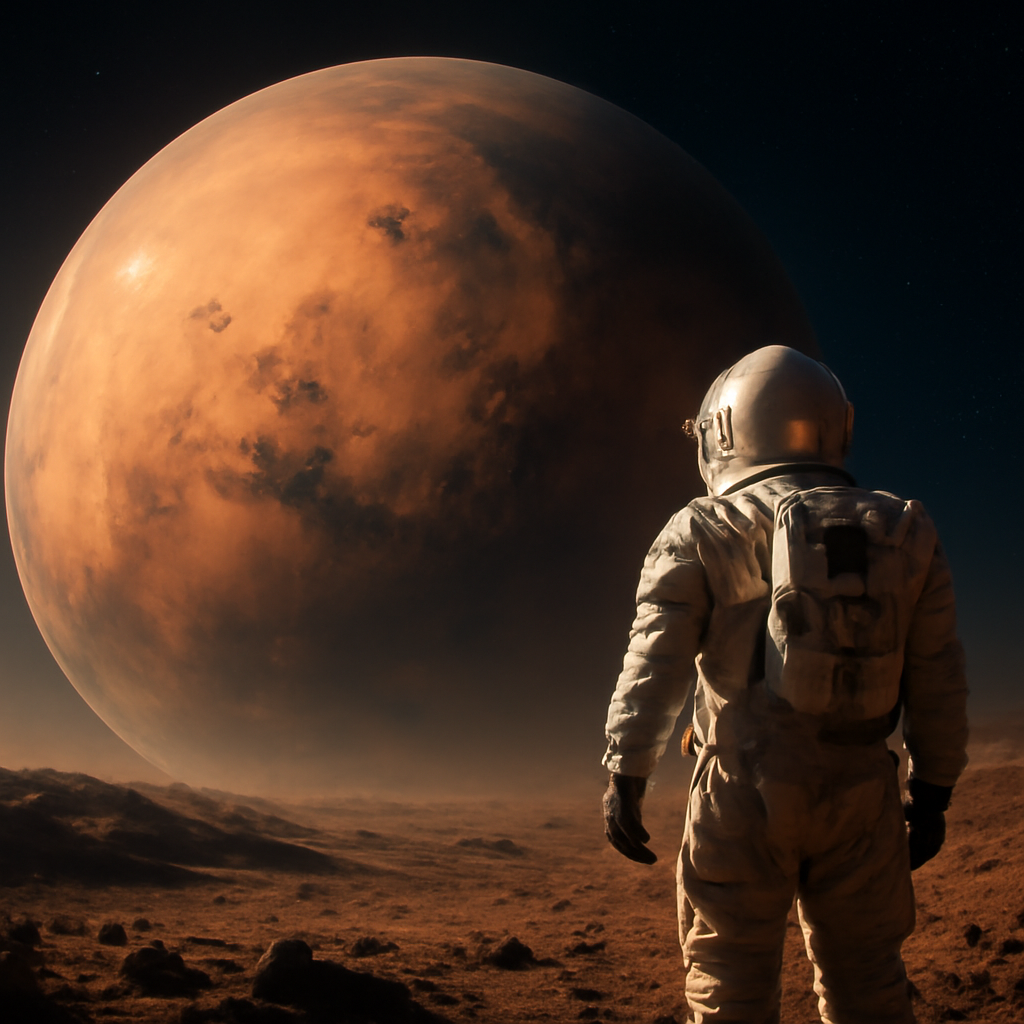
Fifty years after humanity first saw Mars up close, the pace of exploration and colonization is accelerating exponentially. This feature delves into the cutting-edge technologies and ambitious visions propelling us towards a multi-planetary future, from advanced manufacturing to AI-driven operations and the foundational science of Martian habitability.
Echoes of Viking: A Half-Century of Martian Vision
Fifty years ago, humanity's perspective on Mars shifted irrevocably. The Viking 1 lander, touching down on the ochre plains of Chryse Planitia, transmitted the first ground-level images of another world directly into our homes. These weren't mere orbital snapshots; they were panoramic vistas revealing a desolate, yet undeniably real, alien landscape. The lander’s sophisticated instruments, including cameras, a meteorology package, and a seismometer, began a detailed analysis of the Martian environment. Crucially, Viking carried biological experiments designed to detect signs of life in the soil. While the results were ambiguous, sparking decades of scientific debate, they firmly established the search for extraterrestrial life as a central tenet of Mars exploration. The mission’s legacy is profound, having provided foundational data on Martian geology, atmosphere, and the very habitability of the planet, paving the way for every subsequent robotic mission that has followed in its tracks.
Starship's Ascent: Engineering the Interplanetary Transit System
SpaceX’s Starship program is rapidly advancing, moving from conceptual design to tangible hardware undergoing rigorous testing. The "Critical Path" video underscores this momentum, detailing milestones like Booster 20’s extended static fire test. This lengthy burn, designed to validate the Raptor engines' performance under sustained load, is a crucial step in ensuring the Super Heavy booster’s reliability for the massive thrust required to escape Earth’s gravity. Preparations extend beyond engine tests; the installation of a colossal 420-ton crane at Cape Canaveral, detailed in recent news, signifies the growing scale of operations and the logistical complexities of handling the fully assembled Starship and booster stack. This infrastructure is essential for integrating the upper stage with its booster and moving them to the launch pad. With Booster 20 now positioned at Starbase for Flight 13, each test flight, whether reaching orbit or pushing the envelope of atmospheric re-entry, provides invaluable data. This iterative development, focusing on rapid prototyping and testing, is fundamental to SpaceX’s ambitious goal of facilitating interplanetary travel, a stark contrast to the static, single-mission approaches of earlier eras like Viking, which provided humanity's first ground-level views of Mars half a century ago.
The Martian Factory: Additive Manufacturing for Off-World Construction
The construction of robust, habitable structures on Mars, capable of supporting thousands of colonists as envisioned by figures like Elon Musk, hinges on advancements in additive manufacturing. Large-format 3D printing, particularly multi-robot systems and extrusion-based techniques, is rapidly evolving beyond terrestrial applications, as demonstrated by Zaha Hadid Architects' six-meter air traffic control tower. These systems, often employing robotic arms working in concert, can deposit construction materials layer by layer, creating complex geometries with efficiency. The challenge lies in adapting these processes for the Martian environment, utilizing in-situ resources like regolith. Extrusion, whether of concrete-like mixtures or sintered regolith, offers a scalable method for building foundational structures. Wire Arc Additive Manufacturing (Wire-LMD), while currently used for intricate metal parts like custom exhaust systems, represents another avenue for fabricating structural components or even tool heads for larger robotic construction systems. The development of these technologies is crucial for enabling the rapid, cost-effective deployment of infrastructure necessary for long-term off-world habitation, moving beyond the static, single-point observations of missions like Viking.
AI as the Navigator: 'Starmind' and the Future of Space Operations
The sheer complexity of launching, operating, and eventually establishing settlements on Mars necessitates a paradigm shift in mission control, moving beyond human-only oversight. SpaceX's reported development of 'Starmind,' an advanced artificial intelligence system, exemplifies this evolution. Starmind is envisioned to manage the intricate web of Starship operations, a task far exceeding the capacity of even the most experienced human teams. This AI would likely integrate data streams from thousands of sensors across the vehicle, from its propulsion systems during ignition – a critical phase highlighted by Booster 20’s extended static fire – to the atmospheric re-entry dynamics and landing precision required for fully reusable systems. Its role extends to optimizing flight trajectories, managing resource allocation for thousands of individuals envisioned on Mars within a decade, and even coordinating the logistics of construction and life support in nascent Martian outposts, building upon the foundational work of missions like Viking that first provided ground-level views. The goal is not to replace human decision-making entirely, but to augment it, providing real-time analysis, predictive modeling, and autonomous adjustments that ensure safety and efficiency for missions of unprecedented scale and ambition.
Living Off the Land: Bioprinting and ISRU for Martian Sustenance
The prospect of sustained human presence on Mars hinges on a radical departure from Earth-bound supply chains, necessitating the development of in-situ resource utilization (ISRU) and advanced manufacturing techniques. Recent breakthroughs aboard the International Space Station, such as the successful bioprinting of functional kidney and liver tissues by Auxilium, offer a tangible glimpse into this future. This capability, moving beyond simple material extrusion seen in terrestrial applications like the six-meter air traffic control tower, represents a critical leap towards providing essential medical support for Martian colonists. The ISS garden, already cultivating crops to test the viability of extraterrestrial agriculture, complements this by addressing fundamental nutritional needs. These micro-scale experiments directly inform the macro-scale ambitions of Starship, which aims to transport thousands to the Red Planet. The ability to generate food and organs locally, rather than relying on impossibly long and resource-intensive resupply missions from Earth, is not merely a convenience but a fundamental prerequisite for establishing self-sufficient Martian settlements. This dual focus on biological sustenance and advanced additive manufacturing, exemplified by the rapid progress in Starship development and the increasing sophistication of large-format 3D printing, forms the bedrock of humanity's interplanetary aspirations.
The Search for Life: From Sulfur Crystals to Ancient Clues
The ongoing quest to answer whether life ever existed on Mars has entered a new phase, moving beyond the rudimentary observations of the Viking missions 50 years ago to sophisticated in-situ analysis. NASA's Curiosity rover recently provided the first visual confirmation of sulfur crystals on the Martian surface, discovered after the rover inadvertently crushed a rock and imaged the fragments. This discovery, while not direct evidence of life, is significant because sulfur compounds can play a role in biological processes and their presence in specific geological formations can offer clues about past environmental conditions conducive to life. Building on these incremental advances, the European Space Agency (ESA) is contemplating a future rover mission specifically designed to hunt for biosignatures. This mission is being considered for deployment to Mars' clay-rich regions, areas scientists believe may have once held liquid water and could preserve evidence of ancient microbial life. The scientific rationale for targeting these clay deposits stems from their ability to encapsulate and protect organic molecules from degradation by radiation, making them prime targets for biosignature detection. These efforts represent a critical scientific underpinning for the broader ambition of establishing a sustainable human presence on the Red Planet.
Beyond Earthly Bounds: Simulation and Human Factors
Preparing humans for the rigors of Martian habitation extends far beyond simply designing robust spacecraft and shelters, as evidenced by NASA's current call for volunteers for simulated Mars and Moon missions. These analog environments, often located in Earth's most extreme terrestrial regions, serve as crucial testing grounds for everything from life support systems and communication protocols to crew psychology and operational procedures. By immersing participants in scenarios mimicking the isolation, confinement, and resource limitations of extraterrestrial exploration, scientists can identify potential failure points in equipment and human interaction before they become mission-critical issues. This hands-on approach allows for iterative refinement of technologies and strategies, drawing lessons learned from decades of robotic exploration, like the initial Martian surface views provided by Viking 1, and translating them into practical applications for future crewed endeavors. The data gathered from these simulations directly informs the development of everything from food cultivation on the ISS, a vital step for long-duration missions, to the complex AI systems, such as SpaceX's 'Starmind,' intended to manage future spacecraft operations.
The Ten-Year Horizon: Musk's Vision for Martian Cities and Lunar Outposts
Elon Musk's vision, as articulated in recent statements, posits a rapid transition from Earth-bound operations to substantial extraterrestrial settlements within a decade. This ambitious timeline hinges on the iterative development and scaling of the Starship program, with recent test flights of Starship prototypes and Super Heavy boosters demonstrating progress toward full reusability. The logistical challenge of transporting thousands of individuals to the Moon and Mars is underscored by the sheer scale of Starship’s payload capacity and its rapid launch cadence. Beyond human transport, the concept of establishing self-sustaining cities necessitates infrastructure development on an unprecedented scale. Here, advancements in large-format 3D printing, exemplified by Zaha Hadid Architects' six-meter air traffic control tower and Kentstrapper's large-volume extrusion printer, become critical. These technologies, along with innovations in material extrusion and wire-LMD printing, suggest a pathway for in-situ resource utilization and rapid construction. Furthermore, the potential deployment of Tesla's humanoid robots, as suggested by Musk, could automate much of the initial construction and hazardous work, effectively acting as the first wave of colonists tasked with preparing habitats before human arrival. This integrated approach, combining advanced launch systems with sophisticated additive manufacturing and robotic autonomy, forms the bedrock of Musk's aggressive colonization strategy.
Today's headlines paint a vivid picture of humanity's inexorable march towards becoming a multi-planetary species, a trajectory defined by exponential progress. The spirit of innovation is palpable, driven by the understanding that our long-term survival and prosperity depend on expanding beyond Earth. From the foundational steps of Viking to the imminent reality of Starship, we are witnessing a paradigm shift. The convergence of advanced manufacturing, AI, and a renewed focus on fundamental science isn't just about exploration; it's about building the infrastructure and capabilities for self-sustaining off-world civilizations, fulfilling our destiny as a species that transcends planetary boundaries.
This content was produced by the news editor with AI.