Mars: The Dawn of a Multi-Planetary Era – From Martian Sands to Starship Dreams
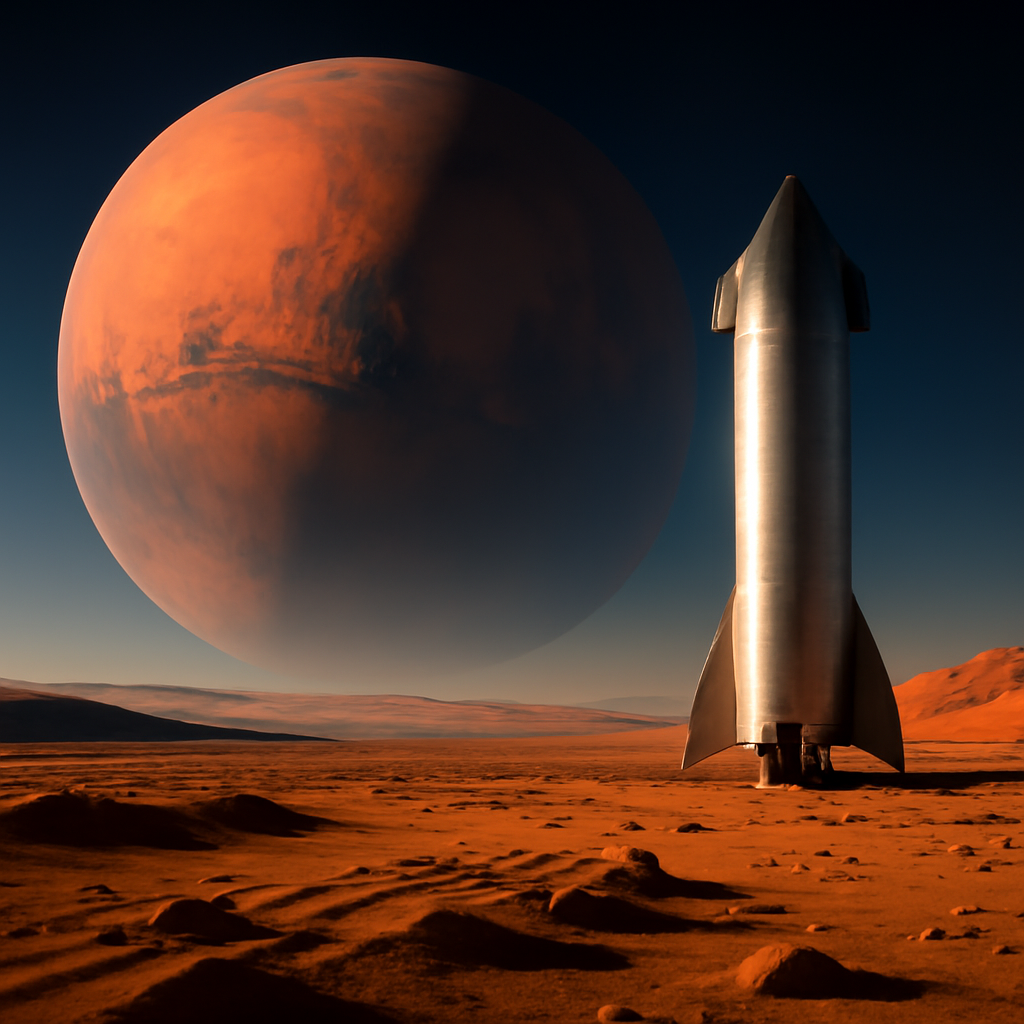
Humanity's gaze is firmly fixed on Mars, with a surge in technological advancements and mission planning pushing us closer to becoming a multi-planetary species. Today's developments highlight progress in everything from fundamental Martian geology to the very spacecraft that will carry us there, underscoring the exponential trajectory of our off-world ambitions.
Martian Geology: Echoes of Ancient Cataclysms
New analyses of Martian rock formations, particularly those examined by the Perseverance rover on the Jezero Crater rim, are painting a vivid picture of a geologically tumultuous early Mars. Stratigraphic studies of bedrock layers, some exceeding 75 meters in thickness, reveal a history punctuated by repeated, significant impact events. These cosmic bombardments, occurring over 3.9 billion years ago, likely reshaped the planet's nascent surface, creating the very geological strata now being studied. Furthermore, evidence of ancient sand ripples climbing over one another, as identified by the Curiosity rover, points to periods of intense, dynamic sandstorms that scoured the Martian landscape. These findings, coupled with the mapping of lava tubes using magnetic field data from terrestrial analogs like Lanzarote, contribute to a growing understanding of Mars' dynamic past. This understanding is crucial for assessing the planet's potential for ancient habitability, as environments capable of sheltering microbial life might have existed in subsurface lava tubes or been influenced by the hydrothermal systems potentially created by large impacts. The presence of chloride salts, identified using thermal infrared data, further hints at the past existence of liquid water, a key ingredient for life as we know it.
The Rise of the Martian Machinist: Additive Manufacturing Takes Root
The burgeoning field of additive manufacturing, or 3D printing, is no longer a nascent technology confined to Earth-based laboratories; it's becoming a cornerstone for Mars exploration. As humanity sets its sights on establishing a permanent presence beyond Earth, the ability to fabricate tools, spare parts, and even habitat components directly on the Martian surface is paramount. This is where In-Situ Resource Utilization (ISRU) truly shines, transforming Martian regolith, or soil, into usable building materials. Innovations in binder jetting and fused deposition modeling, for instance, are being refined to process extraterrestrial materials with minimal Earth-supplied consumables. NASA's funding of Phase3D to improve in-situ monitoring for metal additive manufacturing underscores the critical need for real-time quality control. Without the ability to inspect and qualify printed parts on Mars, rejection rates could cripple mission progress. This mirrors advancements in terrestrial sectors, like BMW's investment in automated Wire Arc Additive Manufacturing (WAAM) for series production, highlighting a maturing industry focus on proven applications and measurable outcomes, as indicated by market projections. The development of robust, radiation-resistant printing materials, coupled with AI-driven alloy discovery for extreme environments, further bolsters the feasibility of creating durable Martian infrastructure. This represents a fundamental shift from relying solely on costly resupply missions to a self-sustaining manufacturing paradigm, essential for long-term human habitation.
Robotic Pioneers: AI-Driven Exploration and Locomotion
The relentless march of robotic exploration on Mars is increasingly powered by sophisticated artificial intelligence and advanced locomotion systems. Recent developments mirror terrestrial breakthroughs, such as a four-legged robot learning to autonomously switch between walking, running, and jumping gaits to navigate challenging terrain, a capability that would be invaluable for traversing Mars' varied landscapes, from the dusty plains surrounding Jezero Crater to the rocky slopes of Olympus Mons. This AI-driven adaptability allows rovers and drones to make real-time decisions, optimizing their paths and conserving energy without constant human oversight. Imagine a future Mars explorer, much like the "Phantom Twist" drone that uses motion blur to achieve near-invisibility, but instead employing advanced camouflage and AI for stealthy reconnaissance in hazardous regions, or a drone that can autonomously seek out and analyze mineral deposits, much like the methods being refined to identify chloride salts using THEMIS data. The integration of AI extends to autonomous navigation and data analysis, enabling these machines to act as true scouts, identifying geological anomalies like the honeycomb-like formations or ancient sandstorm evidence discovered by Curiosity, and relaying critical insights back to Earth or to human outposts, accelerating the pace of scientific discovery and paving the way for more ambitious missions.
Starship: The Interplanetary Ark Takes Shape
The ambitious Starship program, a cornerstone of SpaceX's interplanetary aspirations, is steadily advancing through rigorous testing and iterative design. Recent indications point towards the full stack for its thirteenth orbital test flight being ready for a July 16, 2026 launch, a testament to the rapid development cycle. This iterative approach, characterized by rapid prototyping and learning from each flight, is crucial for achieving the vehicle's immense payload capacity and the necessary reliability for human transit. The system's architecture, featuring the Super Heavy booster and the Starship upper stage, is designed for full reusability, a critical factor for the economic viability of Mars colonization. Each test flight, while often pushing the boundaries of experimental aerospace engineering, provides invaluable data on ascent dynamics, stage separation, orbital maneuvering, and atmospheric re-entry. These tests are not merely about reaching orbit; they are about perfecting the complex ballet of orbital mechanics and thermal management required for a journey of this magnitude. The integration of Starship with NASA's Artemis III mission, as evidenced by recent renders, further underscores its evolving role, demonstrating its potential not just for Mars but also for lunar transit, thereby validating its design for deep-space operations.
Beyond Orbit: Lunar Precursors and Deep Space Aspirations
The burgeoning capabilities demonstrated by lunar missions and other deep space probes are directly informing and accelerating humanity's journey toward Mars. The Artemis program, for instance, is not merely a return to the Moon; it's a proving ground for technologies and operational strategies essential for sustained extraterrestrial presence. The selection of SpaceX's Starlink to relay imagery from the Orion spacecraft during Artemis III, for example, highlights the critical need for robust, high-bandwidth communication infrastructure, a lesson directly transferable to the vastly greater distances involved in Mars missions. Similarly, the ongoing testing of the Artemis III lunar lander, with its integration of Starship, showcases the development of heavy-lift launch and landing systems that will be indispensable for transporting the massive payloads required to establish a Martian outpost. Furthermore, the exploration of the Moon's farside for radio astronomy underscores the scientific potential of off-world observatories, a concept that could eventually extend to Mars, offering unique vantage points for astronomical study. Even the mapping of lava tubes on Earth, like those in Lanzarote, provides analog data for understanding potential subsurface habitats on both the Moon and Mars, informing future site selection and exploration strategies. These lunar and interplanetary endeavors are building a foundational layer of experience and technological readiness, reducing the unknowns and risks associated with venturing further into the solar system.
The Search for Life: Ancient Origins and Modern Approaches
The question of whether life ever arose on Mars, and if so, where it might persist today, is a central driver of our robotic exploration. Emerging theories, like those advanced by Dr. Steven Benner, posit that Mars, with its ancient, potentially more hospitable conditions, could have been the crucible for life's genesis, predating Earth. This perspective reshapes how we interpret Martian geological and chemical data. Current and upcoming missions are meticulously designed to hunt for biosignatures – evidence of past or present life. The Perseverance rover, for instance, is collecting rock and soil samples from Jezero Crater, a region believed to have once held a lake and river delta, precisely because such environments are prime candidates for preserving organic molecules and other signs of biological activity. Future missions will aim to retrieve these samples for detailed analysis on Earth, employing advanced techniques that can discern subtle chemical or structural anomalies indicative of life. Furthermore, understanding Martian subsurface environments, such as lava tubes, which offer protection from radiation, is crucial, drawing parallels from studies like the magnetic field mapping of lava tubes on Lanzarote. These efforts are not just about finding ancient fossils; they are about understanding the fundamental conditions required for life to emerge and persist, whether on Mars or elsewhere in the cosmos.
Human Factors: Health, Safety, and Control in Deep Space
The profound distance to Mars presents a formidable hurdle for astronaut health and operational resilience. Beyond the immediate physiological challenges of microgravity, which have been extensively studied on the ISS and are now being addressed for lunar missions with Artemis III, the Martian environment introduces unique stressors. The reduced gravity (approximately 38% of Earth's) will require specialized exercise regimens and potentially novel rehabilitation strategies to mitigate bone density loss and muscle atrophy, distinct from what's needed on the Moon. Furthermore, the constant threat of radiation, far exceeding that encountered in Earth orbit, necessitates robust shielding for habitats and transit vehicles, as well as advanced medical countermeasures. The psychological toll of isolation, confinement, and the immense distance from Earth, amplified by communication delays, requires careful crew selection and sophisticated support systems. Even seemingly mundane tasks, like maintaining equipment, will demand advanced on-site diagnostic and repair capabilities, potentially leveraging additive manufacturing as seen on naval vessels like the USS Essex, to ensure mission continuity and astronaut safety without the luxury of immediate resupply.
Terraforming: The Long Game of Planetary Engineering
The concept of terraforming Mars, transforming it into an Earth-like planet, represents the ultimate long-term engineering ambition for human settlement. While visions of a breathable atmosphere and flowing water capture the imagination, the scientific and engineering hurdles are immense. The current Martian atmosphere is extremely thin, about 0.6% of Earth's sea-level pressure, and composed primarily of carbon dioxide. To thicken it sufficiently for liquid water to be stable on the surface and to provide a breathable mix, vast quantities of greenhouse gases would need to be introduced. This could potentially be achieved by vaporizing the planet's polar ice caps, which contain significant amounts of frozen carbon dioxide and water ice, or by releasing trapped carbon from the Martian regolith. However, the energy requirements for such processes are staggering, and the long-term stability of a re-engineered atmosphere remains a significant question. Furthermore, Mars lacks a global magnetic field, leaving its surface exposed to harmful solar and cosmic radiation, necessitating extensive shielding for any permanent human presence or for the atmospheric gases themselves to prevent them from being stripped away. These fundamental challenges mean that while technological advancements in areas like additive manufacturing and in-situ resource utilization are progressing, a truly habitable Mars remains a distant prospect, requiring centuries, if not millennia, of sustained effort and potentially entirely new scientific breakthroughs.
The collective news today paints a vivid picture of humanity's inexorable march towards a multi-planetary future, with Mars as the ultimate prize. The exponential progress in additive manufacturing, AI-driven robotics, and advanced propulsion systems are not mere technological curiosities; they are the foundational pillars upon which our expansion into the cosmos will be built. The insights gleaned from Martian soil, the development of resilient materials, and the relentless pursuit of reusable spaceflight all converge on the singular, grand objective: to secure humanity's long-term survival and prosperity beyond Earth. Each mission, each technological leap, is a testament to our species' inherent drive for exploration and our capacity for radical innovation when faced with grand challenges.
This content was produced by the news editor with AI.