Mars Exhibits Green Glow During Martian Nights, NASA Data Reveals
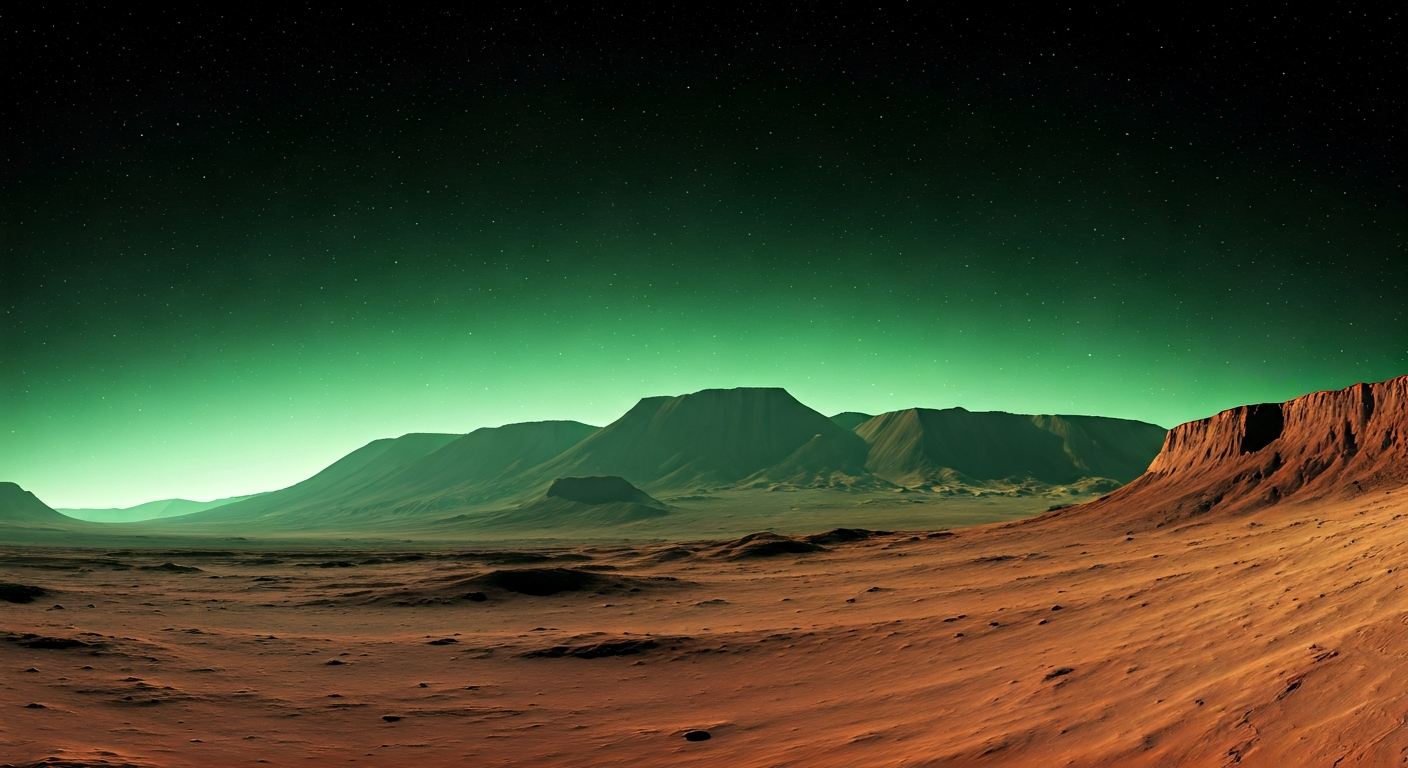
NASA's MAVEN spacecraft has detected a faint green light emanating from the Martian atmosphere during the planet's nighttime hours.
Data collected by NASA's Mars Atmosphere and Volatile Evolution (MAVEN) spacecraft has revealed an unexpected phenomenon: a green glow in the Martian atmosphere that appears during the planet's nighttime.
This subtle luminescence is caused by the interaction of charged particles within the atmosphere. Specifically, it is believed to be the result of oxygen atoms colliding with nitrogen ions. When these charged particles collide, they release energy in the form of light.
The green glow is most prominent in the Martian upper atmosphere, at altitudes between 70 and 150 kilometers. While the light is faint, it is detectable by MAVEN's sensitive instruments. Scientists are studying this phenomenon to gain a deeper understanding of the complex chemical processes occurring in the Martian atmosphere.
This discovery adds another layer to our understanding of Mars' atmospheric dynamics. Previously, auroras have been observed on Mars, similar to Earth's, but this green glow is a distinct phenomenon. Researchers are continuing to analyze MAVEN's data to pinpoint the exact conditions that lead to this nightly emission and to further characterize the composition and behavior of the Martian atmosphere.
MAVEN's detection of a nighttime green atmospheric glow on Mars, driven by ion-molecule reactions, is a crucial step in understanding planetary atmospheric physics. This detailed atmospheric mapping is foundational for future human settlements. As we expand life beyond Earth, understanding and potentially harnessing such atmospheric phenomena are vital for creating self-sustaining Martian environments. Each piece of data like this refines our ability to predict and manage atmospheric conditions, accelerating our trajectory toward becoming a truly multi-planetary species and securing the long-term future of consciousness.
Edited by the news editor with AI and translated into English from the original report — please refer to the original source.