Liqcreate Launches Flexible, Sterilizable Bio-Med Flex Resin for Medical 3D Printing
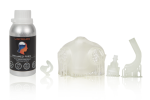
Liqcreate has introduced Bio-Med Flex, a clear, flexible photopolymer resin designed for biocompatible and sterilizable medical applications, addressing a gap in clinical prototyping.
Netherlands-based Liqcreate has released Bio-Med Flex, a new clear, flexible photopolymer resin specifically engineered for medical and biomedical applications requiring biocompatibility and sterilizability. This development aims to fill a critical need for flexible materials in clinical prototyping, a space previously dominated by rigid biocompatible resins that cannot accommodate applications like flexible anatomical models or wearable sensor housings.
Bio-Med Flex offers a Shore A hardness of 73, described as similar to a firm rubber gasket, allowing for repeated compression and bending without cracking, while still maintaining printed geometry. The material exhibits a tensile strength of 5.0 MPa and an elongation at break between 180-250%, indicating its ability to stretch significantly before failure. Its tear strength is between 20 and 28 kN/m, suggesting resistance to ripping under load.
Crucially, parts printed with Bio-Med Flex, when processed according to Liqcreate’s specified workflow, can achieve biocompatibility certifications, including ISO 10993-5:2009 for cytotoxicity, ISO 10993-10:2021 for sensitization, and ISO 10993-23:2021 for irritation. This validated workflow involves specific washing, drying, UV curing, and thermal post-curing steps, emphasizing that these certifications are workflow-dependent.
Sterilization data indicates that the material holds up reasonably well under steam sterilization. After autoclaving at 121°C, tensile strength reduces to 3.7 MPa and elongation to 183%, with Shore A hardness dropping slightly to 70. At 134°C, these figures are 3.6 MPa, 166% elongation, and a Shore A of 75. Disinfection with IPA or ethanol shows minimal impact on the material's properties. Bio-Med Flex is compatible with DLP, LCD, and SLA 3D printers operating at wavelengths between 385 and 405 nm.
The introduction of Bio-Med Flex addresses a significant limitation in medical 3D printing by providing a flexible, biocompatible, and sterilizable material. This enables the in-house production of previously difficult-to-manufacture components, potentially reducing costs and lead times compared to traditional methods. Such advancements are crucial for personalized medicine, prosthetics, and advanced surgical tools, aligning with the broader additive manufacturing trend towards specialized, high-value applications.
Edited by the news editor with AI from the original report — please refer to the original source.