NASA Testing Advanced Capabilities for Moon, Mars Rovers
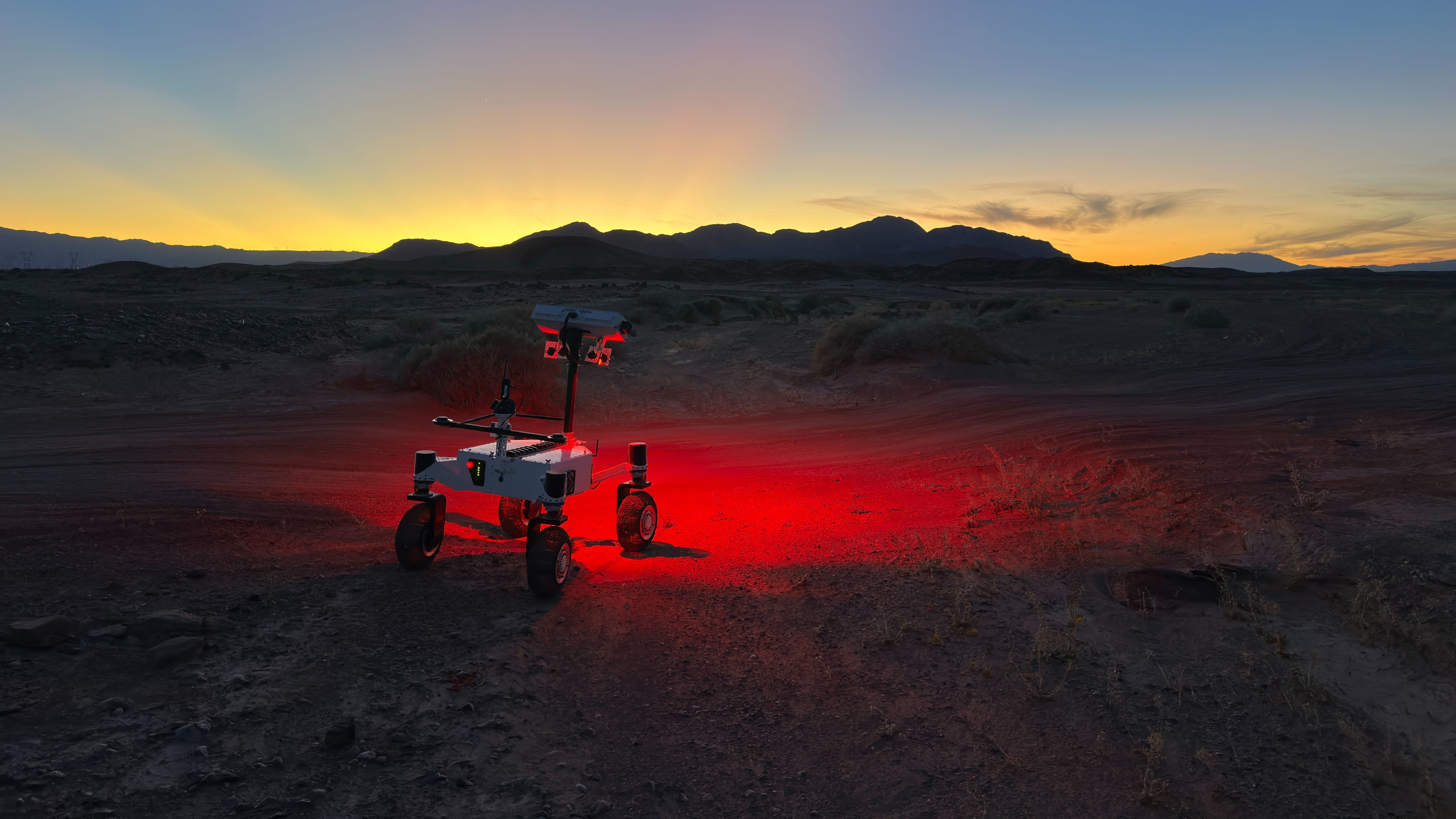
NASA is testing a new rover prototype, ERNEST, to improve robotic autonomy and mobility for future lunar and Martian exploration.
NASA has been testing a new rover prototype, ERNEST, in the Colorado Desert to enhance robotic autonomy and mobility for future lunar and Martian exploration. ERNEST, developed at NASA’s Jet Propulsion Laboratory, is designed to navigate extreme terrain and operate with minimal human intervention. The rover is 4 feet long and features an active suspension system that allows it to lift its wheels over obstacles and adjust its weight distribution, making it more versatile than current Mars rovers like Curiosity and Perseverance.
During field tests, ERNEST traveled over 16 miles (26 kilometers) with limited human input, demonstrating its ability to handle challenging environments. The rover can move at speeds up to 0.6 mph (1 kph), significantly faster than existing rovers. This technology could enable future missions to explore previously inaccessible areas on the Moon or Mars. The testing aims to refine mobility hardware and autonomy software to handle the diverse terrain and lighting conditions expected on the Moon.
ERNEST’s design builds on the trusted rocker-bogie suspension system used on past Mars rovers but introduces active suspension for better adaptability. The rover can use different gaits, such as squirming or wheel-walking, and switch between active and passive suspension modes. This flexibility allows it to balance energy efficiency with terrain capability. The team also tested multiple suspension configurations in earlier prototypes before finalizing the design.
To improve ERNEST’s autonomy, the team used reinforcement learning, an AI technique where the rover learns by interacting with its environment. They created a virtual testing environment to simulate the rover’s behavior and trained it using real-world data. After months of virtual training, ERNEST successfully navigated an obstacle course with sand ripples, rubble, and steep slopes in JPL’s Mars Yard. The success of these tests suggests that ERNEST could serve as a model for future long-range lunar and planetary rovers.
Headline and summary edited by Cloudflare Workers AI (qwen3-30b). Always refer to the original source for the complete article.